When children ask, “How long until pickup?” or “Do we have time to play before snack?”, everyday after-school moments offer a natural way to teach time. Use real routines to build clock-reading, sequencing, and elapsed-time skills—and explore Watch Me Grow: School Age Development ONLINE  Buy Now $24.00 to deepen your understanding of school-age children’s cognitive, physical, and social-emotional development. You can also use ChildCareEd’s Task Cards - Telling Time Buy Now $2.49 for structured analog-clock practice that connects naturally to those real plans.
Why teach time through real after-school plans?
For many children, “3:30” is initially a symbol on a clock rather than a meaningful point in their day. A schedule gives that symbol a purpose: at 3:30, the group may arrive, wash hands, and choose a snack. When children connect clock time with recognizable events, they can see how time organizes activities and helps people plan.
Time learning also draws on several skills at once. Children practice counting, noticing number patterns, sequencing events, estimating duration, and communicating about what comes next. These ideas become more concrete when educators refer to the program’s actual rhythm: “We have ten minutes before outdoor play,” or “Snack starts when the minute hand reaches the six.”
A predictable schedule can support children’s confidence, too. Knowing what is coming next may make transitions feel more manageable, while having a say in planning can strengthen independence. Keep the schedule flexible enough to respond to children’s needs; the goal is not to make every afternoon run like clockwork, but to make time understandable.
- Connect clock numbers to activities children recognize.
- Use consistent time language: before, after, in five minutes, half past, and later.
- Invite children to help check the schedule and anticipate what comes next.
How can you build time-telling into the daily routine?
Choose a few dependable points in the after-school day and make them opportunities for quick, low-pressure practice. At arrival, ask a child to read the clock and compare it with the posted schedule. Before snack or outdoor play, look at the clock together and identify the hour and minute hands. During cleanup, ask how much time remains before the next activity.
Start with events that happen at consistent times, such as arrival, snack, homework support, outdoor play, and pickup. Write or display the time beside each event. A visual schedule can include words and pictures, while an analog clock nearby helps children link the written time to its position on the clock face. Color-coded blocks may provide another cue, but explain that color supports the schedule rather than replaces reading the clock.
Children do not all need to master the same level at once. Some may first recognize the hour hand and whole hours; others may be ready for half-hours, five-minute intervals, or calculating how long an activity lasts. Adjust the challenge to the child’s current knowledge and offer encouragement for reasoning, not just correct answers.
- Arrival: “What time is it, and what comes first on our schedule?”
- Before a transition: “How many minutes until we clean up?”
- At closing: “What happened before pickup? What will happen tomorrow?”
How can real plans become hands-on clock practice?
Use meaningful plans as short math problems. If art begins at 4:15 and ends at 4:45, ask children how long the activity lasts. If outdoor play begins at 5:00 and it is now 4:50, ask how many minutes remain. For younger learners, use whole-hour and half-hour examples first; older children can work with five-minute intervals, elapsed time, or changes to a schedule.
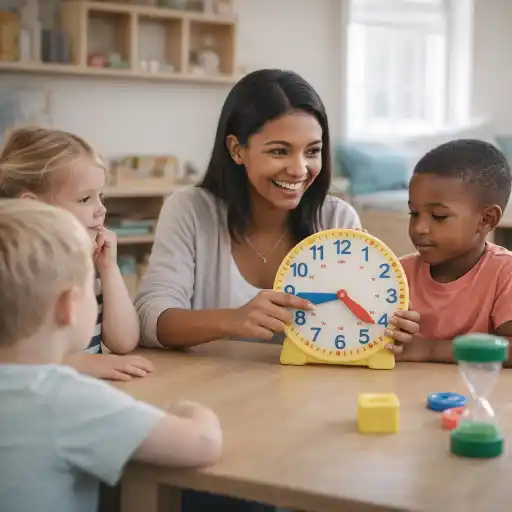
Make the reasoning visible. Invite children to move the hands on a teaching clock, point to the schedule, or draw a clock showing the planned start time. Then connect the answer to the real event: “The minute hand is on the nine, so it is 4:45. We have five minutes before we begin.” This combination of seeing, saying, and doing helps keep an abstract idea anchored in experience.
ChildCareEd’s Task Cards - Telling Time Buy Now $2.49 offer 24 analog-clock cards, a recording sheet, and an answer key for practicing time to the hour and half-hour. Use them at a small-group table or as a “write the room” activity, then ask children to connect a card’s time to a familiar routine. For an additional challenge, invite children to invent a schedule question for a peer.
- Plan: “The game starts at 4:30. Show that time on the clock.”
- Estimate: “Will this puzzle take more or less than ten minutes?”
- Reflect: “Did our activity take about as long as we expected?”
How can you adapt activities for different ages and abilities?
School-age groups include children with different experiences, strengths, and comfort with numbers. One child may confidently read a digital clock but be learning how an analog clock works; another may know the clock face but need support with elapsed time. Begin by noticing what each child can already do, then choose a next step that is challenging but achievable.
Offer several ways to participate. Children can move clock hands, match a clock to a schedule card, draw a timeline, explain an answer aloud, or work with a partner. Visual cues, larger clock faces, fewer answer choices, and extra wait time may help children access the same activity. For children who are ready to extend their thinking, add elapsed-time questions or ask them to create a schedule that includes a chosen activity and a reasonable duration.
Keep learning playful and respectful. Mistakes are useful information about which idea needs another example; they are not evidence that a child is careless. Avoid turning every transition into a quiz. A brief, curious prompt is usually enough, and children should still have time to decompress, make choices, and enjoy the program.
- Offer an entry point: identify the hour, match a picture, or set a whole-hour time.
- Offer an extension: read five-minute intervals or calculate an activity’s duration.
- Use partners thoughtfully, ensuring each child gets a turn to handle the clock.
What common pitfalls should providers avoid?
A common pitfall is expecting children to learn clock reading only from worksheets or isolated drills. Practice is useful, but it becomes more meaningful when children use the skill to understand an actual plan. Pair brief structured exercises with daily opportunities to check the schedule, anticipate a transition, or compare expected and actual duration.
Another pitfall is treating the posted schedule as rigid. After-school programs need reliable routines, but children may need more time for a project, movement, or a calm transition after school. Explain schedule changes clearly and use them as a chance to model flexible planning: “We’ll stay outside five more minutes, so snack will begin later.”
Also avoid assuming that every child understands phrases such as “quarter to” or “in a little while.” Pair time words with a clock, a visual schedule, or a concrete event. Keep analog and digital displays in conversation so children learn that both represent the same time. Finally, observe progress informally: note whether a child recognizes the hour, reads half-hours, estimates duration, or uses schedule information independently.
- Do not rely on digital displays alone; include analog-clock experience.
- Do not rush children through a transition to meet an arbitrary clock target.
- Do not equate a wrong answer with a lack of effort; revisit the concept calmly.
How can you make a simple time-learning plan?
Start with one week and a small number of routines. Choose two or three daily events that occur at predictable times, display them on a schedule, and add one short time question to each. For example, children might read the clock at arrival, estimate the time until outdoor play, and review the sequence of events at pickup. Rotate the question type so the activity stays fresh.
Keep a simple record of what children can do and what support helps. A note such as “recognizes whole hours; benefits from moving the minute hand” gives staff a practical next step without turning the activity into a formal test. Share optional ideas with families, such as asking a child to help plan the time for dinner or a favorite activity, while recognizing that household routines differ.
For a stronger developmental foundation, Watch Me Grow: School Age Development ONLINE Buy Now $24.00 explores physical and cognitive milestones and social-emotional development for children ages 6–13. The course can help providers reflect on how to shape age-appropriate experiences. State requirements vary - check your state licensing agency.
Conclusion: How do real plans help children tell time?
Children develop time-telling skills when clock symbols connect to the events they experience: arriving, having snack, playing outdoors, finishing a project, and getting ready for pickup. A clear, flexible schedule gives children repeated reasons to read a clock, talk about sequence, estimate duration, and make plans. Short conversations and hands-on practice can turn everyday routines into useful math learning without taking the fun out of the afternoon.
Begin with familiar events, adapt the challenge to each child, and use resources such as ChildCareEd’s Task Cards - Telling Time Buy Now $2.49 to add focused analog-clock practice. Pair practical strategies with deeper knowledge of school-age development through Watch Me Grow: School Age Development ONLINE Buy Now $24.00. Above all, treat time as something children can explore together—one real plan, one clock check, and one successful prediction at a time.
- Moving About the Classroom: Effective Transitions for Everyday
- CDA Home Visitor Subject Area 3 Part 3 Birth to 5
- CDA Home Visitor Subject Area 2 Part 3 Birth to 5
- Balancing Physically Active Play in Child Care
- Birth to Five CDA Credential with Portfolio Review
- Setting the Stage: Story Time
- Positive Attention: Interactions & Supervision for Infants & Toddlers
- Balancing Active Play in Child Care
- Moving About the Classroom: Effective Transitions for Everyday
- CDA Certification en Español: Recursos y Consejos para Educadores Bilingües
- First Aid Role Play Scenarios for the Classroom
- Can small classroom changes help my Texas Rising Star program shine?
- How Can California Early Childhood Educators Keep Classrooms Safe During Earthquake Drills and Daily Routines?
- What should Florida child care providers observe during play, learning, and transitions?
- Air Quality and Child Care in Virginia: Outdoor Play Safety Tips
- How do we handle a child care emergency in New York: policies, drills, and preparedness?
- Celebrando la amistad en el cuidado infantil durante el Día de los Mejores Amigos
- What Is an ABA Classroom? A Guide for Child Care Providers
- Canciones, juegos y preguntas de círculo para niños
- How do I run a calm, safe tornado drill with toddlers and preschoolers in Michigan?
- Power Outage at Daycare: Safety, Licensing, and Next Steps
- When a Gas Leak Reaches the Daycare Door: How Can DC Providers Evacuate Fast, Use Warm Shelter Plans, and Talk to Parents?
- School-Age Lesson Plans for After-School Child Care
- How should Minnesota child care programs handle allergies and special diets?
- How Can Washington After-School Providers Support Homework, Social Skills, and Family Stability?
- School-Age Lesson Plan: A Full Week of After-School Activities
- What Should You Do When Older Children Say After-School Rules Are for Babies?
- How Can Child Care Providers Help a Child Who Worries About Family During the School Day?
- How Can Real After-School Plans Help Children Learn to Tell Time?
