Where children walk, pause, gather, and avoid can reveal how well your classroom layout supports their play. Watch for crowded pathways, interrupted activities, and areas children rarely use, then use the 5-Minute Classroom Reset Checklist Buy Now $0.49 to address everyday clutter and organization before considering larger changes. The Classroom Arrangement: The Second Teacher  Buy Now $16.00 course offers practical guidance for using space to support learning, behavior, and supervision. Read on for ways to turn observations of children’s movement into thoughtful adjustments to your room.
Why does children’s movement offer useful clues about a classroom?
Children’s movement is not simply activity to manage. It is one way young learners explore materials, reach people and places, and participate in social and learning experiences. A repeated route may show that a center is inviting and accessible; repeated congestion or avoidance may suggest that the arrangement is getting in the way.
Movement patterns can help providers ask better questions about the environment rather than quickly labeling a child’s behavior. Are several children circling the same area? Do they cross through a quiet center to reach blocks? Does one child remain at the edge of group play, or seem to have difficulty reaching materials? Observing the pattern in context helps distinguish an individual preference from a spatial barrier.
Research reviews suggest that indoor spatial characteristics are associated with children’s social and cognitive behavior, while also noting that more research is needed. Movement data should therefore be treated as a practical source of reflection—not a diagnostic measure or a simple verdict about whether a layout is “good.”
This perspective matters because the environment can shape what choices feel possible. Thoughtful classroom design makes pathways, play options, and expectations easier for children to understand, while giving educators clearer opportunities to supervise and respond.
What do common movement patterns suggest?
Interpret movement as a clue to investigate, not proof of a cause. Watch for patterns across different times, activities, and children. A child weaving through centers may be seeking materials, navigating crowded routes, or moving between interests; the room and the daily routine both deserve attention.
- Clustering: Several children repeatedly gather in one spot. Check whether the materials, peer interaction, or adult presence make it especially appealing—and whether the area is becoming crowded.
- Circling or repeated crossings: Children may be searching for a destination, following a play idea, or moving through an unclear traffic route.
- Avoidance or brief visits: A center might feel noisy, exposed, difficult to enter, or not yet engaging. Ask children and consider sensory, social, and accessibility factors.
- Long stays: Sustained engagement can signal a meaningful invitation, but check whether children have equitable access and enough room to play.
- Frequent collisions or disputes: Narrow paths, competing uses, or poorly placed materials may be creating pinch points.
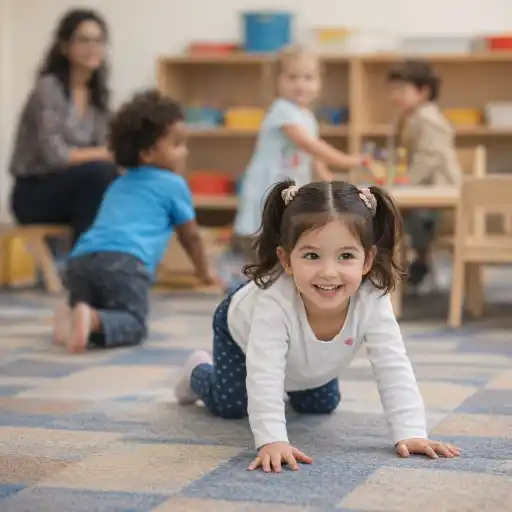
Children also move for reasons unrelated to layout, including developmental differences, temperament, fatigue, and the activity itself. Compare observations over time, and avoid interpreting one child’s route as a concern without a broader developmental context.
How can providers observe movement without overcomplicating it?
A simple play map can turn a vague sense of “this area feels busy” into useful information. Sketch the room and its main centers, then record movement during familiar periods such as arrival, free play, or cleanup. Follow a small number of questions rather than trying to capture everything at once.
- Choose one routine and a brief observation window. Repeat on more than one day if possible.
- Mark where children start, where they spend time, and where they repeatedly cross or stop.
- Note what was happening: available materials, group size, noise, adult location, and transitions.
- Record observations neutrally—for example, “four children crossed between the art table and sink several times,” rather than “children were disruptive.”
- Compare notes with colleagues, then choose one question or small change to test.
Play mapping can also include children’s perspectives. Invite them to point out favorite places, tricky routes, or spaces where they feel calm or crowded. The Australian Children’s Education and Care Quality Authority describes play mapping as a way to document how children use spaces and inform inclusive modifications. NAEYC likewise emphasizes gathering and reflecting on observations to guide teaching and learning experiences.
Use the information to understand the group and environment, not to rank children or track them unnecessarily. Formal location-tracking technology has been studied in research settings, but everyday provider reflection can begin with careful, privacy-conscious observation and a paper map.
How might movement observations guide layout changes?
Look first for a mismatch between the room’s design and what children are trying to do. If children carry blocks through a reading area, moving construction materials farther from quiet play—or creating a clearer route—may protect both kinds of activity. If children repeatedly queue at one shelf, duplicated materials or a more accessible arrangement may reduce waiting.
Make a modest, reversible change and observe what happens. For example, shift a low shelf to clarify a pathway, reposition a popular center to reduce cross-traffic, or create a soft boundary between louder and quieter play. Preserve clear sightlines for active supervision and ensure children can access materials and move through the room safely.
- Separate high-energy play from quiet literacy or focused activities where space allows.
- Keep frequently used materials near the activity where children need them.
- Provide clear, accessible routes, including for children who use mobility supports.
- Use low furniture, rugs, or defined areas to signal center boundaries without blocking adult visibility.
- Trial one adjustment at a time, then review engagement, congestion, conflicts, and supervision.
Changes should reflect the children in your care, not an idealized floor plan. Head Start guidance recommends planning spaces that are safe, accessible, motivating, and easy for educators to supervise. For practical room-arrangement strategies, providers may also explore ChildCareEd’s Classroom Setup for Child Care Buy Now $24.00 course.
How can providers avoid common interpretation pitfalls?
A movement map can prompt useful reflection, but it cannot explain every behavior by itself. One frequent mistake is treating a high-traffic area as evidence that children are “too active.” The pattern may instead show that an essential route passes through play, that a popular center needs more capacity, or that materials are stored in the wrong place.
Another pitfall is making a large redesign after a single observation. Children’s use of a room shifts with the schedule, staffing, materials, relationships, and their interests. Gather information during more than one routine and, where appropriate, across several days. Ask colleagues what they notice and include children’s views in developmentally appropriate ways.
- 🧭 Use neutral descriptions: Record what you see before making assumptions about intent.
- Look for environmental factors: Consider access, noise, crowding, visibility, and the placement of materials.
- Protect privacy: Keep notes focused on program improvement and share them only with appropriate staff and families.
- Check inclusion and safety: Make sure a proposed change does not create a new barrier or interfere with supervision.
- Stay within your role: Movement observations can inform classroom planning, but do not diagnose developmental needs.
When movement differences persist or raise a developmental question, document specific observations and discuss them respectfully with the family and relevant professionals, following program procedures. The goal is to adjust supports and opportunities—not to make a child conform to the room.
What are the main takeaways for improving classroom layout?
Children’s movement patterns reveal how the room functions in real life: where play draws children in, where pathways become crowded, and where the design may limit access or engagement. They are meaningful evidence for reflection, but they need context. Consider the activity, daily timing, materials, individual needs, and children’s own perspectives before deciding what a pattern means.
Start with a simple map, observe one routine, and record movement in objective language. Then test a small layout adjustment and review whether it improves access, engagement, flow, and supervision. Continue refining the space with your team, keeping the needs and strengths of all children at the center. State requirements vary—check your state licensing agency when changing room arrangements or safety-related features.
The central question is not whether children move “correctly,” but what their movement shows about the opportunities and barriers in the classroom. When providers listen to those clues, the room can become more accessible, purposeful, and responsive to children’s learning.
- CDA Home Visitor Subject Area 3 Part 3 Birth to 5
- Balancing Physically Active Play in Child Care
- Bienvenido! Welcoming All Families
- Baby Play: Planning Infant and Toddler Activities
- Pediatric RSV First Aid & CPR/AED
- Classroom Arrangement: The Second Teacher
- Emergent Learning & Development
- Balancing Active Play in Child Care
- Moving About the Classroom: Effective Transitions for Everyday
- Technology as a Classroom Tool
- CDA Certification en Español: Recursos y Consejos para Educadores Bilingües
- 🤯 ¿Por qué este niño está teniendo un comportamiento difícil de repente?
- 10 Ejemplos de Cómo la Cultura Influye en el Desarrollo Infantil
- Proporciones de Cuidado Infantil y Tamaños de Grupo por Edad en Maryland (Guía Rápida para Centros y Hogares)
- Proporciones de Cuidado Infantil y Tamaños de Grupo por Edad en Virginia (Guía Rápida para Centros y Hogares)
- Retraso del Habla en la Guardería: Cómo Pueden Ayudar los Proveedores
- Celebrando la amistad en el cuidado infantil durante el Día de los Mejores Amigos
- How Can I Reduce Classroom Stress Without Changing My Schedule?
- Child Keeps Hitting Other Kids? Look for These 7 Patterns Before Reacting
- Active Supervision Examples: 10 Real Classroom Scenarios—Safe or Unsafe?
- How Can Child Care Providers Help Children Understand Classroom Expectations?
- How Can Child Care Providers Create Sensory-Friendly Learning Spaces for All Children?
- How Can Child Care Providers Create Sensory-Friendly Classroom Spaces?
- How Can Child Care Providers Design Learning Centers That Support Play and Development?
- How Can You Create a Sensory-Friendly Child Care Classroom?
- What Can Children’s Movement Patterns Reveal About Classroom Layout?
- Does an Empty Classroom Space Need to Stay Empty?
- What Can Preschool Teachers Learn from a Child’s Play Preferences?
- What Changes in Infant Exploration After You Rearrange the Room?
- How Can You Safely Check a Classroom After Moving Furniture for Indoor Movement Activities?
