When “What comes next?” becomes a daily question, photographs can turn an abstract routine into a concrete, reassuring guide. Pairing real classroom images with an environment that nurtures growth and community  Buy Now $55.00 helps providers design more inclusive spaces while strengthening classroom practice; the course can deepen your understanding of room arrangement, learning centers, accessibility, and family representation.
Why do photos make classroom routines easier to remember?
Young children are still developing language, working memory, attention, and the ability to imagine events that are not immediately visible. A verbal direction such as “clean up, wash your hands, and come to the table” asks children to hold several steps in mind at once. A photograph of the actual sink, table, or cleanup area gives that direction a stable reference point.
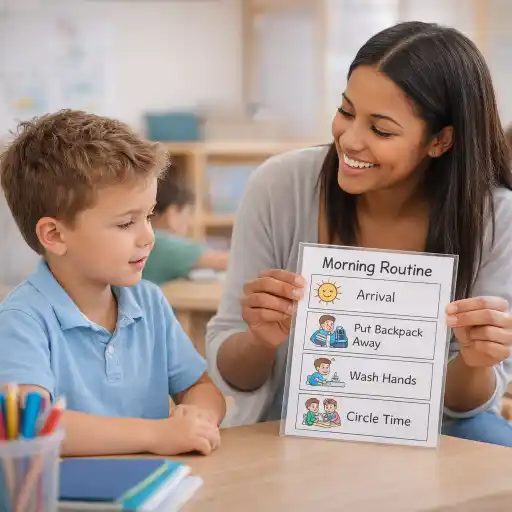
Visual supports are not merely decorative. Head Start explains that pictures can help children understand expectations, participate in routines, and engage across classroom, home, and community settings. Similarly, the ChildCareEd guide to visual schedules connects picture-based planning with calmer #transitions, greater #independence, and increased predictability.
Photos are especially useful when they show the child’s real environment. A generic icon may represent “snack,” but a photo showing your classroom’s snack table communicates location, materials, and expectations simultaneously. This reduces the cognitive distance between the visual and the action.
- Photographs clarify what an activity looks like in this specific classroom.
- They support children who are not yet reading or who process spoken language differently.
- They provide a consistent cue across teachers, substitutes, and family members.
- They help children recall sequences after repeated practice.
The goal is not to make children dependent on cards. Rather, photos serve as temporary scaffolds that children can consult until the routine becomes familiar and increasingly self-directed.
Which routines benefit most from photo cards?
Begin with routines that occur frequently, contain several steps, or regularly lead to confusion. The best starting point is not necessarily the most complex activity; it is the moment where a small amount of clarity could make the greatest difference for children and staff.
Common examples include arrival, handwashing, toileting, meals, cleanup, rest preparation, outdoor preparation, and departure. Activity-specific cards can also guide center choices, moving from one learning area to another, or completing a small-group task.
Consider creating two related tools:
- Whole-day schedule: A sequence of major experiences such as arrival, group meeting, centers, meals, outdoor play, and rest.
- Routine sequence: A smaller step-by-step strip for tasks such as washing hands or putting on outdoor clothing.
The Texas Education Agency recommends visual daily schedules and eye-level visual scaffolds as part of an organized early childhood environment. This aligns with the practical principle that children should be able to see, reach, and interact with the information—not simply observe it from across the room.
When selecting routines, ask:
- Where do children need repeated adult prompts?
- Which steps are often skipped?
- When do children appear uncertain, rushed, or anxious?
- Which routine would give children an immediate opportunity to practice autonomy?
For infants and toddlers, use fewer cards and emphasize concrete care moments. For preschoolers, combine photos with simple words, arrows, or “first–then” language. The Illinois Early Learning Project also identifies whole-class, individual, and activity-specific schedules as useful formats, reinforcing the importance of matching the tool to the child and the routine.
How should providers create effective photo routine cards?
Effective cards are clear, durable, culturally responsive, and easy to update. You can photograph your own classroom with a phone, obtain family permissions when children appear in images, and edit the pictures into consistent cards. An editable photo routine card and schedule template can save preparation time while still allowing you to adapt wording, languages, colors, and activities.
Use one photograph for one meaningful action whenever possible. Avoid crowded scenes, distracting backgrounds, and tiny details. If a routine involves several actions, create a short sequence rather than placing every step on one card.
- Define the action: Write a concise label such as “Put cup in bin” or “Choose a book.”
- Take the photo: Show the actual location, materials, and expected action.
- Add accessible language: Pair the image with words, home-language translations, gestures, or symbols as appropriate.
- Choose a usable size: Make cards large enough for children to identify from their normal viewing distance.
- Protect the resource: Laminate cards or place them in wipeable sleeves, and attach hook-and-loop fasteners or magnets.
- Provide an “all done” location: Let children move completed cards, turn them over, or place them in a finished pocket.
Editable templates are particularly valuable because classroom routines change. A schedule can be revised for special events, weather, staffing, field trips, or children’s emerging abilities without rebuilding the entire system. Keep a few blank cards available for unexpected activities.
Design matters, but consistency matters more. Use the same image for the same routine, place the schedule in a predictable location, and ensure the card reflects what actually happens. A beautiful resource that is rarely consulted will not become a meaningful classroom scaffold.
How can teachers teach children to use photo schedules?
A photo schedule becomes effective through instruction, modeling, and repeated participation. Posting cards alone does not teach children what the cards mean. Introduce the system during a calm period, when children have sufficient attention to explore it without pressure.
At the beginning of the day, walk through the schedule using simple language: “First arrival, then breakfast, then play.” Before each transition, point to the current card and the next card. Invite children to identify what is happening now, predict what comes next, and move or remove the completed image.
Use a consistent sequence of adult actions:
- Gain the child’s attention.
- Point to the current photograph.
- Name the action briefly.
- Point to the next photograph.
- Give adequate processing time.
- Notice and describe the child’s effort.
For example: “You checked the picture. Cleanup is next. You put the cars in the basket.” Specific feedback helps children connect the visual cue with their own successful behavior. The 2016 study by Watson and DiCarlo found that a picture activity schedule increased independent completion of classroom routines for a young child while reducing teacher prompting. Although one study does not determine what will work for every child, it supports the practical value of teaching routines through sequenced visual information.
Children can also take leadership roles. Rotate a schedule helper, invite children to update the board, or ask a peer to carry the next photo to a new location. These practices transform the schedule from an adult-controlled display into a shared classroom tool.
Pair photographs with songs, timers, gestures, and concise verbal cues when helpful. The purpose is coordinated support, not sensory or verbal overload.
How can photo routines support inclusion and flexibility?
Photo cards can support many learners, including children who are acquiring English, children with communication differences, children with autism or ADHD, and children who become distressed when activities change. However, photographs are not automatically accessible to every child. Some children may understand objects, line drawings, written words, sign language, or audio cues more readily.
Use observation to determine the right level of representation. A child may need a real spoon before understanding a photograph of a spoon; another may benefit from a photograph paired with the word “snack” in both English and the family’s home language. Individual mini-schedules, first–then boards, or portable card rings can offer additional support without separating the child from the group.
- Use fewer steps when a child is overwhelmed.
- Offer a portable card for difficult transitions.
- Add an “unexpected change” card for schedule disruptions.
- Show calming choices, such as breathing, quiet space, or asking for help.
- Include children’s families, cultures, and actual classroom materials in images.
Flexibility is essential. A visual schedule should communicate structure while allowing adults to acknowledge real changes. When the plan changes, show the new card, name the change, and explain what remains the same: “Outdoor play is canceled because of rain. First books, then music.” This approach validates children’s need for predictability without promising that every day will unfold identically.
Directors can support inclusion by creating shared expectations for visual supports, training staff to use common language, and reviewing whether cards represent all children respectfully. Remember that #state requirements vary - check your state licensing agency when making environmental or program changes.
What common mistakes should providers avoid?
Even well-intentioned visual systems can become ineffective when they are too complicated, inconsistent, or disconnected from children’s experiences. The most common mistake is treating the schedule as a poster rather than as an instructional tool. Children need opportunities to look at it, act on it, and receive feedback.
Avoid these pitfalls:
- Too many cards: Start with the major parts of the day or three to five steps in a routine.
- Generic images that do not match the room: Photograph the real sink, shelf, cubby, or table when location matters.
- Overly abstract labels: Replace “self-care” with “wash hands” or “put on coat.”
- Inconsistent adult use: Agree on shared cues and teach substitutes how the system works.
- No transition buffer: Build time for finishing, cleanup, toileting, and movement.
- Rigid implementation: Update the schedule when the day changes and teach children how to respond to changes.
- Using visuals as punishment: Cards should clarify expectations and promote participation, not threaten or shame.
Evaluate impact through simple observation. Do children look at the cards without prompting? Are transitions shorter or calmer? Are adults giving fewer repeated directions? Can children describe or demonstrate what comes next? Documenting these indicators for a week or two can help teams decide whether to simplify, enlarge, relocate, or individualize the cards.
For further professional learning, Every Moment Matters: Schedules and Transitions Buy Now $55.00 offers focused training on intentionally designing physical settings, routines, schedules, and transitions. Providers seeking additional support for inclusive practice may also explore Coaching for Success: Inclusive Strategies to Support Children with Autism Buy Now $55.00$45.00, while Classroom Setup for Child Care Buy Now $24.00 addresses arrangement and welcoming learning environments.
Conclusion: How can photos help children remember classroom routines?
Photos help children remember routines by making sequence, location, and expectations visible. When images show the actual classroom, children can connect what they see with what they are expected to do, gradually moving from adult prompting toward participation and independence.
The strongest system is simple, intentionally taught, and responsive. Start with one challenging routine, photograph its meaningful steps, place the cards at children’s eye level, and practice using them every day. Invite children to move completed cards, predict what comes next, and help revise the schedule when plans change.
Use editable photo routine cards and schedule templates as practical tools—not as substitutes for warm relationships, clear modeling, or responsive teaching. With consistent implementation, these small visual supports can make the classroom more predictable, inclusive, and welcoming for children, families, and staff.
- Turning Behavior Around for Toddlers and Preschoolers
- Lesson Planning for Preschoolers
- CDA Home Visitor Subject Area 5 Part 3 Birth to 5
- The ABCs of Behavior: Turning Challenges into Learning Opportunities
- 45 Hour Infant and Toddler Methods and Materials
- Pediatric RSV First Aid & CPR/AED
- Balancing Act: Schedules and Routines
- Texas Director Credential
- Anxiety: Signs & Strategies
- Every Moment Matters: Schedules and Transitions
- CDA Certification en Español: Recursos y Consejos para Educadores Bilingües
- 💛🧩 ¿Cómo puedo hacer que mi enseñanza sea inclusiva para los niños con autismo?
- 10 Ejemplos de Cómo la Cultura Influye en el Desarrollo Infantil
- Proporciones de Cuidado Infantil y Tamaños de Grupo por Edad en Maryland (Guía Rápida para Centros y Hogares)
- Proporciones de Cuidado Infantil y Tamaños de Grupo por Edad en Nueva Jersey (Guía Rápida para Centros y Hogares)
- Proporciones de Cuidado Infantil y Tamaños de Grupo por Edad en Virginia (Guía Rápida para Centros y Hogares)
- Cómo Trabajar en el Cuidado Infantil en Carolina del Norte: Requisitos y Pasos
- How can Florida teachers prepare for a CLASS observation without stress?
- How can Michigan early educators use culturally responsive teaching in their classrooms?
- How can child care programs best support infant and toddler development?
- Managing an Early Childhood Classroom with Confidence
- How Can Oklahoma Early Educators Turn Daily Observations into Better Classroom Support?
- How can DC classrooms welcome every child and make inclusion real?
- Celebrando la amistad en el cuidado infantil durante el Día de los Mejores Amigos
- Canciones, juegos y preguntas de círculo para niños
- Can Visual Supports Improve Behavior and Routines in Early Childhood Programs?
- How can we create classrooms where every child feels represented?
- How Can Photos Help Children Remember Classroom Routines?
- How Can Child Care Providers Help Children Return After a Long Break?
