How can toddlers discover the wider world without leaving the classroom? With thoughtful, sensory-rich invitations, providers can build language, curiosity, movement, and belonging; Montessori Cultural Activities: Exploring the World Through Play and Learning  Buy Now $24.00 offers deeper guidance for designing hands-on cultural experiences that are developmentally appropriate and meaningful.
Toddlers do not need detailed geography lessons to begin developing a respectful interest in people and places. They need repeated opportunities to hear new words, notice similarities, explore materials, and connect learning to the families represented in their community. The best activities are brief, flexible, sensory-aware, and rooted in everyday life rather than stereotypes.
Use the following ideas as invitations, not performances. Children may observe, imitate, touch, move, or communicate nonverbally. Pair the activities with real photographs, authentic books, family input, and simple language such as “Some families…” rather than broad statements about an entire country or culture.
Why does around-the-world play matter for toddlers?
Play is a toddler’s primary way of constructing meaning. A basket of scarves, a photograph of a family, or a rhythm played on a shaker can support vocabulary, sensory integration, motor coordination, social interaction, and emerging identity at the same time. The ChildCareEd resource Passport to Fun: Around the World Classroom Activities emphasizes that global themes can nurture curiosity, empathy, communication, art, mathematics, and classroom community when they are introduced respectfully.
This work also matters because representation communicates who belongs. When toddlers see varied skin tones, languages, homes, family structures, foods, and forms of play in books and materials, they receive a quiet but powerful message: people are diverse, and everyone is worthy of respect.
- Keep experiences short and repeat them across several days.
- Offer a quiet observation option for children who are cautious or sensitive to sound and texture.
- Use authentic images and family knowledge whenever possible.
- 🧭 Connect every activity to a clear developmental purpose, such as turn-taking, new vocabulary, or fine-motor practice.
How can a classroom passport and map invite exploration?
1. Classroom passport: Give each toddler a small booklet with their name or photograph. Add a sticker after a child explores a song, story, object, or family contribution. The passport is not a test and should never require a child to perform.
2. Child-level world map: Place a durable map at eye level. Add photographs of children, animals, homes, or landscapes, and invite toddlers to point, name, or match. Use spatial words such as “near,” “far,” “over,” and “under.”
3. Suitcase discovery basket: Fill a small suitcase with postcards, fabric squares, pretend tickets, binoculars, and sturdy picture books. Rotate two or three objects at a time to prevent overstimulation.
4. Where families connect: With permission, place family-provided photographs or drawings near the map. A child might point to a place connected to a grandparent, a language, or a favorite family story.
5. Traveling animal match: Offer photographs of animals and simple habitat cards. Toddlers can match, carry, or sort the cards while teachers model vocabulary. Avoid implying that one animal represents an entire nation.
These activities support early geography concepts without expecting toddlers to memorize countries. The goal is relationship, language, and wonder.
Which music and movement activities work well with toddlers?
6. Greeting-of-the-week: Introduce one greeting contributed by a family or selected from a reliable source. Say it naturally during arrival rather than requiring children to repeat it. Add a wave, nod, or sign so every child can participate.
7. Rhythm travel: Play brief excerpts from varied musical traditions using an appropriate, licensed source. Ask, “Is it fast or slow?” and invite clapping, rocking, tapping, or swaying. Avoid labeling a complex tradition as a single “country song.”
8. Scarf movement: Provide lightweight scarves and model movements such as floating, circling, or reaching. Pair the movement with music and words including “up,” “down,” “around,” and “stop.”
9. Homemade shaker exploration: Use securely sealed containers prepared by adults, checking that materials cannot escape. Invite toddlers to compare loud and quiet, fast and slow, and stop and go.
10. Echo sounds: Teachers make a simple clap, tap, or vocal rhythm; toddlers respond in their own way. Connect the game to greetings, lullabies, or community music shared by families, while avoiding claims that a rhythm belongs to every person in a culture.
Provide hearing protection or a calm alternative when needed. Active supervision remains essential with instruments and loose materials.
How can art, sensory play, and dramatic play support global learning?
11. Pattern collage: Offer paper strips, circles, lines, and safe adhesive materials. Talk about repetition, color, and texture rather than asking children to reproduce sacred or culturally specific designs.
12. World-texture basket: Include washable fabrics, woven materials, smooth wooden objects, and photographs of everyday clothing or household items. Let toddlers touch, compare, and describe textures.
13. Ocean or travel sensory tub: Use large, age-appropriate objects such as boats, scoops, shells too large to swallow, and blue fabric. If using rice or other small fillers, follow program policy, developmental guidance, and constant supervision. A fabric-based version is safer for children who mouth objects.
14. Build a neighborhood: Add blocks and photographs of homes, schools, markets, parks, and transportation from different communities. Encourage toddlers to build, knock down, rebuild, and cooperate. Use mathematical language such as “tall,” “wide,” “beside,” and “inside.”
15. Travel dramatic-play center: Offer a suitcase, clipboards, pretend tickets, dolls, phones, and postcards. Focus on caring for a travel companion, packing, greeting, and finding a place to rest—not pretending to be a culture.
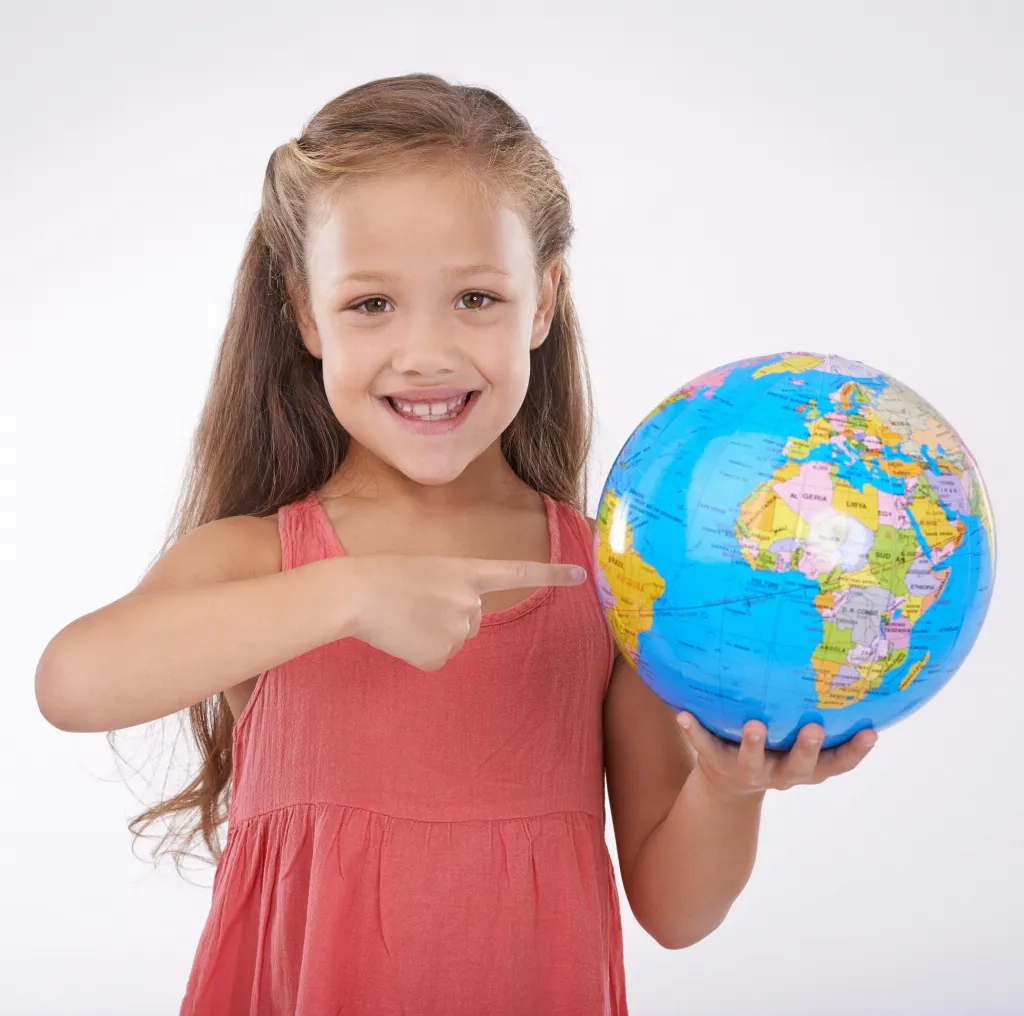 How can stories, food exploration, and family voices deepen the experience?
Choose sturdy picture books that portray children and families in ordinary settings: eating, playing, visiting relatives, attending school, or caring for one another. Use real photographs when appropriate, but review every resource for accuracy, stereotypes, and meaningful representation. Pause for one or two accessible questions: “What do you notice?” “How does the child feel?” or “What are they doing together?”
Food exploration can be sensory without requiring children to eat. Offer photographs, pretend foods, sealed scent containers, or a simple food-preparation demonstration. If real food is included, obtain required permissions, document ingredients, review allergies and dietary practices, and provide an equivalent nonfood option. State requirements vary - check your state licensing agency.
Family participation should be invitational and low-pressure. Ask whether a family would like to contribute a greeting, photograph, song title, recipe card, or short recording. Never ask one child to represent an entire culture, and never require a child to speak a home language publicly. Families may also choose not to participate; that choice deserves respect.
Directors can support consistency by creating a brief family-sharing protocol that addresses consent, translation, privacy, and how contributed materials will be displayed.
How can providers keep these activities respectful, safe, and inclusive?
Respectful global learning is an ongoing practice, not a themed costume day. Avoid caricatures, accent imitation, sacred objects used as props, and activities that reduce a culture to one food, holiday, dance, or outfit. Use precise language: “This family enjoys…” or “Some people in this community…”
Safety requires the same intentionality as cultural responsiveness. Inspect materials, remove choking hazards, supervise sensory play, and adapt for allergies, mobility needs, hearing differences, and sensory preferences. Provide visual directions, predictable transitions, and multiple ways to participate.
Common pitfalls include:
- Tokenism: featuring one culture once a year. Better: include diverse families throughout books, music, dramatic play, and daily routines.
- Forced participation: expecting toddlers to repeat words or perform movements. Better: allow observing, choosing, and communicating nonverbally.
- Overgeneralization: presenting a country as though every family behaves identically. Better: use “some families” and invite family-authored perspectives.
- Unsafe materials: using small fillers or food without planning. Better: choose developmentally appropriate alternatives and follow policies.
Staff reflection is valuable: Which children see their families reflected? Which materials are missing? Are we teaching curiosity without making anyone feel like an exhibit?
How can directors plan, document, and extend the learning?
A successful theme does not require fifteen activities in one week. Select three or four invitations, repeat them, and observe how toddlers respond. A simple planning grid can connect each experience to a goal:
- Language: new words, gestures, greetings, and descriptive vocabulary.
- Social-emotional development: turn-taking, shared attention, empathy, and belonging.
- Physical development: grasping, scooping, dancing, carrying, and coordinating movements.
- Cognitive development: matching, sorting, remembering, predicting, and noticing patterns.
Document learning with brief objective notes, photographs taken with permission, and children’s drawings or passport pages. Record what children did rather than interpreting too quickly: “Maya tapped the drum, paused, and tapped again after Leo.” Use observations to decide whether to simplify, extend, or replace an invitation.
For staff who want stronger skills in developmentally appropriate planning, Teacher & Me Playtime Buy Now $24.00 explores individual planning, teacher- and child-directed activities, and play for children from birth through age three. Providers seeking a broader focus on inclusive environments may also explore Playful Spaces for Infants & Toddlers Buy Now $24.00.
What are the main takeaways?
Fifteen small invitations can help toddlers explore the world through their senses, bodies, relationships, and imagination. The strongest approach combines maps and passports with music, movement, art, sensory materials, stories, dramatic play, and optional family participation.
Keep the goal clear: toddlers are not expected to master geography or speak for a culture. They are learning that homes and traditions can differ, that people share common needs and feelings, and that every family deserves respect and belonging. With careful preparation, active supervision, authentic representation, and reflective planning, around-the-world play becomes a joyful part of everyday early learning.
Start with one greeting, one book, and one open-ended center. Observe closely, listen to families, and build from children’s interests. Those steady choices create a classroom where curiosity can travel far while every child remains securely at home.
Which additional courses may support this work?
- Strength in Differences: Cultural Diversity Buy Now $24.00 — supports culturally responsive practice and intercultural communication.
- Cultures in the Classroom Buy Now $24.00 — focuses on acceptance, culture, and diversity in early learning settings.
- From Play to Planning: Building Culturally Competent, Child-Centered Curriculum Buy Now $55.00 — connects play, planning, inclusion, and anti-bias materials.
- Building Bridges for Dual Language Learners Buy Now $16.00 — offers strategies for language diversity and family collaboration.
- Playful Learning: Infant & Toddler Activities Buy Now $25.00 — strengthens individualized, age-appropriate activity planning.
- 18-Hour Train the Trainer
- Tomorrow's Einsteins: Infant and Toddler Science
- Birth to Five CDA Credential with Portfolio Review
- Children at the Wheel: Emergent Curriculum
- 45-Hour Infant and Toddler Curriculum
- Creating Environments that Nurture Growth and Community
- Texas Director Credential
- Montessori Cultural Activities: Exploring the World Through Play and Learning
- Enhancing STEM Education for Infants and Toddlers
- Every Moment Matters: Schedules and Transitions
- Bye Bye Winter: The Role of Outdoor Play in Early Childhood Development
- Tiny Tinkerers: How Messy Play Today Could Lead to Tomorrow’s Top Inventors
- Pumpkin Spice and Sensory Delight: Easy Autumn Sensory Bins for Early Learners
- CDA Certification en Español: Recursos y Consejos para Educadores Bilingües
- 🥦✨ ¿Cómo apoyar a los niños selectivos a probar nuevos alimentos sin presión?
- Cuáles Son las Señales de Alerta en el Desarrollo Infantil que Todo Educador Debe Conocer?
- ❄️ ¿Qué actividades al aire libre funcionan bien para los niños de Illinois en cada estación? 🌷🍂
- ¿Cuáles son las mejores actividades del Día de la Tierra para niños en casa o en el aula?
- ¿Cómo puedo usar escenarios de juego de roles de primeros auxilios en mi aula?
- Actividades de Motricidad Gruesa que Desarrollan el Equilibrio, la Coordinación y la Fuerza
- 10 Ejemplos de Cómo la Cultura Influye en el Desarrollo Infantil
- Actividades de Otoño Fáciles para Preescolares esta Temporada
- Temas y Actividades para el Día Nacional del Kindergarten para Proveedores
- Las Mejores Ideas de Excursiones para Guarderías en Georgia
- Canciones, juegos y preguntas de círculo para niños
- 15 Around-the-World Activities Toddlers Can Explore Through Play
- Mawlid Around the World: How Kids Can Explore Different Traditions and Celebrations
- Social Studies Activities for Toddlers: Start With Home, Helpers, and Their Little World
- How Can Child Care Providers Plan Infant Activities Around Developmental Milestones?
- What Does a Developmentally Appropriate Daily Schedule Look Like?
