Counting crackers, building block towers, and sorting mittens can turn an ordinary preschool day into a lively math lab. Try these ten low-prep activities with familiar classroom materials, and explore ChildCareEd’s Early Mathematics Through Play Buy Now $24.00 for deeper strategies across counting, patterns, geometry, and measurement. For professional learning about intentional experiences and child-centered planning, see Creating Engaging and Meaningful Learning Experiences  Buy Now $55.00 and From Play to Planning Buy Now $55.00; the printable Pre-K Conversation & Thinking Toolkit Buy Now $0.00 can help you extend children’s reasoning through thoughtful talk.
Why does playful math matter in Michigan preschool classrooms?
Young children develop mathematical ideas by handling objects, comparing outcomes, noticing relationships, and explaining what they see. A preschooler who shares blocks, lines up shoes, or pours water is already exploring quantity, order, shape, and measurement. Brief, inviting experiences help educators make that thinking visible without turning play into a test.
Michigan’s Early Childhood Standards of Quality for Birth to Kindergarten support professionals in recognizing individual learning pathways and using varied approaches to meet children’s needs. The state’s early math guidance emphasizes learning progressions, language-rich play, and connecting mathematics with daily life. These principles make everyday classroom objects useful teaching tools.
Keep activities flexible: offer different quantities, demonstrate a strategy when helpful, and invite children to choose materials. The goal is exploration and growing confidence—not identical results. Use all five #counting, #patterns, #sorting, #shapes, and #measurement ideas across the week, revisiting each in multiple routines.
How can everyday materials make counting meaningful?
Counting becomes more than reciting numbers when children coordinate one number word with one object and understand that the final number tells how many. Use safe, familiar materials and begin with amounts children can manage comfortably.
- 1. Snack-time serving: Place plates or napkins in a row and invite children to give one item to each place. Count together, then ask, “Does everyone have one?” Adapt to your food-service and allergy procedures.
- 2. Roll, count, and build: A child rolls a large die, counts the dots, and builds a tower with that many blocks. Compare towers: “Which is taller? How could we check?” For children ready for more, roll twice and combine the block groups.
Model touching or moving each object once as you count. If a child loses track, calmly restart together rather than correcting sharply. Ask open questions—“How did you know?” or “What could we do to make sure?”—and accept pointing, gestures, or home-language responses as meaningful participation. These small interactions help children connect quantities with language and reasoning.
What playful activities help children notice patterns and sort objects?
Patterns and sorting encourage children to identify attributes, make predictions, and explain a rule. Begin with visible differences and repeat an idea in more than one way—objects, sounds, movement, or classroom routines.
- 3. Make a classroom pattern: Arrange two colors of blocks in an AB sequence, such as red-blue-red-blue. Invite children to continue it, then try a movement pattern: clap, tap, clap, tap. Ask what comes next and how they decided.
- 4. Sort the classroom collection: Offer a small group of large blocks, toy animals, or fabric squares. Children sort by color, size, shape, or type, then try a different rule. Prompt them to describe why an item belongs in a group.
Notice that a single collection can be sorted in several reasonable ways. Rather than deciding for children, ask, “Can you find another way?” When children are ready, invite them to create a pattern for a friend to continue. Use close supervision and avoid small loose parts for children who may mouth objects.
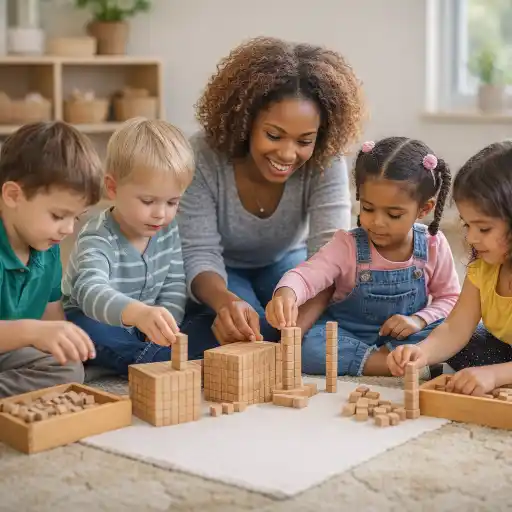
How can shapes and spatial thinking become hands-on?
Children learn about geometry by building, rotating, matching, and describing how shapes fit together. Everyday materials can make abstract shape words concrete and encourage collaboration as children compare their designs.
- 5. Shape hunt: Search the room for circles, rectangles, squares, and triangles in books, windows, signs, or toys. Invite children to describe features: “This has three straight sides.” It is fine if they notice a shape that is only approximately geometric.
- 6. Build a shape picture: Use craft sticks, large paper shapes, or blocks to make a house, vehicle, or imaginative design. Ask which pieces could form a roof, a wheel, or a longer side. Encourage children to turn and combine pieces rather than focus only on naming them.
Introduce spatial words naturally: on, under, beside, between, above, and behind. For children who benefit from extra support, provide a picture model, larger pieces, or a partner. For a greater challenge, ask children to create a design using a set number of shapes and explain their choices.
Which simple measurement activities work with classroom supplies?
Preschool measurement begins with comparing and describing—not formal units or precision. Children can investigate length, height, and capacity using objects already found in centers. Keep the comparison visible and invite predictions before testing them.
- 7. Measure with blocks: Choose a book, toy, or table edge and line up same-size blocks beside it without gaps. Count the blocks and compare two objects: “Which needs more blocks to measure?”
- 8. Compare block towers: Build two towers and decide which is taller or shorter. Place them side by side on the same surface to check. Invite children to adjust a tower until both are the same height.
- 9. Scoop and compare capacity: At a supervised water or sensory table, provide sturdy containers, scoops, and cups. Predict which holds more, then fill and compare using the same scoop. Use appropriate materials and follow classroom safety procedures.
Model language such as longer, shorter, taller, heavier, full, and empty. Do not expect exact measurement vocabulary immediately; children’s actions and comparisons are valuable evidence of developing understanding.
How can teachers connect activities, observe learning, and plan next steps?
A final activity can bring several strands together: 10. Create a class vote graph. Ask a simple question, such as which story to reread or which outdoor game children prefer. Each child places a name card or sticker in a column. Count each column and compare which has more, fewer, or the same. 📊 Invite children to tell what they notice rather than treating the graph as a right-answer exercise.
Across the ten activities, keep materials accessible, directions brief, and the adult role responsive. Observe the strategies children use: Does a child touch each object while counting? Continue a repeating sequence? Explain a sorting rule? Compare lengths by lining objects up? Jot one specific note and a possible next step, then revisit the idea through play. The What Works Clearinghouse guide, Teaching Math to Young Children, recommends developmental progressions, progress monitoring, mathematical talk about the world, and daily opportunities to learn.
Directors can support consistency by helping staff share adaptable materials and discuss observations during planning time. Families can extend the same ideas by counting steps, sorting laundry, or comparing containers at home. State requirements vary - check your state licensing agency when determining documentation or training expectations.
Conclusion: How can you bring these 10 activities into the week?
Ten hands-on activities can make counting, patterns, sorting, shapes, and measurement part of a Michigan preschooler’s everyday experience. Start with a few familiar materials, select one skill to emphasize, and let children explore, talk, and try again. Snack items, blocks, paper shapes, containers, and stickers can all become meaningful math tools when paired with time to reason and responsive adult conversation.
Remember the central goal: build curiosity and understanding through playful experiences, not pressure for perfect answers. Observe what children already do, adjust the challenge, and repeat ideas in new contexts. For more planning support, revisit the linked ChildCareEd courses and toolkit, and use Michigan’s early childhood guidance to inform developmentally responsive practice.
- 45 Hour Child Growth and Development
- CDA Preschool Credential
- 45 Hour Preschool Methods and Materials
- 45 Hour Infant and Toddler Methods and Materials
- Pediatric RSV First Aid & CPR/AED
- Art from the Heart for Preschoolers: Open Ended Art Projects that Build Self-Esteem
- Texas Director Credential
- Letter & Number Planning in Child Care
- Early Mathematics Through Play
- CDA Certification en Español: Recursos y Consejos para Educadores Bilingües
- Qué capacitación se requiere para ser director de cuidado infantil en Texas?
- Actividades de Motricidad Gruesa que Desarrollan el Equilibrio, la Coordinación y la Fuerza
- Normas de Licenciamiento de Cuidado Infantil en Virginia para Centros Diurnos Infantiles y Hogares Diurnos Familiares
- Proporciones de Cuidado Infantil y Tamaños de Grupo por Edad en Maryland (Guía Rápida para Centros y Hogares)
- What are age-appropriate learning activities for infants, toddlers & preschoolers in Michigan?
- How can I teach colors, shapes & numbers through play in Michigan classrooms?
- Calabazas, hojas y manzanas: actividades de otoño para preescolares
- How can Michigan childcare providers build trust with families from day one?
- How Can I Use Fun Math Activities for Preschoolers Every Day?
- How Can Michigan Providers Prevent Summer Learning Loss in Young Children?
- How can Michigan providers teach community and citizenship with America’s 250th activities?
- How can Michigan preschool programs build strong fine and gross motor skills?
- Can You Build a Leaf Bridge? Fall STEM Challenges for Pre-K
- How Can Simple Fall Activities Support Kindergarten Readiness Through Play?
- How Can Familiar Daily Events Help Children Learn to Read Clocks?
- How Can Michigan Preschool Teachers Turn Snowy Days Into Learning Opportunities?
- How Can Michigan Preschool Teachers Build Kindergarten Readiness Through Play?
- How Can Preschoolers Explore Michigan’s Great Lakes Through Science?
- What Are 10 Hands-On Math Activities for Michigan Preschoolers?
