When children can connect the clock to something they care about—snack, recess, a classroom celebration—time becomes more than numbers and moving hands. Try these practical ways to build clock-reading and early elapsed-time understanding through familiar schedules, and explore Early Mathematics Through Play Buy Now $24.00 for additional strategies that make math meaningful through routines and hands-on experiences. For school-age providers who want more context for children’s learning needs, Watch Me Grow: School Age Development ONLINE  Buy Now $24.00 offers a deeper look at development from ages 6–13.
Why do familiar events make clock learning more meaningful?
For first- and second-grade children, time is abstract: they cannot hold an hour or watch thirty minutes as a finished object. A familiar daily event provides an anchor. “We have snack at 10:00” connects the numbers and clock hands to an experience children anticipate. Repeated connections help learners understand that a clock represents when something happens, not simply a puzzle to decode.
Real routines also support broader mathematical thinking. Children sequence events, notice patterns, count in intervals, estimate duration, and explain how they know what comes next. An analog clock makes movement visible: the minute hand travels around the face while the hour hand gradually shifts toward the next number. This can help children reason about passage of time rather than memorize isolated answers.
Meaningful contexts can support confidence, too. Instead of asking a child to solve a string of disconnected examples, invite them to check a real classroom schedule. ChildCareEd’s ideas for connecting time to real after-school plans likewise emphasize linking clock symbols to recognizable activities and using schedule questions naturally.
- Use events children know: arrival, snack, outdoor play, story time, or pickup.
- Ask curious questions rather than turning every schedule check into a quiz.
- Celebrate reasoning and progress, even when a child needs another try.
How can providers introduce the hour and half-hour?
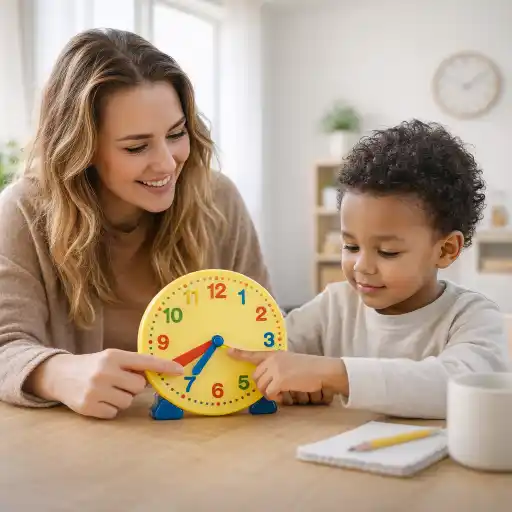
Begin with a large teaching clock and a predictable event. Point out the shorter hour hand and longer minute hand, and explain each role with consistent language. At an exact hour, the minute hand points to 12; at half past, it points to 6. The hour hand’s position changes as time passes, so at 3:30 it sits between 3 and 4—not exactly on either number.
Model the connection aloud: “Our story begins at 9:00. The minute hand is at 12, so it is exactly nine o’clock.” Later, move the hands to 9:30 and say, “The minute hand has traveled halfway around. It is half past nine, and we have had thirty minutes of learning and play since nine.” Connect the model to digital notation only after children have had a chance to interpret the analog face.
Keep the first practice set small and meaningful. Choose two or three schedule points rather than presenting a full day of clock times at once. Ask children to show the time on a movable clock, match it to a picture of the event, or draw the hands on a blank face. Task cards can provide focused repetition: ChildCareEd’s Telling Time task cards Buy Now $2.49 include analog clocks for hour and half-hour practice.
- “At 8:00, what do we do first?”
- “Show 10:30 on your clock. What happens around that time?”
- “Which hand tells us the hour? How can you tell?”
How can schedules and countdowns build time reasoning?
A visible schedule can turn the day into a sequence children can discuss. Display event names, pictures, and times together, with an analog clock nearby. Invite a child to locate the next event, read or identify its time, and compare it with what is happening now. Keep expectations aligned with the skill being taught: children who are learning hours and half-hours should not be expected to calculate complex durations independently.
Countdowns make the passage of time engaging when used with a clear mathematical purpose. A classroom “Noon Year” celebration, for example, can include an hourly activity leading to a midday countdown. Children can watch the clock approach each event, name the time, and describe what comes next. New Year’s countdown materials such as a paper-plate countdown clock craft can also inspire a hands-on classroom model; adapt it so children distinguish a countdown spinner from the hour and minute hands on a standard clock.
For early elapsed-time exploration, begin by counting forward in simple jumps. If an activity starts at 9:00 and ends at 9:30, ask how much time passed. Use a number line or move the minute hand to show the interval. Then connect the answer to the real event: “We read and talked for half an hour.” This makes elapsed time a description of an experience rather than a disconnected subtraction problem.
- Post a few predictable events with their times.
- Invite children to predict what comes next and check the clock together.
- Use a movement or verbal countdown to mark an upcoming transition, without rushing children.
How can practice be hands-on, inclusive, and age-appropriate?
Children learn in different ways and arrive with different experience reading clocks. Offer multiple ways to participate: set the hands, point to a time, match a picture card, explain an answer to a partner, or arrange event cards in order. Some children may be ready to read half-hours; others may first need to identify the hour hand and connect whole hours with daily events. These are valid starting points, not deficits.
Use familiar events while remembering that routines vary across homes and cultures. A child’s breakfast, bedtime, or family celebration may happen at a different time from a classmate’s. Describe the classroom schedule as one shared plan, not a rule for every family. Visual schedules, clear vocabulary, hands-on clocks, and additional wait time can make participation more accessible. Encourage children to use their home language when explaining an event, then build the corresponding time words in English as appropriate.
Practice should be brief and distributed across the week. A few purposeful clock conversations during transitions are often more useful than one long drill. Keep analog and digital clocks visible together and explain that they represent the same time in different ways. Observe whether children identify the hands, locate the hour, recognize half past, and relate a time to an event. Use those observations to plan the next small step.
- 🕒 Let children take turns being the “schedule checker” or moving the clock hands.
- Offer large clock faces, fewer choices, or partner support when helpful.
- Invite children who are ready to explain how long an activity lasts or create a schedule question.
What common pitfalls should providers avoid?
One common pitfall is teaching time only through worksheets or repeated drills. Paper practice can reinforce a skill, but it is less meaningful when children never use that skill to understand their day. Pair brief structured practice with real schedule checks, hands-on clocks, and conversations about what comes before or after an event.
Another pitfall is expecting children to read the minute hand before they understand the hour hand. On an analog clock, the hour hand moves gradually between numbers; children need repeated modeling to see that its position indicates the hour that has begun. Avoid rushing into five-minute increments or complicated elapsed-time calculations before the hour and half-hour concepts are stable.
Finally, do not make the schedule so rigid that learning time creates stress. Programs need routines, but activities sometimes take longer, and children may need time to finish or transition. Use changes as authentic planning moments: “We are staying outside five more minutes, so snack will begin a little later. Let’s see what the clock shows.” That language models flexible thinking and reassures children. State requirements vary - check your state licensing agency.
Conclusion: How do daily events help children learn to read clocks?
Familiar daily events give clock-reading a purpose. When children connect analog clock hands to arrival, snack, play, stories, and countdowns, they can see how time organizes experiences and helps people anticipate what comes next. Start with whole hours and half-hours, model with a movable clock, and use schedules to make sequence and simple elapsed time visible.
Keep practice hands-on, welcoming, and responsive to each child’s current understanding. Encourage predictions, explain the reasoning, and treat mistakes as information about what to model next. The central question—how can children learn to read clocks meaningfully?—has a practical answer: connect each new clock idea to a real event they recognize, then give them repeated, low-pressure chances to notice, explain, and try.
Five helpful ChildCareEd courses
- Early Mathematics Through Play Buy Now $24.00 — strategies for incorporating math through play, routines, and hands-on experiences.
- Watch Me Grow: School Age Development ONLINE Buy Now $24.00 — development and learning for children ages 6–13.
- Math Foundations in Early Childhood Buy Now $16.00 — practical approaches to playful math and problem-solving.
- No Such Thing as Boring Math Buy Now $24.00 — connecting math concepts with intentional play.
- Lesson Planning to Meet School Age Needs Buy Now $16.00 — planning engaging experiences for school-age learners.
- 45 Hour Child Growth and Development
- Moving About the Classroom: Effective Transitions for Everyday
- 45 Hour Preschool Methods and Materials
- Language and Literacy Foundations in Pre-K
- What Makes Me Special: An Overview of Autism and ADHD
- 45 Hour Infant and Toddler Methods and Materials
- Setting the Stage: Story Time
- 45 Hour School Age Methods and Materials
- 45-Hour Infant and Toddler Curriculum
- Moving About the Classroom: Effective Transitions for Everyday
- A quirky investigation into why kids’ sleep cycles can be unpredictable
- CDA Certification en Español: Recursos y Consejos para Educadores Bilingües
- 💛🧩 ¿Cómo puedo hacer que mi enseñanza sea inclusiva para los niños con autismo?
- 10 Ejemplos de Cómo la Cultura Influye en el Desarrollo Infantil
- Capacitación en Salud y Seguridad Preventiva en Línea para Proveedores de Cuidado Infantil
- Proporciones de Cuidado Infantil y Tamaños de Grupo por Edad en Nueva Jersey (Guía Rápida para Centros y Hogares)
- Proporciones de Cuidado Infantil y Tamaños de Grupo por Edad en Virginia (Guía Rápida para Centros y Hogares)
- Retraso del Habla en la Guardería: Cómo Pueden Ayudar los Proveedores
- Cómo Trabajar en el Cuidado Infantil en Carolina del Norte: Requisitos y Pasos
- What are the best infant care practices for New York child care providers?
- Celebrando la amistad en el cuidado infantil durante el Día de los Mejores Amigos
- Canciones, juegos y preguntas de círculo para niños
- How Can Child Care Providers Introduce Simple Routines to Infants and Toddlers?
- How Do Infants Learn Through Everyday Caregiving Routines?
- How Can Day vs. Night Sorting Help Children Understand Time and Routine?
- How Can Shape Vocabulary Strengthen Early Reading Practice?
- How Do Repetitive Sentence Patterns Build Early Reading Confidence?
- What Should Be Included in an Infant Daily Schedule?
- How Can Real After-School Plans Help Children Learn to Tell Time?
- How Can Familiar Daily Events Help Children Learn to Read Clocks?
