Michigan’s Great Lakes offer a remarkable science lab—one that can begin with a tub of water, a handful of leaves, and a child’s question. Try these ten playful activities to build observation, early reasoning, and environmental care; for a deeper foundation in planning engaging experiences, explore ChildCareEd’s Creating Engaging and Meaningful Learning Experiences  Buy Now $55.00 and From Play to Planning Buy Now $55.00. The first course offers strategies for designing developmentally appropriate learning, while the second supports child-centered curriculum planning; both can help you turn children’s discoveries into purposeful classroom experiences.
Why does Great Lakes science matter in preschool?
Michigan’s lakes, rivers, wetlands, beaches, and forests make science feel immediate. When a child watches water move through sand or compares two leaves from a neighborhood walk, abstract ideas become something they can see, touch, describe, and revisit. These experiences nurture curiosity and help children practice the foundations of scientific inquiry: noticing, wondering, testing, and communicating.
Place-based activities can also encourage care without asking preschoolers to carry the weight of environmental problems. Keep the emphasis on positive, achievable actions: use water thoughtfully, treat living things gently, and leave outdoor spaces as you found them. To enrich lesson planning, the verified ChildCareEd Climate Change and Children resource page is a starting point for exploring that topic with children in a thoughtful, age-aware way. For Great Lakes visuals and printable materials, see NOAA’s Great Lakes activities and materials.
What water experiments can young children try?
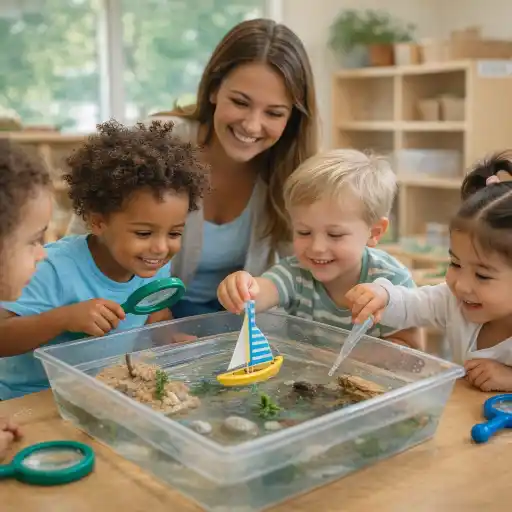
Use clean tap water for classroom investigations; children should not drink experiment water or collect water from lakes and streams. Offer small amounts, close supervision, and a dry towel nearby. Invite predictions before each test and let children describe what they observe.
- 1. What sinks or floats? Set out large, washable objects such as a plastic lid, wooden block, and smooth stone. Predict, test, and sort results. Ask what the objects have in common.
- 2. Can you make a boat? Provide foil or other safe, reusable materials. Children shape a small boat, test it in a shallow bin, and adjust the design to carry a few large counters.
- 3. Which surface absorbs water? Compare a sponge, waxed paper, cloth, and paper towel using a dropper. Notice whether water soaks in, beads up, or spreads.
- 4. How does water travel through a watershed? Crumple a sheet of paper into gentle hills and valleys, cover it with a shallow layer of foil, and use a spray bottle to model rain. Watch where the water runs and gathers. This makes a simple connection to a Great Lakes watershed model.
How can nature sorting build science and math skills?
Sorting encourages children to compare, create categories, and explain their choices—important habits shared by early science and mathematics. Gather only fallen, safe-to-handle materials, or use classroom items and photographs. Avoid unknown plants, mushrooms, berries, sharp objects, and small pieces that could be choking hazards.
- 5. Sort leaves by color, shape, or size. Offer a small collection of fallen leaves. Children can group them, count each set, then try a different sorting rule.
- 6. Compare rocks and pebbles. Use clean, large stones. Sort by color, texture, or size; invite descriptive words such as smooth, speckled, or bumpy.
- 7. Build a shoreline nature pattern. Arrange large leaves, sticks, and stones in a repeating sequence. Ask children what comes next and invite them to invent a new pattern.
Ask open-ended questions—“How did you decide?” or “Could this belong in another group?”—rather than requiring one correct system. Some items can fit more than one category, and discussing that flexibility is part of the learning.
How can children investigate wildlife and habitats?
Children can learn about freshwater life through careful observation, pictures, movement, and pretend play. Do not collect or handle wild animals. Use books, educator-approved images, or a visit from a qualified local naturalist to introduce fish, frogs, turtles, insects, and birds found around Michigan’s waters.
- 8. Create a freshwater habitat match. Pair animal photographs with habitat pictures such as shallow wetland, open lake, or stream edge. Children explain what they notice and what an animal might need—food, water, shelter, and space.
- 9. Make a food-chain movement game. Use picture cards to represent plants, small aquatic animals, and fish. Children move a soft ball or scarf along the chain to show that living things are connected. NOAA’s Great Lakes food-web posters and fish resources can support adult preparation.
Keep explanations accurate but simple: animals depend on suitable habitats, and changes to one part of an ecosystem can affect others. Avoid presenting complex issues as frightening or inevitable; focus on children’s questions and concrete examples.
How can environmental awareness become a daily practice?
Stewardship grows through small routines that children can understand and repeat. Connect classroom science to everyday choices, and model care rather than using blame. The tenth activity can become a recurring class project:
- 10. Start a “Great Lakes helpers” routine. Children can turn off a tap after washing hands, use a reusable container when appropriate, help sort clean recycling according to local program rules, or pick up litter with adult supervision and protective equipment. Record the class’s actions with drawings or a simple chart.
- Take a short observation walk and notice storm drains, plants, birds, or puddles. Remind children to observe without disturbing wildlife or entering unsafe areas.
- Invite families to share a favorite local nature place, a photograph, or a story about water in their community.
Use children’s comments, drawings, and questions to plan what comes next. Basic Science in Early Childhood Buy Now $25.00 can further support educators in incorporating meaningful, inquiry-based science. For play-led curriculum ideas, explore Children at the Wheel: Emergent Curriculum Buy Now $25.00. These are additional optional learning links—not a substitute for checking local program guidance.
How can providers keep the activities safe and meaningful?
Choose brief, hands-on investigations, then leave time for children to talk, draw, or return to a question later. Adapt materials to children’s developmental abilities, sensory preferences, languages, and access needs. For example, offer picture choices, larger tools, a quiet observation role, or a partner activity. Focus assessment on what children notice and how their ideas change, rather than on memorizing scientific terms.
- Use shallow water bins only with continuous, close adult supervision; empty them immediately after use.
- Check natural materials for hazards and allergies. Wash hands after handling outdoor items.
- Keep collected materials limited and respectful of local rules; do not disturb habitats or remove protected plants and wildlife.
- For field trips or outdoor activities, state requirements vary - check your state licensing agency for supervision, permissions, and safety procedures.
- 🔎 Document one child’s question and revisit it with a new test or observation the next day.
Short activities can still be rigorous when children make predictions, observe evidence, and share their thinking. Your thoughtful questions and responsive planning help transform ordinary materials into meaningful #science experiences.
How can you help preschoolers become Great Lakes stewards?
Michigan’s Great Lakes and surrounding habitats provide rich, familiar contexts for preschool science. Water experiments introduce properties and movement; sorting strengthens observation and classification; habitat play builds awareness of freshwater wildlife; and everyday routines offer manageable ways to practice environmental care.
Start with one or two activities, follow children’s interests, and repeat investigations so ideas have time to develop. Prioritize safe, respectful exploration and invite children to explain what they noticed. The goal is not to make preschoolers responsible for solving environmental challenges, but to help them grow curious, informed, and caring about the places they share. With a tub of water, a collection of fallen leaves, and patient adult guidance, Great Lakes learning can begin right in your classroom.
- What Makes Me Special: An Overview of Autism and ADHD
- Art from the Heart for Preschoolers: Open Ended Art Projects that Build Self-Esteem
- Building Equity: Inclusionary Practices in Preschool
- Connections That Count: Building Relationships in Child Care
- Language Development in School Age
- Lesson Planning for Preschoolers
- Building Early Science Foundations
- Environments That Inspire Independence and Exploration
- Montessori Cultural Activities: Exploring the World Through Play and Learning
- Capacitación Previa al Servicio en Michigan
- ¡El Método Científico en el Aula!
- CDA Certification en Español: Recursos y Consejos para Educadores Bilingües
- 💛🧩 ¿Cómo puedo hacer que mi enseñanza sea inclusiva para los niños con autismo?
- 10 Ejemplos de Cómo la Cultura Influye en el Desarrollo Infantil
- Proporciones de Cuidado Infantil y Tamaños de Grupo por Edad en Maryland (Guía Rápida para Centros y Hogares)
- Proporciones de Cuidado Infantil y Tamaños de Grupo por Edad en Virginia (Guía Rápida para Centros y Hogares)
- Actividades de Otoño Fáciles para Preescolares esta Temporada
- Cómo Trabajar en el Cuidado Infantil en Carolina del Norte: Requisitos y Pasos
- Cómo Trabajar en el Cuidado Infantil en California: Requisitos y Pasos
- Las Mejores Ideas de Excursiones para Guarderías en Texas
- How can Michigan classrooms teach children about the Great Lakes with hands-on science activities?
- Calabazas, hojas y manzanas: actividades de otoño para preescolares
- How can Michigan's Great Lakes communities fix rural child care deserts?
- Celebrando la amistad en el cuidado infantil durante el Día de los Mejores Amigos
- Canciones, juegos y preguntas de círculo para niños
- Cómo simplificar la capacitación para sus empleados de daycare
- How can Michigan providers keep kids safe around the Great Lakes and backyard pools?
- How Could Employer-Sponsored Child Care Reshape Demand for Michigan Providers?
- How Can Preschoolers Explore Michigan’s Great Lakes Through Science?
