Children may be able to repeat a bus rule without knowing how to use it in a real situation. Check understanding through brief conversations, hands-on demonstrations, and playful sorting—then use what you observe to guide the next practice. For a deeper look at supervision, restraints, vehicle hazards, and transportation planning, explore ChildCareEd’s Appropriate Precautions in Transportation of Children  Buy Now $10.00 course; it can strengthen your professional knowledge and help you plan safer routines.
Why check understanding instead of only reviewing the rules?
Bus safety depends on decisions children make at several moments: waiting near the curb, approaching a stopped bus, boarding, riding, and exiting. A child who can say “stay seated” may still need help applying that idea when a friend drops a toy or the bus stops unexpectedly. Informal assessment helps educators find out whether children can recognize a situation, explain a safe choice, and practice what to do next.
Assessment is not a pass-or-fail test. It is a way to notice children’s strengths and identify where teaching needs to be clearer or repeated. This aligns with developmentally appropriate assessment: observe children’s thinking and actions in meaningful contexts, rather than relying only on a worksheet or a single answer.
Keep expectations realistic. Children differ in language, experience with buses, attention, motor skills, and comfort around vehicles. A quiet child may demonstrate understanding by pointing or showing a gesture; another may need more opportunities before responding confidently.
- Look for children to identify a safe choice, not merely repeat a phrase.
- Notice what they do during practice and transitions, as well as what they say.
- Use mistakes as information about what to model and rehearse next.
Which bus safety skills should providers look for?
Choose a small set of clear, observable behaviors. Children should understand where to wait, when it is safe to approach, how to board, what to do while riding, and how to get help near the vehicle. National guidance from NHTSA’s school bus safety information notes that children face particular risk as they approach or leave the bus, so include both the ride and the surrounding area in instruction.
- At the stop: Wait with an adult in the designated area, away from the curb; do not run or push toward the bus.
- Boarding: Wait until the bus stops and the driver or responsible adult indicates it is time; use the handrail.
- Riding: Remain seated as instructed, keep the aisle clear, and use an available restraint according to program and vehicle procedures.
- Exiting and crossing: Follow the adult’s directions, stay where the driver can see you, and never walk behind the bus.
- Dropped item: Do not reach beneath or near the vehicle; tell the driver or another responsible adult.
Teach the procedures that apply to your program and the children’s route. Exact distances, crossing procedures, restraints, and staff responsibilities may differ by setting. State requirements vary - check your state licensing agency, transportation provider, and local school district. Consistent language between educators, families, drivers, and monitors makes a child’s #routine easier to understand and follow.
How can discussion reveal what children understand?
Use short, concrete prompts and give children time to think. Rather than asking only “Do you know the bus rules?”, describe a situation: “The bus has arrived. What do we do before walking closer?” Follow with “Why?” or “What could happen if…?” Their explanations reveal whether they understand the purpose of the rule or are guessing based on familiar words.
Try a quick think-and-share conversation with a small group. Present one scenario at a time, invite children to respond verbally or nonverbally, and gently ask them to explain or show their thinking. Avoid correcting every answer immediately; first listen for the child’s reasoning. Then restate the safety message in clear language and model the action if needed.
- “Your hat falls beside the bus. What should you do?”
- “A friend stands up while the bus is moving. What is a safe choice?”
- “The driver has not opened the door yet. Where should we wait?”
- “You feel worried or need help on the bus. Which adult can you tell?”
Record brief notes about what each child can explain, identify, or demonstrate. Use neutral observations—“pointed to the waiting area after a visual cue”—rather than labels such as “doesn’t know the rule.” This makes the information useful for planning without turning a conversation into a stressful quiz. If a child has limited spoken language or is learning English, accept pointing, signing, drawing, home-language responses, or demonstration as meaningful evidence of understanding.
How can demonstrations show whether a child can apply a rule?
Children often show more through action than through verbal answers. Create a simple pretend bus with chairs, masking tape, a toy steering wheel, or picture cues. Model one procedure at a time—waiting, boarding with a handrail, finding a seat, keeping the aisle clear, or exiting calmly—then invite children to try. Keep the activity supervised and use classroom materials rather than asking children to approach a moving or operating vehicle.
During the demonstration, observe the sequence as well as the final action. Does the child wait for the signal? Do they move calmly and use the handrail? Can they identify an adult to ask for help? If they skip a step, pause and model the sequence again. Head Start guidance supports predictable routines, clear cues, repeated practice, and positive feedback as children develop bus procedures.
Offer specific, encouraging feedback: “You waited until I gave the signal before stepping forward,” or “You kept the backpack out of the aisle.” If the child needs support, simplify the task, add a visual cue, or practice one transition at a time. A #demonstration should feel like a safe rehearsal, not a performance in front of peers.
- Model first, then invite a child or small group to practice.
- Use the same short phrases that staff will use during actual transitions.
- Repeat practice on different days so you can see whether skills are becoming familiar.
How can sorting activities make assessment engaging?
A safe-or-unsafe sort lets children compare choices, explain their thinking, and consider a safer alternative. ChildCareEd’s School Bus Safety: Safe or Unsafe Choices Sort Buy Now $0.49 is a print-and-go resource in which children write or draw behaviors in categories and create their own bus safety rule. Use it as a conversation starter, not a scored test.
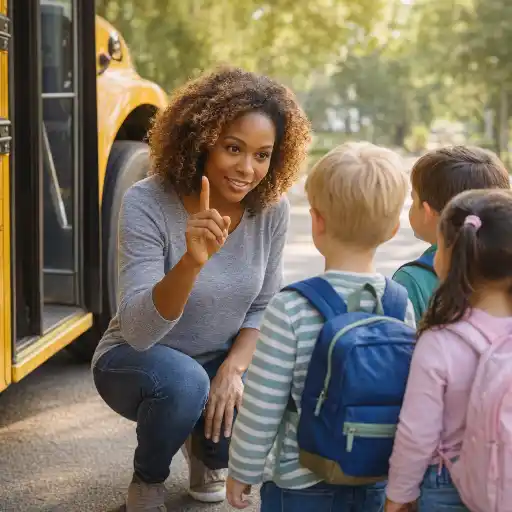
Before the activity, review only a few rules and show the categories. Read or describe one behavior at a time. Ask children to sort it, explain why, and suggest what the person could do instead. For example: “A child waits for the driver’s signal” or “Someone walks behind the bus to retrieve a ball.” Invite children to act out the safe alternative or draw it.
- ✅ Safe: A child waits with an adult away from the curb.
- ⚠️ Unsafe: A child runs toward the bus before it has stopped.
- ✅ Safe: A child tells the driver when an item falls near the bus.
- ⚠️ Unsafe: A child reaches beneath the bus to pick something up.
Notice who can classify a choice, explain the reason, and name an alternative. If children disagree, ask what they noticed and revisit the scenario together. You can repeat the same sort later to see whether explanations become clearer, or ask children to create a new scenario. The activity builds #decisionmaking while showing you what to reteach. For more background, read ChildCareEd’s ideas for teaching bus safety through realistic choices.
How should providers use assessment results to plan next steps?
Use what you observe to decide what children need next—not to rank them. If several children confuse where to wait and when to approach, revisit the sequence with photographs or floor markers. If one child understands the rule but struggles to remember it during transitions, add a consistent visual cue and rehearse with a familiar adult. Revisit the skill briefly before bus travel, after a school break, or when procedures change.
Make the assessment accessible. Offer pictures, gestures, objects, or simple verbal choices; allow children to respond in different ways; and break complex routines into manageable steps. Coordinate with families and relevant team members when a child has an individualized plan, communication needs, mobility needs, or sensory concerns. For some children, the sound, movement, or unpredictability of a bus may make learning harder; a social story, advance familiarization, or predictable transition may help.
Common pitfalls include asking questions that are too abstract, treating silence as lack of knowledge, expecting one demonstration to prove mastery, or using a sort as a substitute for direct supervision. Avoid these by using realistic, age-appropriate prompts, allowing multiple ways to respond, and continuing active adult supervision in real settings. Share observations with transportation staff so children hear consistent guidance.
- 🔎 Note the behavior observed, the support provided, and the next practice opportunity.
- Use specific encouragement to reinforce safe actions without shaming children.
- Confirm program procedures and local rules with the appropriate agencies and transportation partners.
Conclusion: How can you tell whether children understand bus safety?
You can assess children’s understanding by listening to their explanations, watching them demonstrate procedures, and inviting them to sort realistic safe and unsafe choices. Look for children to recognize a situation, explain or show an appropriate response, and identify an adult who can help. A single correct answer is only one piece of evidence; repeated practice in supportive, familiar settings gives a fuller picture.
Keep assessment playful, accessible, and connected to the routines children will encounter. Use discussion to uncover their reasoning, demonstrations to observe action, and a sorting activity to explore choices. Then adapt teaching, offer positive feedback, and coordinate with families and transportation staff. For broader professional learning about supervision, restraints, vehicle operation, and trip planning, consider the Appropriate Precautions in Transportation of Children Buy Now $10.00 course. Center each lesson on #safety, consistent supervision, and practical skills children can use.
- CDA Home Visitor Subject Area 3 Part 3 Birth to 5
- Basic Life Support (BLS) Blended Healthcare Providers
- Children at the Wheel: Emergent Curriculum
- 45 Hour Infant and Toddler Methods and Materials
- Pediatric RSV First Aid & CPR/AED
- CDA Bridge Bundle: Family Child Care without Portfolio Review
- CDA Bridge Bundle: Infant/Toddler without Portfolio Review
- CDA Bridge Bundle: Preschool without Portfolio Review
- CDA Certification en Español: Recursos y Consejos para Educadores Bilingües
- 🚌 ¿Qué Significan las Regulaciones de Transporte de Illinois para las Excursiones Infantiles? 🚦
- Regulaciones de Cuidado Infantil en Maryland para Centros y Hogares de Cuidado Infantil Familiar
- Regulaciones de Licenciamiento de Cuidado Infantil en California para Centros y Hogares de Cuidado Infantil Familiar
- Requisitos de Cuidado Infantil en Nueva Jersey para Centros y Proveedores de Cuidado Infantil Familiar
- Reglas de Cuidado Infantil en Illinois
- Proporciones de Cuidado Infantil y Tamaños de Grupo por Edad en Nueva Jersey (Guía Rápida para Centros y Hogares)
- Proporciones de Cuidado Infantil y Tamaños de Grupo por Edad en Virginia (Guía Rápida para Centros y Hogares)
- Lista para Abrir una Guardería en Casa en Dakota del Norte: Cómo Empezar
- Lista para Guardería en Casa en Illinois: Cómo Iniciar una Guardería en el Hogar
- Cómo Ser Maestra de Preescolar en Illinois
- Las Mejores Ideas de Excursiones para Guarderías en Texas
- Best Daycare Field Trip Ideas in Virginia
- Best Daycare Field Trip Ideas in California
- Canciones, juegos y preguntas de círculo para niños
- How can child care programs keep children safe during transportation?
- Social Studies Activities for Toddlers: Start With Home, Helpers, and Their Little World
- How Can Child Care Providers Teach School Bus Safety Through Realistic Choices?
- How Can Transportation Interests Motivate Beginning Readers?
- How to Check Children’s Understanding of Bus Safety Rules
