Children learn transportation safety most effectively when they can explain what a safe choice looks like—not simply repeat a rule. Pair realistic classroom discussions with ChildCareEd’s Transportation Safety course  Buy Now $16.00 to strengthen staff knowledge about supervision, vehicle hazards, and precautions while earning relevant professional development hours. For a child-centered extension, explore the Appropriate Precautions in Transportation of Children course Buy Now $10.00.
Why do realistic choices make school bus safety easier to learn?
School bus safety involves more than memorizing isolated instructions. Children must make decisions during fast-moving transitions: whether to stand back from the curb, wait for the driver’s signal, remain seated, or tell an adult when an object falls near the bus. Realistic choices allow children to connect a rule with a situation they may actually encounter.
This approach also respects young children as developing problem-solvers. Instead of presenting children as passive recipients of rules, educators invite them to observe, predict, explain, and revise their thinking. A prompt such as “Is this safe or unsafe, and what could the child do instead?” supports language development, self-regulation, social reasoning, and practical #safety knowledge at the same time.
The School Bus Safety: Safe or Unsafe Choices Sort Buy Now $0.49 is especially useful because children can write or draw behaviors in the appropriate category and create their own bus safety rule. The print-and-go format makes it easy to use during a back-to-school lesson, small group, transportation unit, or safety review.
Which bus safety decisions should children practice?
Begin with decisions that are concrete, observable, and connected to the child’s role as a passenger or pedestrian. ChildCareEd transportation guidance recommends standing approximately six feet, or three giant steps, from the curb while waiting. Children should also wait for the bus to stop and the door to open before approaching.
Around the vehicle, children need repeated practice with the danger zone. The area around a bus—often described as approximately ten feet—may be difficult for the driver to see, particularly near the wheels. Children should cross only in front of the bus when directed, make eye contact with the driver, and never walk behind the bus.
- Safe: Standing away from the curb with an adult while waiting.
- Unsafe: Pushing forward as the bus approaches.
- Safe: Waiting for the driver’s signal before crossing.
- Unsafe: Walking behind the bus or reaching beneath it.
- Safe: Using the handrail and keeping backpacks secure.
- Unsafe: Leaving bags in the aisle or allowing straps to hang near the door.
- Safe: Remaining seated and using a restraint when one is available.
Keep language consistent across classrooms, bus monitors, and families. State requirements vary - check your state licensing agency, transportation provider, and local school district for specific procedures.
How can providers turn the choice sort into a meaningful lesson?
Before presenting the cards or prompts, activate children’s prior knowledge. Ask, “What do you notice when a bus arrives?” or “How can we show the driver that we are ready to cross safely?” Avoid beginning with a long lecture. Children are more likely to engage when the conversation starts with their observations and experiences.
Next, introduce one scenario at a time. Invite children to identify whether the behavior is safe or unsafe, explain why, and suggest a safer alternative. Accept partial answers and extend them with precise vocabulary such as curb, handrail, driver, aisle, restraint, signal, and danger zone. For younger children, use gestures, photographs, toy buses, or classroom furniture to represent the bus.
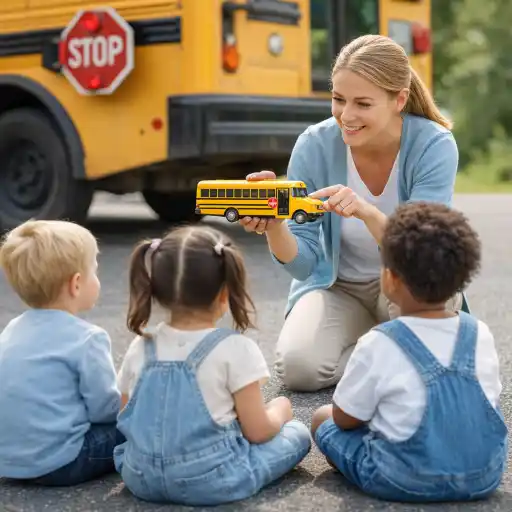
A simple lesson sequence may include:
- Show a behavior card or describe a realistic situation.
- Give children time to think before calling on volunteers.
- Ask children to justify their decision.
- Model the safer choice with your body or classroom materials.
- Invite children to practice or draw the correct behavior.
- Review the rule in the same words used by transportation staff.
Use the activity as a conversation tool rather than a test. The goal is not to identify which children already know the rules; it is to build shared understanding and confidence.
How can realistic scenarios support positive behavior on the bus?
Bus behavior is closely connected to self-regulation, communication, and relationships. Head Start guidance emphasizes predictable routines, clear directions, positive reinforcement, and calm adult responses. When adults describe the expected behavior instead of relying primarily on correction, children receive a usable script for what to do next.
For example, replace “Don’t yell” with “Use a quiet voice so the driver can focus.” Replace “Stop moving” with “Keep your body in your seat while the bus is moving.” These statements identify the safety reason and give children an action they can perform. Specific feedback is equally valuable: “You waited until the driver signaled. That helped everyone cross safely.”
Providers can add role-play scenarios after the sort:
- “Your friend is standing while the bus is moving. What could you say?”
- “Your mitten falls near the bus. What should you do?”
- “The bus is loud and you feel worried. Which adult can help?”
- “Someone is blocking the aisle with a backpack. How can the group solve the problem?”
Never use humiliation, isolation, food, or threats as behavior-management strategies. If a child struggles, repeat the procedure, reduce the language, offer a visual cue, and practice again. Consistent coaching protects dignity while strengthening #supervision and group safety.
How can programs include children with disabilities and sensory needs?
Transportation safety instruction should be accessible, individualized, and coordinated with families. Some children may find a bus loud, crowded, bumpy, or unpredictable. Supports might include a visual schedule, photo story, preferred seat, quiet transition routine, noise-reduction headphones, familiar adult, or advance practice in an empty vehicle. Specialized seating, harnesses, and medical equipment must be used according to the child’s plan and applicable regulations.
- Use photographs, objects, gestures, or symbols instead of text alone.
- Offer two choices before introducing several choices.
- Allow pointing, signing, drawing, or verbal responses.
- Practice one transition at a time and celebrate approximations.
- Teach peers respectful ways to offer space and assistance.
Document agreed supports and ensure every adult knows their role. If a child has an IEP, IFSP, health plan, or transportation safety plan, coordinate instruction with that plan. Inclusion is part of responsible safety planning.
How can directors connect classroom teaching to transportation procedures?
Children benefit when classroom rules match procedures used during arrival, dismissal, and field trips. Directors can create a written protocol identifying supervision positions, head-count points, release procedures, emergency contacts, and communication responsibilities.
- Maintain sight-and-sound supervision during loading, unloading, and transitions.
- Count children before loading, after loading, upon arrival, and before departure.
- Keep attendance records current and document changes immediately.
- Inspect restraints, seating, aisles, and vehicle conditions as required.
- Practice evacuation and danger-zone procedures in developmentally appropriate ways.
- Review incidents and near-misses without blame so procedures improve.
For broader professional learning, Transportation and Field Trip Safety Buy Now $25.00 addresses supervision, passenger restraints, vehicle operation, and field-trip planning.
Conclusion: How can realistic choices build safer bus routines?
Teaching school bus safety through realistic choices helps children move from repeating rules to applying them. Effective lessons are concrete, interactive, repeated, and connected to children’s actual routines. The School Bus Safety: Safe or Unsafe Choices Sort provides a practical starting point: children classify behaviors, explain their reasoning, practice alternatives, and create a rule in their own words.
- Teach observable behaviors such as waiting, boarding, sitting, crossing, and asking for help.
- Use calm, positive language that tells children what to do.
- Practice scenarios through role-play, visuals, and repetition.
- Adapt instruction and transportation plans for individual needs.
- Align classroom learning with written program procedures and staff training.
When children are given meaningful choices and adults provide consistent guidance, transportation becomes a setting for learning, independence, and shared responsibility—not merely a transition. Keep #transportation, #supervision, #decisionmaking, #inclusion, and #safety at the center of every lesson and routine.
Frequently asked questions
How early can children begin learning bus safety?
Children can begin with simple concepts such as stopping, waiting, staying with an adult, and using a handrail. Adjust vocabulary and expectations to developmental level.
Should the activity be used as an assessment?
It can provide informal assessment information, but its primary purpose should be discussion, practice, and reinforcement rather than grading.
What if children give different answers?
Ask them to explain their reasoning, revisit the relevant rule, and model the behavior. Different answers can become productive opportunities for language and safety thinking.
How often should bus safety be reviewed?
Review it before children begin riding, after long breaks, when routines change, and periodically throughout the year.
Where can directors find more training?
ChildCareEd offers Transportation Safety Buy Now $16.00, Appropriate Precautions in Transportation of Children Buy Now $10.00, Transportation and Field Trip Safety Buy Now $25.00, and Active Supervision: A Strategy That Works Buy Now $35.00.
- Basic Health & Safety and Breastfeeding Awareness
- CDA Bridge Bundle: Family Child Care without Portfolio Review
- CDA Bridge Bundle: Infant/Toddler without Portfolio Review
- CDA Bridge Bundle: Preschool without Portfolio Review
- Safe Supervision in Child Care: Birth to School Age
- Texas Director Credential
- Preventative Health and Safety
- Mindful Supervision: Balancing Safety & Independence in Montessori
- Transportation Safety
- CDA Certification en Español: Recursos y Consejos para Educadores Bilingües
- Requisitos Para Ser Maestra Principal En Un Daycare: Lo Que Necesitas Para Empezar
- Capacitación en Salud y Seguridad Preventiva en Línea para Proveedores de Cuidado Infantil
- Regulaciones de Licenciamiento de Cuidado Infantil en California para Centros y Hogares de Cuidado Infantil Familiar
- Normas de Licenciamiento de Cuidado Infantil en Virginia para Centros Diurnos Infantiles y Hogares Diurnos Familiares
- Proporciones de Cuidado Infantil y Tamaños de Grupo por Edad en Maryland (Guía Rápida para Centros y Hogares)
- Proporciones de Cuidado Infantil y Tamaños de Grupo por Edad en Nueva Jersey (Guía Rápida para Centros y Hogares)
- Proporciones de Cuidado Infantil y Tamaños de Grupo por Edad en Virginia (Guía Rápida para Centros y Hogares)
- Lista para Guardería en Casa en Texas: Cómo Iniciar una Guardería en el Hogar
- Cómo Trabajar en el Cuidado Infantil en Carolina del Norte: Requisitos y Pasos
- Cómo Trabajar en el Cuidado Infantil en California: Requisitos y Pasos
- Cómo Trabajar en el Cuidado Infantil en Wisconsin: Requisitos y Pasos
- Cómo Ser Maestra de Preescolar en Maryland
- Capacitación Previa al Servicio para Proveedores de Cuidado Infantil en Maryland
- Capacitación Previa al Servicio para Proveedores de Cuidado Infantil en Georgia
- Capacitación Previa al Servicio para Proveedores de Cuidado Infantil en Virginia
- Cómo Ser Maestra de Preescolar en Virginia
- Canciones, juegos y preguntas de círculo para niños
- Cómo simplificar la capacitación para sus empleados de daycare
- How Can Child Care Providers Teach School Bus Safety Through Realistic Choices?
