Creating clear, child-centered learning goals is a practical skill for directors and providers who want teaching to be purposeful, measurable, and equitable. This article provides step-by-step guidance for designing, implementing, and reviewing individual goals so every child can make meaningful progress and programs can document that growth effectively. You will find practical checklists, strategies for partnering with families, and methods for connecting goals to observation, assessment, intentional instruction, and staff coaching.
Why this matters: goals tailored to each child reduce guesswork, promote equitable learning opportunities, and give educators clear evidence to share with families, administrators, and funders. Strong goals also help staff feel more confident because expectations, teaching strategies, and needed supports are clearly defined. To strengthen these skills, explore ChildCareEd’s Observations and Goal Setting in Childcare  Buy Now $24.00, which explains how to translate observations and assessment information into meaningful short- and long-term goals. Providers can also take Tracking Progress, Shaping Futures: Observation & Assessment Skills Buy Now $55.00 to learn how to document children’s development objectively, identify individual needs, and use assessment results to guide instruction and goal setting. State requirements vary, so always check with your state licensing agency. If you work in New Hampshire, see Meeting New Hampshire’s Needs for Individualized Learning for information about state-accepted H&H Child Care Training courses and resources to support individualized learning.
What core components should every individual learning goal include?
Use a concise template so goals are teachable, observable, and time-limited. The SMART framework (Specific, Measurable, Attainable, Relevant, Time-bound) is widely used in early childhood practice and detailed at ChildCareEd’s SMART guide.
- 🎯 Specific: Name the child, the behavior/skill, and the context. Example: "During circle time, Maya will use two-word phrases to request materials."
- 📏 Measurable: Pick an observable indicator (counts, minutes, frequency, or examples). Example: "3 independent requests in 20 minutes, across 4 of 5 sessions."
- ⚖️ Attainable: Base the goal on current baseline data and realistic steps—scaffolding matters (see scaffolding and individualized learning).
- 🔗 Relevant: Connect to developmental priorities (language, social-emotional, motor skills) or family priorities.
- ⏳ Time-bound: Set review checkpoints (e.g., 4–8 week cycle) to iterate.
Why this works: clear wording reduces interpretation differences across staff and families and makes coaching focused and efficient. For classroom and program examples, consult ChildCareEd’s individualized learning overview.
How do I identify meaningful, measurable starting points for each child?
Begin with systematic observation and brief, purposeful assessment so goals reflect real needs and strengths. Combine naturalistic observation with short, standardized-informed tools when appropriate.
- 🔍 Observe: Take 1–2 weeks of focused notes. Record when the skill happens, what prompts it, and who is present.
- 📸 Document: Use photos, anecdotal notes, and simple checklists. ChildCareEd resources such as the Preschool Weekly Lesson Plan Template and free PDFs can help structure documentation.
- 🧭 Use assessment wisely: Use observational measures or program tools (e.g., DRDP adaptations, described at Desired Results Access Project) rather than relying solely on brief impressions. Commercial options like Pearson’s early childhood tools provide formal options when needed (Pearson).
- 📊 Set a baseline: Translate observations into a concrete baseline statement (e.g., "Child points to needs and waits for adult help 0–1 times per transition").
- 🔁 Prioritize: Choose 1–2 goals per child each cycle so instruction is focused and doable.
Note: choose tools and practices that allow children with diverse needs to show what they know—see the DRDP accessibility guidance for using adaptations and alternative response modes (DRDP accessibility).
How can I write goals that teachers can use and families will support?
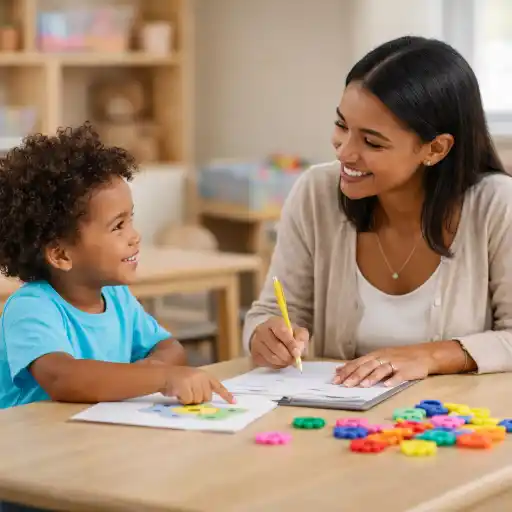
Co-creation builds buy-in. When families understand the goal and see small wins, they become partners. Use plain language and short action steps so teachers and caregivers can easily follow the plan.
- 📝 Draft a 1-sentence goal using this formula: "[Child] will [action] in [context] as measured by [indicator] by [timeframe]." (A template and examples are in ChildCareEd’s SMART goals article: SMART guide.)
- 🤝 Share with families: Use a short, translated form or a one-sentence note at drop-off. Offer strategies families can use at home (modeling phrases, routines, or simple games).
- 📆 Schedule checkpoints: Agree on 2–3 review dates and a communication method (email, journal, quick call). State requirements vary - check your state licensing agency.
- 🔧 Align with supports: If the child has an IEP or IFSP, coordinate with service providers—see guidance on IEP implementation (implementing an IEP).
- 📣 Celebrate: Share brief wins (photos, a sentence in a newsletter) so families see progress and copy strategies at home.
Simple tools—sticker charts, weekly one-sentence notes, or a shared checklist—are powerful. ChildCareEd’s article on teaching goal-setting to preschoolers offers age-appropriate ways to involve children and families (Small Resolutions for Small People).
How do I adapt goals for inclusion and diverse learners?
Equitable goal-setting begins with Universal Design for Learning (UDL) and practical adaptations so each child demonstrates progress in a way that fits their communication and motor abilities.
- 🔁 Offer multiple ways to show the skill: spoken words, gestures, picture selection, or use of a communication device. DRDP guidance explains using alternative response modes and other adaptations (DRDP accessibility).
- 🛠️ Break the goal into scaffolded steps: 1) adult model, 2) child imitation with prompt, 3) child attempt with partial support, 4) independent attempt.
- 🧩 Modify the context rather than the target: keep the same outcome (e.g., expressive language) but change materials or time (shorter, quieter moments) so the child can succeed.
- 📚 Use evidence-informed inclusion practices: consult resources on inclusive planning and behavior supports (see Planning with Purpose and free PDFs on behavior support in the ChildCareEd resources page: Resources).
- 🤝 Partner with specialists: If an IFSP/IEP is present, include service providers in goal-writing and data collection so classroom strategies reinforce therapy goals (IEP guidance).
Practical example: A language goal could allow a child to point to a picture (adaptation) instead of producing the full word while continuing to work toward spoken language. That preserves a meaningful outcome while honoring the child’s current mode of communication.
How do I use goal data to coach staff, show progress, and improve practice?
Use short PD cycles (4–8 weeks), paired coaching, and simple fidelity checks so data drives practice—an approach recommended in ChildCareEd PD materials (SMART guide). Keep tracking low-burden and part of routine.
- 📋 Use a one-page tracking sheet: baseline, target, weekly notes, and a short evidence column (photo, tally, or checklist).
- 👩🏫 Coach with short cycles: 1 observation, 1 focused feedback conversation, 1 modeling visit. Repeat every 4–6 weeks.
- 📈 Review program patterns: aggregate data to spot common needs (e.g., playground transitions, language at routines) and plan staff training.
- 👏 Celebrate wins: highlight staff and child progress in huddles and family notes to maintain momentum.
- 🔄 Iterate: if a goal isn’t met, analyze barriers (time, materials, adult prompts), adjust supports, and set a revised 4–6 week plan.
For assessment-informed planning in specific domains (e.g., science learning), see literature on preschool assessment and learning environments (Assessment for Preschool Science Learning).
Summary — common mistakes and quick FAQ
Common mistakes to avoid:
- ⚠️ Too many goals: Limit to 1–2 per cycle so staff and families can focus.
- ⚠️ Vague wording: Use observable verbs and measurable indicators.
- ⚠️ No follow-up: Pair goals with coaching and checkpoints.
- ⚠️ One-size-fits-all: Adapt response modes and scaffolds for diverse learners.
Quick FAQ:
- Q: How long should a goal cycle last? A: 4–8 weeks is practical for early childhood change.
- Q: Who should write goals? A: Co-create: teacher + coach/director + family (and specialists if present).
- Q: What if a child has an IEP/IFSP? A: Align classroom goals with the IEP/IFSP and include service providers in planning (IEP implementation).
- Q: How to show progress to families? A: Share 1–2 photos or a one-sentence update and a short graph or tally at checkpoints.
Final encouragement: start with one clear, measurable goal this month. Use the SMART template in ChildCareEd’s SMART guide, partner with families, and make small data collection part of everyday routines. You are building a culture of intentional teaching and measurable #development for each child.
- SMART Goals in Coaching & Mentoring
- Family Voices Matter: Tools for Meaningful Collaboration
- Tracking Progress, Shaping Futures: Observation & Assessment Skills
- CDA Bridge Bundle: Family Child Care without Portfolio Review
- CDA Bridge Bundle: Infant/Toddler without Portfolio Review
- CDA Bridge Bundle: Preschool without Portfolio Review
- Early Childhood Education
- Creating Engaging and Meaningful Learning Experiences
- Texas Director Credential
- Exploring ChildCareEd Subscription Options: Empowering Childcare Professionals
- Teaching with Purpose
- Canciones, juegos y preguntas de círculo para niños
- How can assessment results be used to plan meaningful activities in early childhood programs?
- How do I create meaningful individual learning goals for young children?
- How Can I Create Engaging Learning Centers for Preschoolers?
- What Counts as Professional Development for Early Childhood Educators?
- How Can You Tell If an Activity Is Developmentally Appropriate?
- Building a Better Head Start Lesson Plan: 7 Things Every Teacher Should Include
- How to Write a Lesson Plan for Early Childhood Education: Start With the Skill, Not the Craft
- Types of Curriculum in Early Childhood Education: Which Approach Fits Your Classroom Best?
- How Can Child Care Providers Prevent the Isolation of Children with Disabilities?
- How Can Child Care Providers Make Individualized Learning Practical and Inclusive?
- What Is Developmentally Appropriate Practice—and What Does It Look Like?
- ¿Todos los niños deben participar en el tiempo de círculo?
- How Can Preschool Educators Encourage Learning Through Play?
- How Can You Support an After-School Research Project for a Child with an IEP?
- What Should Child Care Providers Prioritize When Preschool Readiness Goals Compete for Time?
- How Can You Plan Staff Training That Engages Experienced Child Care Teachers?
- How Can You Check Whether an AI-Written Learning Objective Is Measurable?
