Play is not a break from learning—it is one of the ways preschoolers investigate ideas, practice skills, and make meaning with others. You can make everyday play more intentional while keeping children’s curiosity and choice at the center; ChildCareEd’s The Best Promotion is Play Buy Now $35.00 offers practical strategies for supporting play in child care, and From Play to Planning: Building Culturally Competent, Child-Centered Curriculum  Buy Now $55.00 can help you connect children’s interests to thoughtful curriculum planning.
Why does learning through play matter in preschool?
For young children, play is a powerful context for active learning. While building, pretending, moving, and experimenting, children make choices, test ideas, notice results, and revise their plans. These experiences can support cognitive, language, physical, social, and emotional development at the same time. A block structure, for example, may involve spatial reasoning, persistence, negotiation, and new vocabulary.
Play also gives educators an authentic view of what children understand and what they are ready to explore next. The goal is not to turn every joyful moment into a lesson. Rather, educators combine meaningful learning intentions with enough freedom for children to lead, wonder, and make discoveries.
This balance matters for equity, too. Every child deserves access to engaging play opportunities, with materials and supports that allow them to participate in ways that suit their strengths, interests, abilities, and language experiences. Providers can protect play while still planning intentionally for development and curriculum goals.
How can educators balance child-led and guided play?
Think of play as a spectrum, not a choice between “no teaching” and direct instruction. During free play, children decide what to do and how to do it. In guided play, an educator prepares an environment or offers a prompt connected to a learning goal, while children retain meaningful choice. A structured game may include clearer rules, but can still be engaging and developmentally appropriate.
For example, if children are building a pretend neighborhood, you might add maps, signs, clipboards, and blocks. Their play can invite literacy, early math, design, and cooperation without requiring everyone to follow a scripted outcome. If a particular concept is a focus, pose a light-touch challenge: “How could people get across this river?” Then pause and let children develop possible solutions.
- Offer open-ended materials that can be used in many ways.
- Keep learning intentions clear to staff, but flexible in how children reach them.
- Use a short prompt or model when it supports the play, then return the lead to children.
- Make room for unstructured play as well as teacher-supported experiences.
How can classroom materials and spaces invite meaningful play?
A well-prepared environment makes it easier for preschoolers to choose, sustain, and extend their play. Organize clear areas for construction, dramatic play, books, art, sensory exploration, and quiet activities. Children benefit when materials are visible, accessible, safe, and easy to return. Picture labels and uncluttered shelves can support independence, including for children who are still learning classroom routines or communicating in more than one language.
Choose materials that invite multiple possibilities rather than one predetermined result: blocks, fabric, boxes, natural objects, drawing tools, pretend food, puppets, and containers for sorting or building. Add print and simple tools where they fit naturally. A pretend café might include menus, order pads, pencils, and play money; a construction area might include photographs of bridges or buildings as inspiration, not as required models.
Children’s interests are a strong starting point. If they are fascinated by rain, offer books, toy animals, measuring cups, and materials for making a “weather station.” If a family or community experience is meaningful to children, consider how it can be represented respectfully in the room.
Review the environment regularly: remove broken or unsuitable items, adapt access as needed, and rotate a few materials when interest changes. State requirements vary - check your state licensing agency for applicable safety and supervision rules.
What can teachers do to extend play without taking it over?
Start by observing. Notice what children are trying to do, the words they use, how they negotiate roles, and where they encounter a problem. A pause before intervening often gives children time to solve the challenge themselves. When support would help, join briefly and respectfully: describe what you notice, introduce a useful word, offer a prop, or ask an open question.
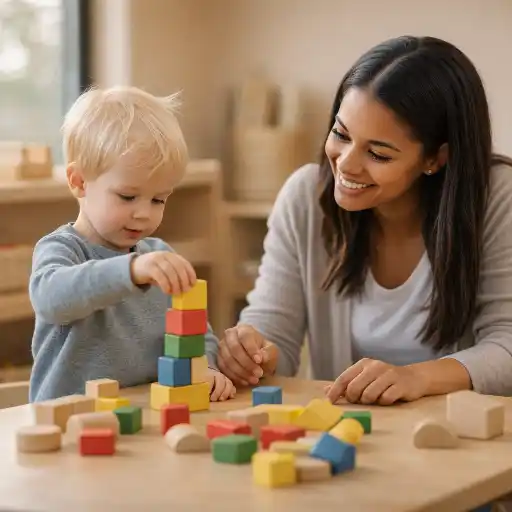
Questions such as “What are you figuring out?” “What might happen if you change the ramp?” or “How could everyone get a turn?” invite thinking without implying there is only one correct answer. Add a new material or a small complication only when it connects with children’s direction. For instance, if children are running a store, adding a sign or a basket of pretend coins may expand counting, writing, and role negotiation.
- 👀 Watch first to understand the play and each child’s participation.
- Use descriptive language: “You tried two shapes to make the roof stay up.”
- Offer support that makes the next step possible, rather than completing the task.
- Step back when children re-engage or begin solving the problem together.
How can play support inclusion, relationships, and learning goals?
Play becomes more equitable when every child has a genuine way to enter, communicate, make choices, and contribute. Consider whether the environment offers physical access, familiar and varied materials, visual supports, and more than one way to participate. Some children may benefit from adapted tools, a quieter play area, extra time, peer support, or an adult modeling a simple entry phrase. Work with families and relevant specialists to understand what helps an individual child engage.
Represent children’s languages, families, cultures, and communities thoughtfully. Include books, props, music, and images that reflect a range of lived experiences, avoiding stereotypes or treating one child as a spokesperson for a culture. In dramatic play, children might use familiar home-language words alongside English, or make signs and menus in more than one language.
To connect play with curriculum, choose a manageable learning intention—such as comparing quantities, telling a story sequence, or practicing turn-taking—and look for authentic opportunities during play. A pretend restaurant might inspire children to count plates, take orders, draw menus, and negotiate roles. The point is integration, not forcing every center to cover every domain every day.
Play can also help children practice emotional and social skills in context. They work through differences, make plans together, and experience the satisfaction of shared ideas. When conflict arises, offer calm coaching and support children in expressing needs and considering solutions, rather than treating every disagreement as a failure.
How should educators observe progress and avoid common pitfalls?
Observation makes play-based teaching intentional without turning play into a test. Choose a small number of goals, then collect brief, objective examples: a child’s words, a strategy they tried, a drawing, or a short note about collaboration. Use what you notice to decide whether to maintain the experience, add a challenge, adjust materials, or offer individual support.
Documentation can also help families see the learning within play. Share a concise example—“During block play, Maya compared the bridge’s length with blocks and worked with a peer to make it sturdier”—rather than relying on broad claims. Invite families to share interests, home experiences, and language resources that might enrich future play.
Common pitfalls are often addressed through small adjustments:
- Over-directing: Offer a prompt or material, then allow children to shape what happens.
- Frequent interruptions: Protect sustained play periods when the schedule allows.
- Too many materials: Select a purposeful, accessible range and rotate thoughtfully.
- Assuming all children play the same way: Recognize different communication styles, interests, abilities, and cultural experiences.
- Documenting without a purpose: Link observations to a next step or a family conversation.
Conclusion: How can you make learning through play part of every day?
Encouraging learning through play means creating welcoming spaces, offering open-ended materials, protecting children’s choices, and guiding with a light, intentional touch. Free play, guided play, and structured games can all contribute when they are meaningful, inclusive, and responsive to preschoolers’ development. The educator’s work is not to control every moment, but to observe carefully, notice learning, and prepare experiences that invite children to think, communicate, create, and collaborate.
Begin with one practical change: extend a play period, add a few purposeful materials to a center, or observe one child and use that observation to plan a next step. Share specific examples with families and colleagues. These steady choices help make play a valued part of the curriculum—and affirm the curiosity and capability children bring to learning each day.
For professional learning related to the strategies in this article, explore these English-language ChildCareEd courses:
- The Best Promotion is Play Buy Now $35.00 — strategies for supporting play in child care.
- From Play to Planning: Building Culturally Competent, Child-Centered Curriculum Buy Now $55.00 — planning, scaffolding, and inclusive curriculum.
- Early Mathematics Through Play Buy Now $24.00 — practical ways to weave early math into play and routines.
- Play with Purpose: Supporting Children with Autism Buy Now
$55.00$40.00 — play-based strategies for inclusion and engagement. - Preschool Assessments & Observations Buy Now $24.00 — objective observation and developmentally appropriate assessment.
- 45 Hour Child Growth and Development
- CDA Preschool Credential
- CDA Preschool Credential with Portfolio Review
- Birth to Five CDA Credential with Portfolio Review
- CDA Bridge Bundle: Preschool
- Pediatric RSV First Aid & CPR/AED
- CDA Infant/Toddler Credential with Portfolio Review
- CDA Bridge Bundle: Preschool without Portfolio Review
- Texas Director Credential
- Bye Bye Winter: The Role of Outdoor Play in Early Childhood Development
- The Power of Play
- Building Social Foundations
- Tiny Tinkerers: How Messy Play Today Could Lead to Tomorrow’s Top Inventors
- Tiny Hands, Big Dreams: Fostering Creativity in Preschoolers
- Frosty Fun: Trauma-Informed Play for Resilient Young Learners
- How motor skills shape child development and creative ways educators can foster them.
- CDA Certification en Español: Recursos y Consejos para Educadores Bilingües
- 🎈 Better Together: Why Little Friends Make a Big Difference in Early Childhood
- 🌲Leading the Way: How Directors & Administrators Shape Early Learning in Oregon
- STEM for Preschoolers: Fun Activities That Encourage Curiosity
- How Can Child Care Providers Support Preschool Development?
- How Can Task Cards Encourage Independent Learning?
- How Can You Set Up Learning Centers in a Preschool Classroom?
- How Can Educators Help Children Negotiate When Pretend-Play Rules Change Midgame?
- What Learning Centers Should Every Preschool Classroom Have?
