Every child deserves more than physical access to a classroom—they deserve genuine belonging, friendships, and meaningful participation. This guide offers practical ways to notice social exclusion, redesign routines, and build peer connections; for deeper preparation, explore Building Equity: Inclusionary Practices in Preschool  Buy Now $10.00 to strengthen daily inclusive teaching practices and support professional learning goals.
Why does preventing isolation matter in early childhood?
Isolation is not always obvious. A child may be present during circle time yet remain disconnected from the conversation, or sit near peers without entering their play. Repeated experiences of being overlooked can affect confidence, communication, emotional regulation, and willingness to participate. Research on inclusive early childhood settings connects peer relationships and acceptance with children’s broader social and academic adjustment. The federal 2023 policy statement on inclusion likewise emphasizes that children with disabilities should participate alongside peers with individualized and appropriate supports.
Prevention is therefore more than placing children in the same room. It means intentionally creating opportunities for shared activity, mutual influence, and recognition. The goal is not to make a child appear typical; it is to remove barriers while honoring communication, movement, sensory, and learning differences.
Begin with a strengths-based question: What does this child enjoy, notice, communicate, and contribute? Those answers can guide authentic connections. A child who loves wheels may connect through vehicles; a child who communicates with gestures may initiate a game through movement. Belonging grows when adults recognize these contributions as meaningful.
How can educators recognize early signs of social isolation?
Careful observation helps staff distinguish preference for solitude from exclusion. Some children need quiet time or observe before joining. Others want connection but lack the communication, motor, sensory, or play skills needed to enter a group. Adults should look for patterns across activities rather than drawing conclusions from one moment.
- Does the child approach peers but receive few responses?
- Are the child’s gestures, eye gaze, sounds, or movements being missed?
- Does the child participate more successfully with an adult than with peers?
- Do transitions, noise, or unclear rules limit access to play?
- Are peers consistently choosing one another while leaving this child out?
Document objective details: what happened before the interaction, the child’s initiative, peer and adult responses, and what followed. Research on peer interaction cautions that subtle, nonverbal initiatives—especially those made by children with special educational needs—can be overlooked. Recording these moments can reveal that a child is attempting to connect even when the attempt does not resemble conventional speech.
Also consider language and culture. Children learning English may watch silently, use their home language, or appear withdrawn while processing a new language.
How can the environment make peer participation easier?
The physical and social environment can either invite connection or quietly create barriers. Review the room from the child’s perspective. Can every child reach popular materials? Are pathways wide enough for mobility devices? Is there a place to regulate without being removed from the group? Are activity instructions understandable through pictures, gestures, objects, or demonstrations?
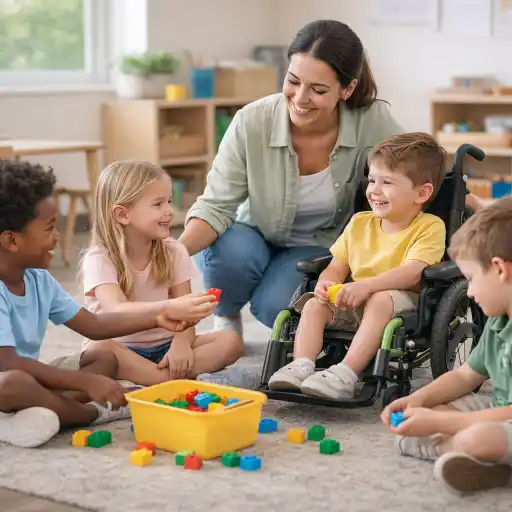 Use universal supports so accommodations do not single out one child. A visual schedule, choice board, communication cards, flexible seating, and a quiet area can benefit many children. The Tennessee inclusion resource describes how visual schedules, calming areas, accessible routes, and adapted materials can increase participation.
- 🧩 Arrange materials so children can approach, select, and return them independently.
- Offer multiple ways to respond: pointing, signing, speaking, moving, drawing, or using AAC.
- Place highly engaging activities in small-group areas where interaction is likely.
- Provide duplicates or turn-taking supports when sharing one item creates frustration.
- Use predictable routines and transition warnings to reduce uncertainty.
Design activities with interdependence rather than parallel isolation. For example, one child can hold the paper while another paints, or children can contribute different sounds to a group song. Each role should be authentic, not a decorative assignment. Check accessibility continuously; state requirements vary - check your state licensing agency.
How can adults scaffold friendships without taking over?
Adults are often the bridge between a child’s initiative and a peer’s response. Effective scaffolding is responsive and temporary: notice an attempt, interpret it respectfully, and help peers understand how to respond. If a child reaches toward a block structure, an educator might say, “Jordan wants the long block. Can you pass one?” Then pause so the children, rather than the adult, carry the interaction forward.
Teach peers concrete inclusion skills. Model phrases such as “You can play with us,” “Your turn,” and “Do you want red or blue?” Demonstrate how to wait, watch communication signals, offer choices, and accept different ways of participating. Avoid assigning one child as a permanent helper; friendships should be reciprocal and varied.
Play is a powerful context because it offers shared purpose. Pair children by interest, not simply by ability, and begin with brief, structured activities. Adults can:
- join a child’s preferred play without redirecting immediately;
- imitate the child’s actions to communicate interest;
- add one simple social opportunity, such as passing, copying, or choosing;
- expand successful exchanges gradually;
- fade prompts when peers begin responding independently.
The literature review on friendship development identifies mutual liking and shared time as important features of friendship. Therefore, measure more than compliance or proximity. Notice whether children seek one another, share enjoyment, remember each other’s preferences, and continue playing together over time.
How should programs partner with families and specialists?
Families bring essential knowledge about a child’s interests, communication, sensory profile, culture, and existing relationships. Begin conversations with strengths: “When does your child seem most connected?” and “What does your child do to invite someone to play?” Ask what words, gestures, objects, or routines are familiar at home. With permission, incorporate those approaches into the classroom.
Specialists can help teams adapt communication systems, motor access, sensory supports, and play goals. Collaboration works best when it occurs in ordinary routines rather than only during formal meetings. A speech-language pathologist might model how peers can respond to AAC; an occupational therapist might suggest an accessible table arrangement; an early interventionist might help embed goals into block play or snack.
Create a brief shared plan:
- one participation goal;
- two strategies adults will use consistently;
- one way peers can participate naturally;
- a simple observation method;
- a date to review progress with the family.
Respect privacy and clarify roles. Educators implement agreed supports and document participation; they do not diagnose. The ChildCareEd family engagement resource offers complementary ideas for two-way communication, shared goals, and culturally responsive partnerships. For additional professional learning, Family Voices Matter: Tools for Meaningful Collaboration Buy Now $55.00 can help providers strengthen family-centered planning and communication.
What common mistakes can programs avoid?
Well-intentioned practices can still isolate children when they focus on appearance rather than participation. One common mistake is assuming that physical proximity equals inclusion. A child may be seated with peers yet have no meaningful role. Another is speaking for the child too quickly, which can prevent peers from learning how to notice and respond to the child’s own communication.
Programs should also avoid making every interaction adult-directed. Constant prompting may produce short-term participation but can limit autonomy and authentic friendship. Instead, use the least intrusive support that works, wait for responses, and gradually step back.
Additional pitfalls include:
- using diagnosis-based assumptions instead of observing individual strengths;
- removing a child from peer activities whenever behavior becomes difficult;
- treating sensory breaks as punishment or permanent separation;
- asking peers to “help” without teaching mutual respect and consent;
- measuring success only by speech, eye contact, or conventional play;
- failing to examine whether adult bias or inaccessible routines contribute to exclusion.
Positive guidance should teach skills and preserve belonging. Federal child care guidance recommends preventive supports and states that suspension, expulsion, or denial of services should be eliminated or severely limited, with safety decisions based on actual risk and objective evidence. When a serious concern arises, use a team-based plan that includes reasonable modifications, family input, documentation, and consultation.
Staff reflection matters. Ask: Whose initiatives do we notice? Who receives invitations? Who gets interrupted? Which children are expected to adapt? These questions turn inclusion into an ongoing program responsibility.
Conclusion: How can child care providers make belonging routine?
Preventing isolation requires intentional design, responsive adults, welcoming peers, and sustained partnership with families. Observe subtle communication, adapt the environment, create shared purposes in play, teach peers how to include, and measure authentic relationships rather than simple proximity.
A practical starting plan is small: choose one routine, identify one barrier, add one support, and observe what changes. Celebrate meaningful progress—a child returning to a peer, a gesture being understood, a shared laugh, or a friend being sought out. These moments show that inclusion is becoming relational rather than merely physical.
For directors, build these practices into staff meetings, onboarding, classroom observation, and individual support plans. For educators, remember that you do not have to create perfect connections immediately. Consistent, respectful responses help children learn that their communication matters and that the group has room for them.
- CDA Home Visitor Subject Area 3 Part 3 Birth to 5
- Beyond the Classroom: Connecting Families to Essential Services
- From Play to Planning: Building Culturally Competent, Child-Centered Curriculum
- Birth to Five CDA Credential with Portfolio Review
- CDA Bridge Bundle: Family Child Care without Portfolio Review
- CDA Bridge Bundle: Infant/Toddler without Portfolio Review
- CDA Bridge Bundle: Preschool without Portfolio Review
- Texas Director Credential
- Access for All: Inclusion and the ADA
- Every Moment Matters: Schedules and Transitions
- CDA Certification en Español: Recursos y Consejos para Educadores Bilingües
- Capacitación en Salud y Seguridad Preventiva en Línea para Proveedores de Cuidado Infantil
- Proporciones de Cuidado Infantil y Tamaños de Grupo por Edad en Maryland (Guía Rápida para Centros y Hogares)
- Proporciones de Cuidado Infantil y Tamaños de Grupo por Edad en Nueva Jersey (Guía Rápida para Centros y Hogares)
- Proporciones de Cuidado Infantil y Tamaños de Grupo por Edad en Virginia (Guía Rápida para Centros y Hogares)
- Lista para Guardería en Casa en Illinois: Cómo Iniciar una Guardería en el Hogar
- How can Michigan child care providers protect children now that measles is back in 2026?
- How can North Dakota child care providers protect children now that measles is back in 2026?
- How Can New York Child Care Providers Protect Children Now That Measles Is Back in 2026?
- How should Michigan child care providers watch for measles this summer?
- How should New York child care providers respond to a measles exposure?
- How can childcare settings prevent the spread of illness?
- How Do You Choose 10 Books for Your CDA Bibliography? Examples by Topic
- Including Every Child: What Child Care Providers Should Know About the ADA
- How Can Child Care Providers Prevent the Isolation of Children with Disabilities?
- How Can Child Care Providers Respond When Children Exclude Others From Play?
- How Can Educators Use Emergent Curriculum and Project-Based Learning Effectively?
- How Can Providers Teach Children to Notice When a Friend Needs Space?
