Toddlers want to participate, contribute, and hear, “You can do it!” Thoughtfully designed classroom jobs turn that desire into daily practice with responsibility, #confidence, and belonging. To strengthen your team’s approach, explore Supporting Children’s Independence  Buy Now $24.00 for practical strategies that can improve classroom practices and provide relevant professional training.
Why do classroom jobs matter for toddlers?
A toddler’s small contribution can carry enormous emotional meaning. Returning one block, carrying a washcloth, or placing a cup on the table communicates that the child is a valued member of the group. Research and professional guidance consistently connect meaningful responsibilities with emerging self-direction, executive function, social competence, and self-esteem.
Classroom jobs also make learning visible. A toddler who waters a plant is coordinating movement, following a sequence, and noticing the needs of something living. A child who helps collect books is practicing memory, categorization, cooperation, and care for shared materials. These experiences are not merely chores; they are integrated learning opportunities.
NAEYC describes daily routines and transitions as essential elements of supportive early learning environments. When toddlers participate in those routines, they are more likely to experience the classroom as predictable and manageable. Predictability reduces unnecessary waiting and adult direction, while repeated success builds the internal message, “I am capable.”
For directors, classroom jobs can support smoother transitions and a stronger community culture. However, the goal should never be adult convenience alone. The job must be developmentally appropriate, relationally supported, and meaningful to the child.
Which classroom jobs are appropriate for toddlers?
Toddler jobs should be brief, concrete, safe, and connected to a real classroom need. Choose responsibilities that require one or two steps at first. Children may need modeling, physical guidance, or a visual cue, and that support should gradually fade as competence grows.
- 🧺 Clean-up helper: Places one or two toys in a labeled basket.
- Book helper: Carries a book to the reading area or places it on a low shelf.
- Napkin helper: Delivers napkins to one or two peers with adult supervision.
- Plant helper: Uses a small watering tool while an educator controls the amount of water.
- Table helper: Carries a lightweight cloth and wipes a small, clearly defined area.
- Door or transition helper: Walks near the teacher and helps carry a visual transition card.
- Music helper: Chooses between two songs or helps put away a simple instrument.
Jobs should be adapted for mobility, sensory, communication, and attention differences. A child who does not use spoken language can still participate by matching a picture, handing over an object, pointing to the next step, or using a gesture. The resource Classroom Jobs offers additional ideas for connecting responsibilities with developmental goals.
Safety remains central. Avoid jobs involving hot liquids, cleaning chemicals, sharp tools, heavy objects, or unsupervised access to doors and food. State requirements vary - check your state licensing agency.
How should educators introduce and scaffold a toddler job?
Effective implementation begins with a calm, enthusiastic demonstration. Get down to the child’s level, name the job, and perform the task slowly. For example: “You are the book helper. First, pick up the book. Next, put it on the shelf.” Use gestures and photographs whenever possible.
- Choose one small task with a clear beginning and ending.
- Model the task without rushing.
- Invite the child to try one step.
- Offer the least assistance necessary.
- Pause long enough for the child to process and respond.
- Describe the child’s effort and contribution.
Specific language is more powerful than generic praise. Try, “You carried the cloth carefully,” or “You put the block in the basket and made space for your friend.” This narration helps toddlers connect action, effort, and outcome. It also models the self-talk that supports planning and self-regulation.
When a child struggles, reduce the task rather than taking over immediately. If placing three toys in a bin is too difficult, begin with one. If pouring is unsafe or frustrating, let the child carry the empty cup while the adult pours. The objective is not perfect performance; it is participation with growing agency.
Educators should also validate refusal. “You do not want to do that job right now. You can carry the book or help with the cloth.” Offering two acceptable choices preserves boundaries while supporting autonomy.
How do classroom jobs build confidence and social-emotional skills?
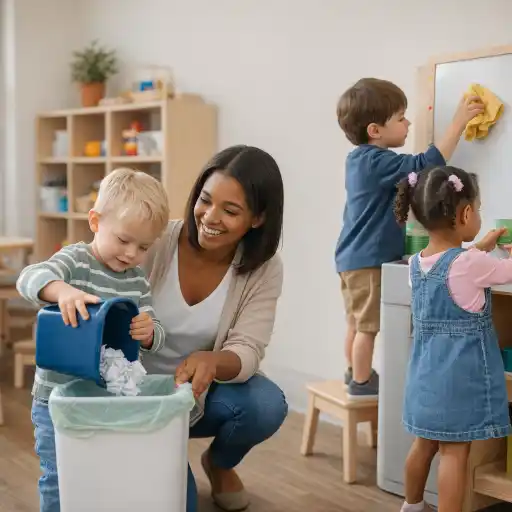
Confidence develops through repeated experiences of mastery within supportive relationships. A toddler does not need a large public role to feel competent. Completing a small responsibility, receiving genuine acknowledgment, and trying again the next day can gradually strengthen self-efficacy.
Jobs also create opportunities for toddlers to practice social participation. A snack helper may wait while a peer receives a napkin. A clean-up helper may work beside another child. A plant helper may learn that classroom materials and living things require gentle care. These moments support turn-taking, empathy, cooperation, and early #responsibility.
Adults shape the emotional meaning of the experience. If educators correct every movement or redo the task immediately, children may learn that helping is risky or that adults do not trust their abilities. If adults ignore safety and allow frustration to escalate, children may experience the job as overwhelming. The strongest approach combines warmth, clear limits, and appropriately calibrated support.
Classroom jobs can also help children who are quiet, new to the program, learning more than one language, or hesitant during group activities. A predictable role offers an authentic reason to engage without demanding extended verbal performance. Teachers can pair words with gestures, home-language labels, photographs, or peer modeling so every child can experience belonging.
Remember that confidence is not the same as being loud or compliant. A child who quietly returns a puzzle, makes a choice, or asks for help is demonstrating meaningful growth.
How can directors create an equitable and sustainable job system?
A successful system must be simple enough for staff to maintain and flexible enough to honor individual children. Begin with three to five jobs per classroom rather than creating a long list. Assign jobs during a predictable part of the day, such as morning meeting, and use photographs or symbols so toddlers can recognize their roles.
- Rotate jobs frequently, while allowing a child enough time to become familiar with the routine.
- Ensure that every child receives meaningful participation, not only the most verbal or compliant children.
- Offer alternative versions of the same job for different abilities and interests.
- Use child-sized, accessible materials and clearly marked storage locations.
- Align staff language so children receive consistent prompts and encouragement.
- Document brief observations rather than grading performance.
Directors can support implementation by modeling the practice during staff meetings, observing whether jobs are genuinely child-directed, and discussing adaptations. The course Environments That Inspire Independence and Exploration Buy Now $55.00 can help providers consider how room arrangement, accessibility, and inclusion influence children’s opportunities to participate.
Common mistakes include assigning jobs that are too complex, rotating so quickly that children cannot learn the routine, using responsibilities as rewards for “good behavior,” or allowing one child to dominate preferred roles. Correct these issues through visual choices, predictable rotation, and a strengths-based view of participation.
Family communication adds continuity. Ask caregivers what tasks the child enjoys at home and share one classroom responsibility the family can reinforce, such as placing shoes in a basket or carrying a napkin to the table.
How can teachers evaluate progress without turning jobs into tests?
Observation is the most appropriate form of assessment. Rather than asking whether a toddler “can” or “cannot” do a job, record the conditions under which participation occurs. Useful questions include:
- Does the child approach the job independently, after a cue, or only with full assistance?
- How many steps can the child complete?
- What communication does the child use to accept, refuse, or request help?
- How does the child respond when the task does not go as planned?
- Does the child notice and respond to peers or shared materials?
A short note might say: “After seeing the photo cue, Maya carried the cloth to the table, wiped twice, and returned it to the basket. She smiled when a peer joined her.” Such documentation captures development more accurately than a sticker or compliance score.
Use observations to adjust the environment and adult support. If children frequently wait for help, move materials closer. If a job creates conflict, add duplicate tools or assign two complementary roles. If a child avoids a sensory experience, provide gloves, a dry alternative, or a different responsibility that meets the same developmental goal.
Reflection should include children’s feelings. Toddlers may be disappointed when a preferred job ends. Acknowledge the emotion: “You wanted to water today. You feel sad. Tomorrow we can check the job picture again.” This teaches that disappointment can be expressed safely and managed with support.
Progress may appear as greater initiative, persistence, communication, flexibility, or willingness to participate—not just faster completion. Share these specific observations with families to celebrate growth and build consistent expectations across settings.
Conclusion: How do classroom jobs build responsibility and confidence in toddlers?
Classroom jobs build responsibility and confidence by giving toddlers repeated, meaningful opportunities to contribute, make choices, practice skills, and experience success. The most effective jobs are brief, safe, visible, inclusive, and embedded in everyday routines rather than treated as extra work.
Start with one task this week. Model it, offer limited choices, step back thoughtfully, and describe the child’s effort. Observe what support helps the child participate, then refine the environment and expectations. Over time, these small moments help toddlers develop #independence, self-regulation, communication, cooperation, and a durable belief that their actions matter.
For additional professional learning, consider Ways to Serve: Leadership Buy Now $24.00, which offers strategies for nurturing initiative and leadership in young children, alongside the independence and environment courses linked above.
Frequently asked questions
- How young can children be when classroom jobs begin?
Toddlers can participate in very simple responsibilities, such as placing one toy in a basket or carrying a cloth, with close supervision and adult modeling. - What if a toddler refuses a job?
Respect the refusal, offer two alternatives, reduce the task, or try again later. Participation should be encouraged, not forced. - How often should jobs rotate?
Rotation depends on the group. Toddlers may need several days or a week to become familiar with a job, while still receiving occasional choices among roles. - Should jobs be used to manage challenging behavior?
Jobs can increase belonging and engagement, but they should not be rewards or punishments. Every child should have access to meaningful participation. - How can jobs support children with disabilities?
Break tasks into smaller steps, use visual or tactile cues, adapt tools, offer communication choices, and select roles that build on each child’s strengths.
- 45 Hour Child Growth and Development
- Easy Steps to Resume and Interview Success
- The ABCs of Behavior: Turning Challenges into Learning Opportunities
- Setting the Stage: Story Time
- Texas Director Credential
- Building Bridges for Dual Language Learners
- 45 hour Growth and Development Birth-age 12 ONLINE
- Enhancing STEM Education for Infants and Toddlers
- Equity-Centered Communication in ECE
- 👶 ¿Cuáles son las proporciones y grupos requeridos en Dakota del Norte? 🏫
- Recursos en Español sobre el Sueño Seguro del Bebé
- Apoyo en Español para Capacitaciones Grupales Presenciales y por Zoom en Cursos Selectos
- Que es Título 22 en California?
- ¿Cuáles son los pasos, requisitos y opciones en línea para la certificación de 90 horas en cuidado de Infantes/Toddlers en Maryland?
- Capacitación en Salud y Seguridad Preventiva en Línea para Proveedores de Cuidado Infantil
- Proporciones de Cuidado Infantil y Tamaños de Grupo por Edad en Virginia (Guía Rápida para Centros y Hogares)
- Lista para Guardería en Casa en Illinois: Cómo Iniciar una Guardería en el Hogar
- Lista para Guardería en Casa en Texas: Cómo Iniciar una Guardería en el Hogar
- Retraso del Habla en la Guardería: Cómo Pueden Ayudar los Proveedores
- Cómo Ser Maestra de Preescolar en Maryland
- Capacitación Previa al Servicio para Proveedores de Cuidado Infantil en Dakota del Norte
- Superhero Theme Activities for Preschool and Child Care
- Cómo simplificar la capacitación para sus empleados de daycare
- How can childcare programs encourage independence and responsibility in young children?
- How Do Classroom Jobs Build Responsibility and Confidence in Toddlers?
- How Can Toddlers Contribute to Classroom Jobs Without Turning Them into Rewards?
- How Can You Choose Classroom Jobs a Toddler Is Ready to Try?
- What Are Developmentally Appropriate Ways to Teach Classroom Responsibilities?
- How Can Toddler Classroom Jobs Build Early Math Beyond Counting?
