Classroom jobs can help toddlers feel capable and connected—but only when every child has a meaningful way to take part. Explore practical strategies for adapting responsibilities to children’s strengths, communication, mobility, sensory preferences, and developmental needs, and consider ChildCareEd’s CDA Infants/Toddlers: Individualized Learning and Inclusion  Buy Now $16.00 for focused professional learning on individualized, inclusive practice. This course can deepen your understanding of how to notice children’s needs and build a classroom where participation is genuinely accessible.
For a visual starting point, try ChildCareEd’s Make Classroom Jobs Fun: Toddler Classroom Helper Chart Buy Now $1.99. Its familiar helper roles can make daily routines easier to anticipate; thoughtful adaptation helps each toddler participate in a way that is safe, meaningful, and their own.
Why do inclusive classroom jobs matter for toddlers?
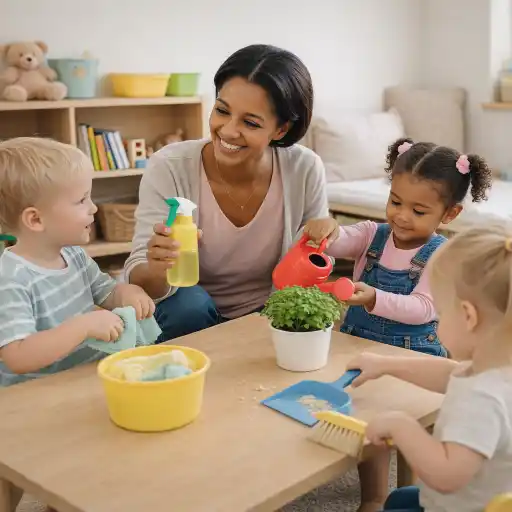
A toddler returning a book, carrying a light cloth, or placing a toy in a basket is doing more than helping tidy the room. The child is practicing a sequence, coordinating movement, communicating choices, and experiencing a contribution to the group. These small experiences can support growing #independence, confidence, and belonging—especially when adults recognize effort rather than expecting a polished result.
Inclusion means more than assigning every child the same task. It means creating access, supporting participation, and adjusting help so each child can contribute meaningfully. NAEYC’s discussion of inclusion in infant and toddler settings emphasizes planning around children’s strengths and needs, with families and other partners as resources. A child may participate by speaking, pointing, using a picture, moving an item, or directing an adult; these are different routes to real participation.
Jobs are not tests of obedience or a way to shift adult responsibilities onto toddlers. They should be brief, voluntary in spirit, developmentally appropriate, and connected to a real classroom routine. A child who declines today still belongs in the classroom community.
How can you choose a job that fits each child?
Start with observation rather than assumptions about age, diagnosis, or what a child “should” be able to do. Notice which materials attract the toddler, how they communicate interest or refusal, what movements feel comfortable, and how they respond to one-step directions. Individualization focuses on the child in context: the task, materials, environment, timing, and available support all matter.
Choose a job with a clear beginning and finish, one or two simple actions, and a safe, visible outcome. If “clean up the room” feels too broad, invite the child to put one large block in a nearby basket. A child who loves books might carry a sturdy book to a low shelf; a child who enjoys music might choose between two songs or help put away a simple instrument.
- Match the task to interests and current skills, while leaving room for practice.
- Check that materials and destinations are reachable and safe for the child.
- Offer choices among roles, including a seated or low-movement option.
- Notice readiness in context: a child may need different support on different days.
Use ChildCareEd’s Toddler Classroom Helper Chart Buy Now $1.99 as a menu, not a fixed assignment list. Adapt each role to the child rather than expecting every toddler to perform it in the same way.
What adaptations make jobs accessible across abilities?
Adjust the environment, materials, directions, and timing before deciding that a child cannot do a job. A lower shelf, open basket, stable container, larger handle, or non-slip surface may remove a physical barrier. A picture or photograph placed near the materials can show where an item goes. Keep the room’s pathways clear and ensure that the child can approach the task safely.
Communication should not depend on spoken words alone. Pair a short phrase with a gesture, object, or visual cue. Invite children to show a choice by pointing, looking, signing, handing over a picture, using an assistive communication device, or moving toward a material. For a child who benefits from additional processing time, give one direction, pause, and allow a response without rushing in.
- For fine-motor differences, use larger, easy-to-grasp materials or reduce the number of items to carry.
- For mobility differences, place materials within reach or offer a role completed from a stable seated position.
- For sensory preferences, offer a dry cloth instead of a wet task, or a quieter role away from a busy transition.
- For language or attention needs, show one step at a time using a photo, demonstration, or familiar phrase.
- For social participation, let two toddlers share complementary roles with adult support.
🌟 A child who chooses the song, points to the cleanup picture, or hands an item to an educator is contributing. The goal stays shared; the route into the task can vary.
How should educators introduce and support a job?
Introduce a responsibility during a familiar, unhurried routine. Get down to the toddler’s level, name the role in a few words, and demonstrate the action: “Book helper. Pick up the book. Put it here.” A picture cue or gesture can make the invitation clearer. Then wait. Toddlers need time to understand, shift attention, and decide whether to participate.
Offer the least intrusive support that makes the task accessible. You might move the basket closer, point to the destination, model one step, or steady an object. Avoid doing the whole job for the child when a small adjustment would allow them to act. If frustration appears, simplify the task, change the materials, or offer a different role. Support should never become force; acknowledge a refusal and leave room to try another time.
- Choose a safe, concrete task connected to a real routine.
- Prepare accessible materials and demonstrate the action slowly.
- Invite the child to try, then pause before adding another cue.
- Describe the contribution: “You put the book on the low shelf.”
- Offer another opportunity or role if the child declines or needs a break.
Use descriptive acknowledgment rather than ranking children or promising a prize. “You carried the cloth to the table” names what happened and helps the toddler connect their action with the shared routine. Keep close supervision, particularly during transitions, meals, and tasks involving materials that require adult oversight.
How can teams and families keep the system equitable and safe?
A consistent approach helps toddlers understand what to expect, while flexibility ensures that consistency does not become sameness. Staff can agree on a few accessible roles, predictable visual cues, and shared language for inviting participation. Rotate opportunities thoughtfully, but allow children enough repetition to become familiar with a task. Avoid making a chart a public ranking or offering preferred roles only to children who are verbal, quick, or eager to please.
Families can share information about a child’s interests, communication, home-language words, and approaches that work in familiar routines. Ask open questions such as, “What does your child enjoy helping with?” When a child has an IFSP or IEP, collaborate with the family and relevant professionals, follow applicable plans, and clarify classroom strategies as needed. Protect private information and share it only with staff who need it to support the child.
Keep toddlers away from cleaning chemicals, sharp or heavy tools, hot liquids, and unsupervised access to doors, food, or animals. Child participation does not replace adult sanitation, food-safety, or supervision responsibilities. State requirements vary - check your state licensing agency.
Directors can support staff with time to plan, focused professional learning, and brief reflection. ChildCareEd’s Playful Learning: Infant & Toddler Activities Buy Now $25.00 offers a related opportunity to explore planning experiences for children’s ages and abilities, while Supporting Children’s Independence Buy Now $24.00 focuses on fostering autonomy and self-regulation. For broader inclusion strategies, consider Recognize, Respond, Respect: Supporting Diverse Learners Buy Now $55.00.
How can you tell whether a job is working?
Evaluate the task and supports—not the child’s worth, compliance, or speed. Brief, objective observations help a team see which parts are accessible and what adjustment could help next. Record what happened in context: “After seeing the photo, Lee carried one book to the low shelf; the basket was too far away for the next step.” This points to a practical change without labeling the child.
Notice more than task completion. A child may show progress by approaching the materials, making a choice, communicating no, asking for help, completing one step, or joining a peer. These actions matter because they show agency and engagement. If the child seems overwhelmed, revisit the task’s sensory demands, number of steps, materials, timing, and adult prompts.
- Did the child understand the invitation through the cues provided?
- Could the child reach and use the materials comfortably?
- What form of communication or assistance supported participation?
- Was the task safe, brief, and meaningful to the child?
- What one adjustment could make the next opportunity more accessible?
Common pitfalls include expecting identical performance, prompting so quickly that a toddler has no time to respond, and treating helping as a reward or behavior test. Instead, start with one manageable adjustment, give the child time, and share observations with the team. Small, responsive changes can make a familiar routine more welcoming for many children.
Conclusion: What is the key to adapting toddler classroom jobs?
Adapt toddler classroom jobs by matching the responsibility to each child’s interests and current abilities, removing barriers in the environment, offering more than one way to communicate and participate, and providing support without taking over. The job chart can prompt ideas, but thoughtful observation and respectful relationships make the roles inclusive.
Begin with one routine this week. Choose a safe, concrete job, identify a possible barrier, and try one adjustment—perhaps a visual cue, a reachable basket, a simplified step, or a quieter option. Notice how the child responds and adjust with the family and team as needed. When every toddler has a meaningful way to contribute, classroom jobs become everyday opportunities for #belonging, confidence, participation, and growing independence.
- Beyond the Classroom: Connecting Families to Essential Services
- Easy Steps to Resume and Interview Success
- Planning for Every Child: Responsive Strategies in Action
- From Play to Planning: Building Culturally Competent, Child-Centered Curriculum
- Birth to Five CDA Credential with Portfolio Review
- Pediatric RSV First Aid & CPR/AED
- Effective Approaches for Autism and Inclusion
- 45-Hour Infant and Toddler Curriculum
- Creating Engaging and Meaningful Learning Experiences
- Texas Director Credential
- 💛🧩 ¿Cómo puedo hacer que mi enseñanza sea inclusiva para los niños con autismo?
- 😫🧸 ¿Qué hacer cuando un bebé no quiere dormir la siesta en el aula?
- Recursos en Español sobre el Sueño Seguro del Bebé
- 10 Ejemplos de Cómo la Cultura Influye en el Desarrollo Infantil
- Proporciones de Cuidado Infantil y Tamaños de Grupo por Edad en Maryland (Guía Rápida para Centros y Hogares)
- Proporciones de Cuidado Infantil y Tamaños de Grupo por Edad en Nueva Jersey (Guía Rápida para Centros y Hogares)
- Proporciones de Cuidado Infantil y Tamaños de Grupo por Edad en Virginia (Guía Rápida para Centros y Hogares)
- Labor Day Activities for Kids at Home or in the Classroom
- Celebrando la amistad en el cuidado infantil durante el Día de los Mejores Amigos
- Canciones, juegos y preguntas de círculo para niños
- Mixed-Age Daycare Schedule: How to Plan a Day for Different Age Groups
- How Do Classroom Jobs Build Responsibility and Confidence in Toddlers?
- How Can You Adapt Classroom Activities for Mixed-Age Groups?
- How Can Toddlers Contribute to Classroom Jobs Without Turning Them into Rewards?
- How Can You Repeat a Toddler Activity Without Repeating the Exact Same Lesson?
- How Can One Material Spark Different Discoveries for Infants and Toddlers?
- How Can You Choose Classroom Jobs a Toddler Is Ready to Try?
- How Can Toddler Classroom Jobs Build Early Math Beyond Counting?
- How Can You Adapt Toddler Classroom Jobs for Different Abilities?
