When a toddler carries a book or returns a block, that small contribution can send a powerful message: “I belong here, and I can help.” Use the Make Classroom Jobs Fun: Toddler Classroom Helper Chart Buy Now $1.99 to introduce simple helping roles, giving every child opportunities to participate without making jobs something they must earn through good behavior. Offer choices, model each task, and adjust the help you provide to the child’s abilities. For more ways to support growing autonomy and confidence, explore ChildCareEd’s Supporting Children’s Independence  Buy Now $24.00. Read on for practical approaches to making classroom contributions a welcoming part of everyday routines.
Why do classroom jobs matter when contribution—not compliance—is the goal?
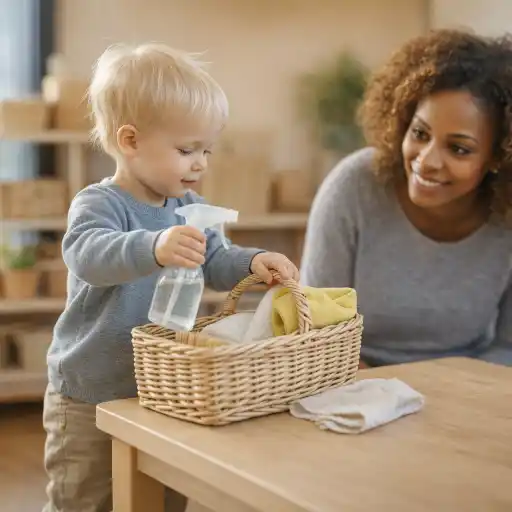
Toddlers are eager to participate in the world around them. A carefully chosen classroom job gives that impulse a meaningful place: returning a book, carrying a cloth, or helping place napkins can communicate that the child is a valued member of the group. The purpose is not to make young children responsible for adult workloads. It is to make room for purposeful participation within a safe, warm relationship.
Helping tasks can integrate learning into ordinary routines. A toddler who puts a toy in a labeled basket practices movement, attention, and recognition of where things belong. A child who brings a washcloth to the table experiences a simple sequence and sees that their action affects a shared space. Repeated opportunities also support emerging agency and #confidence: children begin to experience themselves as people who can try, contribute, and ask for help.
Routines and transitions are recognized as essential parts of supportive early learning environments by NAEYC’s guidance on daily routines and classroom transitions. But a job is not automatically meaningful because it appears on a chart. Its value depends on whether it is developmentally appropriate, inclusive, voluntary in spirit, and connected to a real classroom need.
That distinction matters. If a child’s role is offered only to reward good behavior, participation becomes a prize to earn. If every child is expected to perform perfectly, a learning opportunity becomes a test. Instead, educators can frame jobs as ordinary ways the classroom community cares for its people and materials. This strengths-based approach helps toddlers experience contribution without making adult approval or treats the reason to help.
What makes a toddler job meaningful and developmentally appropriate?
A good toddler job is brief, concrete, safe, and connected to something the child can see. Start with one step—or two closely linked steps—rather than a broad instruction such as “clean the room.” Demonstrate what to do, choose tools that fit small hands, and allow time for the child to respond. Children may need physical assistance, a picture cue, or a peer model; support is part of teaching, not evidence that the child has failed.
- 🧺 Basket helper: Place one or two large toys into an open, labeled basket.
- Book helper: Carry a sturdy book to a low shelf or reading area.
- Table helper: Carry a lightweight, dry cloth to an adult or wipe a small, defined spot with supervision.
- Napkin helper: Hand out one or two napkins with an educator nearby, following the program’s meal and allergy procedures.
- Plant helper: Help hold a small watering tool while the adult supervises the amount of water.
- Music helper: Choose between two songs or help place a simple instrument in its storage spot.
Adapt each role to the child, not the other way around. A child who communicates with gestures, pictures, or an AAC system can match a photo, point to a next step, or hand over an object. A child with mobility, sensory, or attention differences might take on a seated role or use a quieter cue. Those are authentic contributions, not lesser versions of helping.
Keep safety in view: toddlers should not handle cleaning chemicals, sharp or heavy tools, hot liquids, or unsupervised doors, food, or animals. Separate child-friendly participation from adult sanitation responsibilities. State requirements vary - check your state licensing agency.
How can educators invite participation without using prizes or pressure?
Introduce a job as an invitation to join a real routine, not a performance for adult approval. Get down to the child’s level, name the task in a few words, and model it slowly: “Book helper. Pick up the book. Put it on the shelf.” Pair speech with a gesture, photograph, or object when useful. Then pause. Toddlers need time to process language, shift attention, and decide how to respond.
- Choose one manageable task with a clear beginning and ending.
- Show the action at a calm moment, and let the child watch or try a step.
- Offer the least assistance needed; wait before stepping in.
- Use descriptive language about the action and its real effect.
- Accept a child’s “no” or hesitation, and offer another appropriate way to participate.
For example, say, “You put the block in the basket; now there’s room for your friend’s block,” rather than promising a sticker or saying, “You’re the best helper.” The first statement helps the toddler notice their contribution without turning adult approval into payment. The American Psychological Association’s principles on motivation in early childhood education recommend supporting children’s autonomy and competence and, when possible, avoiding external rewards as the routine signal that a task was worthwhile.
Choices can protect agency while keeping boundaries clear: “Would you like to carry the cloth or put in one block?” If the child declines, respond calmly: “You don’t want that job now. I’ll do it, and you can choose another time.” There is no need to bargain, threaten, or insist that the child earn a preferred activity. Contribution grows best when adults make participation accessible and relationships secure.
How can classroom jobs support belonging, confidence, and equity?
Children do not need a prominent title or a flawless result to feel capable. Small, repeated experiences—trying a task, receiving patient support, and being welcomed back to try again—can help toddlers build a sense of competence. This process unfolds within relationships: Head Start’s infant and toddler teaching practices emphasize that learning in the earliest years happens in the context of relationships with important adults.
Jobs also let children practice social participation in ordinary ways. Two toddlers may return books together; one child may wait while a peer receives a napkin; another may show a classmate where a familiar toy belongs. These moments create natural opportunities for turn-taking, cooperation, communication, and care for shared materials. They are not guaranteed to produce instant harmony—toddlers still need close adult support—but they give educators meaningful moments to notice and coach.
Equity requires attention to who gets invited and what counts as helping. If only the most verbal, quick, or compliant children receive roles, the system can unintentionally communicate that contribution belongs to a select few. Offer multiple ways to participate, rotate opportunities thoughtfully, and ensure every child can be included without requiring identical tasks.
- Pair spoken prompts with photos, gestures, home-language words, or communication tools.
- Offer seated, movement-based, sensory-friendly, and peer-supported versions of a task.
- Notice quiet participation, attempts, choices, and requests for help—not only enthusiastic performance.
- Ask families what kinds of everyday helping their child enjoys, without assuming every home follows the same routines.
Contribution can reflect children’s cultural knowledge and family practices, too. NAEYC’s discussion of children helping out as a support for equity, learning, and development encourages educators to recognize children’s capacities and create space for meaningful participation. Respectful jobs communicate: you belong as you are, and there is more than one way to help.
How can directors build a consistent system without turning jobs into a behavior chart?
A simple, shared approach is easier for staff to sustain than a complex job economy. Start with a few genuine classroom needs and agree on the purpose: children are invited to contribute and practice skills, not rewarded for being “good” or punished for refusing. A photo-based chart can help toddlers anticipate a routine, but it should remain a visual support—not a scoreboard or a public ranking of children.
- Choose a small number of short, safe tasks that fit naturally into existing routines.
- Make materials accessible: low shelves, open baskets, stable containers, and child-sized tools.
- Use photographs or simple symbols, and keep the chart at a child-accessible height.
- Rotate roles in a predictable way, while allowing children time to become familiar with each task.
- Agree on common staff language, such as “Would you like to help?” and “You carried the cloth to the table.”
- Review who gets opportunities and adapt roles so every child can participate meaningfully.
Directors can model the approach during staff meetings, observe routines, and coach educators to pause rather than take over. If jobs create long waits or conflict, reconsider the design: add a second tool, offer two complementary roles, or choose another routine. If a task repeatedly overwhelms children, simplify it. The useful question is not “How do we get toddlers to comply?” but “What would make this contribution understandable, safe, and possible?”
Keep child-friendly tasks separate from regulated cleaning and sanitation work; adults remain responsible for hazardous products, bodily fluids, and procedures required by program policy. State requirements vary - check your state licensing agency. For professional learning on autonomy and appropriate support, explore ChildCareEd’s Student Success: Expectations & Independence Buy Now $16.00, which focuses on age-appropriate expectations and opportunities to practice independence, or Environments That Inspire Independence and Exploration Buy Now $55.00 for inclusive classroom design strategies.
How can teachers notice growth without grading a toddler’s helping?
Observation is more useful than a sticker chart, compliance tally, or judgment about whether the job was done “right.” Record what the child did and what helped: Did the child approach independently, after a photo cue, or alongside an adult? How many steps did they try? How did they communicate acceptance, refusal, or a need for help? Did the routine, materials, or adult timing make participation easier?
A concise note might read: “After seeing the basket photo, Leo carried one soft toy to the shelf. The educator pointed to the basket, and Leo placed the toy inside.” This records the child’s action and the support provided without turning the observation into a score. Over time, notes can help a team adjust the task, environment, or prompt—not label a toddler as helpful or unhelpful.
Use reflection to look for barriers. If many children wait for adults, bring materials closer. If a sensory experience is uncomfortable, offer a different role that serves the same community purpose. If a child loses interest, shorten the task or revisit it another day. Toddler self-regulation is emerging; the Administration for Children and Families’ guidance on supporting self-regulation in toddler classrooms underscores the importance of warm relationships, structure, and adult support.
Finally, keep the emotional climate welcoming. A child may be disappointed when a favorite task ends or may refuse on a particular day. Acknowledge the feeling, maintain safety, and avoid making belonging conditional on participation. The goal is not to produce a perfectly tidy room or a perfectly cooperative toddler. It is to create recurring, supported chances to contribute and learn.
Conclusion: How can toddlers contribute without classroom jobs becoming rewards?
Toddlers can contribute meaningfully when jobs are real, brief, safe, inclusive, and taught through warm relationships. Offer invitations instead of bargains; model a manageable step; allow time, choice, and refusal; and describe the child’s contribution rather than attaching a prize or status to it. Rotate opportunities equitably, adapt tasks to individual strengths, and use observation to improve the environment—not to grade children.
When helping is part of everyday community life, a book returned to a shelf or a cloth carried to the table is more than a chore. It is a small, genuine message that the toddler belongs and has something to offer. Keep the expectation modest, the support responsive, and the invitation open.
Related ChildCareEd learning: Supporting Children’s Independence Buy Now $24.00; Student Success: Expectations & Independence Buy Now $16.00; Environments That Inspire Independence and Exploration Buy Now $55.00; Solutions NOT Punishments Buy Now $16.00; Every Moment Matters: Schedules and Transitions Buy Now $55.00.
- 45 Hour Child Growth and Development
- Turning Behavior Around for Toddlers and Preschoolers
- 45 Hour Infant and Toddler Methods and Materials
- CDA Bridge Bundle: Infant/Toddler without Portfolio Review
- Texas Director Credential
- 45-Hour Infant and Toddler Curriculum
- Every Moment Matters: Schedules and Transitions
- CDA Certification en Español: Recursos y Consejos para Educadores Bilingües
- 💛🧩 ¿Cómo puedo hacer que mi enseñanza sea inclusiva para los niños con autismo?
- 👶 ¿Cuáles son las proporciones y grupos requeridos en Dakota del Norte? 🏫
- Recursos en Español sobre el Sueño Seguro del Bebé
- ¿Cuáles son los pasos, requisitos y opciones en línea para la certificación de 90 horas en cuidado de Infantes/Toddlers en Maryland?
- 10 Ejemplos de Cómo la Cultura Influye en el Desarrollo Infantil
- Proporciones de Cuidado Infantil y Tamaños de Grupo por Edad en Maryland (Guía Rápida para Centros y Hogares)
- Proporciones de Cuidado Infantil y Tamaños de Grupo por Edad en Nueva Jersey (Guía Rápida para Centros y Hogares)
- Proporciones de Cuidado Infantil y Tamaños de Grupo por Edad en Virginia (Guía Rápida para Centros y Hogares)
- ¿Cuál es la Diferencia Entre la Crianza Respetuosa y la Crianza Permisiva?
- Ejemplos de Crianza Respetuosa vs. Crianza Permisiva
- Celebrando la amistad en el cuidado infantil durante el Día de los Mejores Amigos
- Canciones, juegos y preguntas de círculo para niños
- Cómo simplificar la capacitación para sus empleados de daycare
- Why Do Classroom Management Strategies Fail With 3-Year-Olds—and What Works Instead?
- Labor Day Makers: Creative Projects That Get Pre-K Kids Thinking and Building
- Beyond “How Are You?” Circle Time Questions Kids Actually Want to Answer
- How Can Child Care Providers Encourage Positive Behavior Without Relying on Rewards All the Time?
- How Do Classroom Jobs Build Responsibility and Confidence in Toddlers?
- How Can Toddlers Contribute to Classroom Jobs Without Turning Them into Rewards?
