A child can show understanding of a routine through actions, gestures, pointing, or a communication device. Try using the Home Routine Cards Buy Now $1.99 with families to introduce familiar sequences, selecting relevant pictures and adapting them to the child’s classroom routine. Allow time to process each cue and notice how the child communicates readiness or a need for help. For practical ways to adapt communication, explore Effective Approaches for Autism and Inclusion  Buy Now $55.00. To strengthen consistent staff support, consider Coaching for Success: Inclusive Strategies to Support Children with Autism Buy Now
 $55.00$45.00. Read on for ways to make routines understandable without requiring spoken answers.
Why should providers support routines without requiring spoken answers?
Routines help children understand what is happening, what comes next, and how they can take part. For an autistic child who does not use speech, uses it inconsistently, or needs extra time to respond, a spoken question such as “What do we do now?” may create an unnecessary barrier. The child may know the routine yet be unable or unwilling to demonstrate that knowledge through speech at that moment.
Communication includes gestures, pointing, movement, pictures, signs, objects, and augmentative and alternative communication (AAC), as well as spoken words. A child may show understanding by reaching for a coat when shown the outdoor picture, moving a finished card, or starting handwashing after seeing the relevant cue. Providers can recognize these responses as meaningful participation rather than interpreting silence as noncompliance.
Predictable supports can reduce uncertainty, repeated verbal prompting, and long periods of waiting. Guidance from the Indiana Resource Center for Autism on transition support describes visual schedules, timers, and concrete cues as ways to help individuals anticipate activities and participate more independently.
- Notice what the child understands and does, not only what they say.
- Keep expectations meaningful while offering different ways to respond.
- Remember that state requirements vary - check your state licensing agency when considering training or compliance practices.
How can a daily routine be made easier to understand?
Start by observing the day from the child’s perspective. Identify moments that require stopping, waiting, moving, gathering materials, or beginning a new task. These are often the times when a child needs clearer information. A schedule may look orderly to adults but still be difficult if transitions are abrupt, instructions are long, or waiting time is extensive.
Create a simple visual schedule that shows the major events in the day. Use photographs of familiar places or objects when those are clearer for the child than abstract icons. Place the schedule where the child can see and reach it. A removable “now” marker, finished pocket, or card the child can turn over can show progress through the sequence.
Teach the schedule as part of the routine, rather than expecting a child to interpret it independently from the start. At arrival, show the first activity. Before a transition, point to the current and next pictures and use a concise phrase such as, “First cleanup, then snack.” Then pause so the child has time to process the cue and act.
- Keep the display uncluttered and use familiar images consistently.
- Build cleanup, handwashing, and movement time into the schedule.
- Provide an individual mini-schedule or task strip if the whole-day display is not enough.
- Use the same visual and brief cue across staff whenever possible.
Predictability does not require a rigid day. If plans change, update the display and show what will happen instead. Resources on visual schedules for young children include examples of picture schedules, first-then boards, and routine supports.
What visual cues can guide a child through each step?
Choose a cue based on what the child can readily understand. Some children respond best to a real object associated with the activity, such as a cup to signal snack or a coat to signal going outdoors. Others understand photographs, picture symbols, written words, or a combination. Begin with the most concrete format that works for the child, then adjust based on observation rather than selecting visuals for appearance alone.
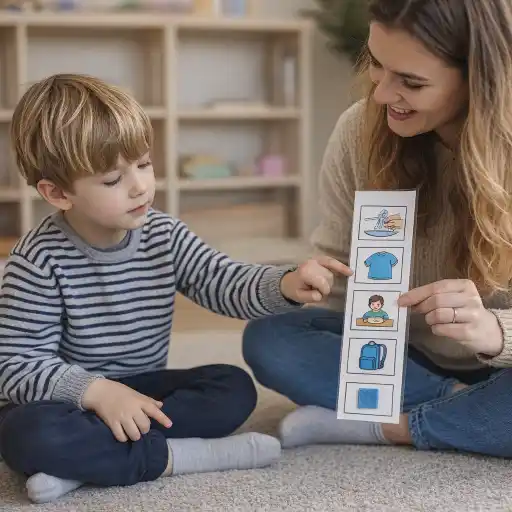
A first-then board can clarify a short sequence: “First put the blocks in the bin, then bubbles.” It is most useful when the immediate next step matters, such as ending a preferred activity or beginning a less-preferred task. Present it neutrally as information—not as a threat, bargaining tool, or demand for a spoken response.
- Show the current or first step and the next activity.
- Point to the cue and say a few clear words, then allow processing time.
- Invite the child to move, turn over, or remove the finished picture if that suits them.
- Use a visual timer or countdown when seeing time pass would be helpful.
- For a multistep routine, show only a few steps at a time, such as “soap, rinse, dry.”
Pair visual supports with AAC when the child uses a communication system. Keep that system available during transitions and routines, and model relevant messages—such as “help,” “finished,” “wait,” or “go”—without requiring the child to copy them. Adults can also accept a gesture, movement, or selection as a response. To build your understanding of communication across spoken and nonverbal forms, see Language Development in Early Childhood Buy Now $16.00.
How can staff respond when the child does not answer?
First, consider whether an answer is actually needed. If the visual cue already communicates the next step, the adult can calmly show it and proceed with support instead of repeating a question. Repeatedly asking “Are you ready?” or “What comes next?” may add language demands without helping the child understand the routine.
After giving a cue, wait. Processing an instruction, shifting attention, and preparing a response can take time. A quiet pause gives the child a genuine opportunity to act or communicate. If the child does not move right away, check that the picture is understandable, the next activity is accessible, and sensory or environmental demands are manageable.
- Use one short direction at a time, paired with a gesture or visual.
- Allow a pause before repeating or adding another prompt.
- Notice responses such as looking toward the item, reaching, pointing, moving, or using AAC.
- Offer a limited, real choice when possible: “Carry the picture or walk beside me?”
- Respond to “no,” “stop,” “help,” or “finished” through the child’s communication method when safe and appropriate.
Keep the interaction respectful and low-pressure. Do not require eye contact, speech, or repetition as proof of understanding. If distress occurs, reduce unnecessary words, acknowledge the child’s experience, and help with the next manageable step. The aim is access and participation, not a performance of compliance.
How can teams individualize supports and work with families?
A classroom-wide schedule provides a useful foundation, but the most effective support fits the individual child. Some children may need a portable two-card board; others may benefit from a picture sequence at the sink, a transition object, additional time, reduced verbal language, or a quieter route between activities. Observe which supports help the child participate with less adult assistance.
Families can share important information about the child’s preferred words, signs, pictures, interests, sensory needs, and successful routines at home. Ask what cues are familiar and which approaches are comfortable for the child. With family permission, coordinate relevant strategies with speech-language pathologists, early intervention providers, or inclusion specialists. The goal is continuity—not expecting every setting to look identical.
- Write a concise support snapshot for classroom staff and substitutes.
- Agree on consistent visuals and short phrases for priority routines.
- Keep AAC accessible and consult the family or relevant professionals about its use.
- Track a practical measure, such as prompts needed or steps completed independently.
- Review supports periodically and adjust when the routine or child’s needs change.
For further professional learning, consider Recognize, Respond, Respect: Supporting Diverse Learners Buy Now $55.00, which addresses observation and inclusive support, and Special Needs: From Referral to Inclusion Buy Now $24.00, which explores inclusion and classroom accommodations. Check course details and your local training requirements before enrolling.
Conclusion: What helps autistic children follow routines without spoken answers?
Children can follow routines without providing spoken answers when adults make expectations visible, teach each sequence, allow processing time, and recognize communication in many forms. A clear schedule, first-then board, object or photo cue, and accessible AAC can help make the next step understandable and support participation.
Begin with one challenging routine. Choose a concrete visual, teach it when the child is calm, use a brief consistent cue, and wait for the child’s response—spoken or otherwise. Partner with families and colleagues, then observe whether the support increases participation or reduces prompting. These practical steps honor the child’s communication and build #routines, #visuals, #communication, #independence, and #inclusion.
- Reducing the Risk of Sudden Infant Death Syndrome
- Bienvenido! Welcoming All Families
- Pediatric RSV First Aid & CPR/AED
- Balancing Act: Schedules and Routines
- Positive Attention: Interactions & Supervision for Infants & Toddlers
- Texas Director Credential
- Behind the Scenes: Baby Routines ONLINE
- Every Moment Matters: Schedules and Transitions
- Everyday Safety: Creating Healthy Environments
- CDA Certification en Español: Recursos y Consejos para Educadores Bilingües
- Capacitación en Salud y Seguridad Preventiva en Línea para Proveedores de Cuidado Infantil
- Regulaciones de Licenciamiento de Cuidado Infantil en California para Centros y Hogares de Cuidado Infantil Familiar
- Proporciones de Cuidado Infantil y Tamaños de Grupo por Edad en Maryland (Guía Rápida para Centros y Hogares)
- Proporciones de Cuidado Infantil y Tamaños de Grupo por Edad en Nueva Jersey (Guía Rápida para Centros y Hogares)
- Proporciones de Cuidado Infantil y Tamaños de Grupo por Edad en Virginia (Guía Rápida para Centros y Hogares)
- ¿Cuál es la Diferencia Entre la Crianza Respetuosa y la Crianza Permisiva?
- Cómo Trabajar en el Cuidado Infantil en Carolina del Norte: Requisitos y Pasos
- Cómo Trabajar en el Cuidado Infantil en Wisconsin: Requisitos y Pasos
- Capacitación Previa al Servicio para Proveedores de Cuidado Infantil en Wisconsin
- Celebrando la amistad en el cuidado infantil durante el Día de los Mejores Amigos
- Canciones, juegos y preguntas de círculo para niños
- Cómo simplificar la capacitación para sus empleados de daycare
- How Can Predictable Classroom Routines Support Autistic Children?
- How Can You Support an Autistic Child in a Preschool Classroom?
- How Can You Help an Autistic Preschooler Join a Group Game on Their Own Terms?
- How Can Teachers Support an Autistic Child in a Preschool Classroom?
- How Can You Prepare an Autistic Child for a Small Change in the Arrival Routine?
- How Can Providers Use Feelings Pictures with Autistic Children Without Making Assumptions?
- How Can Child Care Providers Help Autistic Children Follow Routines Without Spoken Answers?
