A toddler’s request for “again!” gives you a chance to revisit familiar play and notice what they are ready to explore next. Use the Simple Daily Lesson Plan Template for Early Childhood Educators Buy Now $1.00 to keep a learning goal in view, note what interested the children, and plan a small change to the materials or your support. Playful Learning: Infant & Toddler Activities Buy Now $25.00 offers guidance on adapting experiences to children’s ages and abilities, while Playing with a Purpose: Infant/Toddler Lesson Planning  Buy Now $24.00 helps you connect repeated play with intentional planning. Read on for ways to preserve the familiarity toddlers enjoy while making room for new discoveries.
Why can repeating an activity support toddler learning?
For toddlers, repetition is active investigation. Each return to a familiar activity lets a child anticipate what might happen, practice a movement, notice a detail, or test a new idea. A child who fills and empties the same container may be exploring cause and effect, hand control, and the changing meaning of “full” and “empty.” The action may look familiar to an adult, while the child’s understanding is becoming more precise.
Repetition can also create a welcome sense of predictability. When toddlers know the materials and basic sequence, they may feel more comfortable trying a new step, using a word, or sharing space with a peer. Research observing children in free-play settings found motor repetition across all children in the study and across varied kinds of play, illustrating that repeating actions is a common feature of young children’s exploration (A Natural History of Repetition).
For providers, the goal is not to eliminate repetition or to manufacture novelty every day. It is to notice what children are practicing and decide whether a small, purposeful variation could extend the experience. Keep the familiar core, then make room for fresh discovery. This balance respects toddlers’ agency while helping educators plan with intention.
How can you keep the learning goal while changing the experience?
Start by identifying the skill or idea beneath the activity. If toddlers are rolling cars down a ramp, the goal might be to explore movement, practice turn-taking, or use words such as “fast,” “slow,” and “go.” Keep that goal steady while changing one feature at a time. This makes the experience recognizable without requiring an identical lesson.
For example, a ramp-and-car invitation might evolve across several revisits:
- First, offer a short ramp and a few large cars for open exploration.
- Next, add a longer or gently sloped ramp and narrate what children notice.
- Later, invite toddlers to choose which car to roll or place a soft block at the bottom as a stopping point.
- On another day, bring the idea outdoors with balls rolling down a low, safe slope.
Change just one or two elements—materials, setting, partner, movement, language, or level of challenge—so children can connect the new experience to what they already know. NAEYC describes responsive scaffolding as observing a child and offering support that fits the child’s current interests and abilities; a small change can reengage a toddler while leaving the child in charge of the play.
When you plan this way, an activity can support different kinds of learning over time. A water-pouring invitation, for instance, can emphasize coordination one day and vocabulary or turn-taking on a later revisit. The activity remains familiar; the learning possibilities expand.
How do you plan useful variations for toddlers?
A simple planning note can keep the process manageable: write down the learning intention, the familiar element to preserve, one variation to try, and what you will observe. Toddlers often benefit from flexible, brief invitations rather than long, tightly directed lessons. Follow their cues and allow an activity to continue when engagement is strong—or end when interest shifts.
Try this adaptable sequence with a familiar sensory activity:
- Keep: the same shallow water tray and a few familiar cups.
- Vary the tool: add a large scoop or a small pitcher to explore different ways of transferring water.
- Vary the language: model “pour,” “drip,” “empty,” or “more” as children play.
- Vary the social invitation: offer a second set of tools so a peer can join, without requiring children to take turns before they are ready.
- Vary the challenge: place a wide container nearby and let children decide how to fill it.
🎯 Planning reminder: choose one achievable learning focus and one change for the next revisit. Too many new materials or adult directions can make a familiar activity feel like an entirely different task.
Adjust variations to children’s developmental stages, interests, communication, sensory preferences, and mobility. NAEYC’s guidance on developmentally appropriate practice emphasizes knowing individual children and their families.
How can you extend play without taking over?
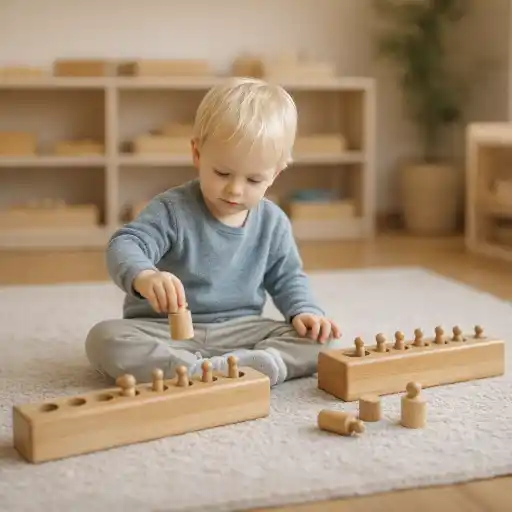
Begin with observation. Watch what the toddler repeats, what changes between attempts, and whether the child is communicating through words, gestures, gaze, or movement. Then decide whether to comment, model a word, offer a material, or simply stay nearby. Responsive scaffolding means providing enough support to invite a next step without replacing the child’s idea.
For instance, if a toddler repeatedly places large blocks in a basket and empties it, you might describe the action: “In, out. The basket is empty.” After a pause, offer a second basket of a different size. The child may compare them, ignore the new option, or return to the original action. Each response tells you something about the child’s interest and readiness. NAEYC’s discussion of scaffolding with infants and toddlers highlights following children’s leads, modeling, offering choices, and adjusting support in response to observation.
Keep adult prompts open and light. Instead of directing the child through a series of steps, try a short observation or an invitation such as “I wonder what fits here.” Give toddlers time to respond in their own way. Some may answer with words; others will show their thinking by acting.
Protect uninterrupted play when it is safe and meaningful. The NAEYC article on using materials creatively in toddler environments describes following children’s interests and offering accessible, open-ended materials. Those practices make it easier to revisit an idea while allowing each child to direct how the play unfolds.
How can you observe progress and adapt for individual needs?
Brief, objective observations help you distinguish a repeated activity from a repeated lesson plan. Record what the child did or communicated, the context, and a possible next step. For example: “During outdoor play, Sam rolled three balls down the board ramp, watched each one reach the grass, then moved the board to a lower step.” This note captures actions and a change in strategy without assuming what Sam was thinking.
Over several revisits, look for small signs of development: a new movement, longer engagement, an added word, a change in problem-solving, or increased participation alongside peers. These observations can guide whether to keep the same setup, offer a gentle extension, simplify access, or pause the activity. For more structured guidance, Tracking Progress, Shaping Futures: Observation & Assessment Skills Buy Now $55.00 explores objective observation and using assessment information to inform learning goals.
One activity does not need to look identical for every toddler. Adapt the tools, position, instructions, pace, or sensory demands while preserving the shared learning idea. A child who avoids touching wet materials might pour with a large handled cup; a child who uses gestures or a communication system can select a tool by pointing or choosing a picture. Partner with families and specialists when a child has individualized guidance.
Most repeated play is a typical and valuable part of exploration. If a pattern is consistently associated with distress, creates a safety concern, or occurs alongside loss of skills or persistent barriers to participation, document specific observations and speak with the family through your program’s established process. Avoid diagnosing from classroom behavior. State requirements vary - check your state licensing agency.
What common pitfalls should providers avoid?
Even a well-intentioned effort to make activities fresh can unintentionally interrupt toddlers’ learning. Avoid treating repetition as evidence that a child is bored or that the educator has run out of ideas. A toddler may be concentrating, testing a pattern, seeking predictability, or practicing a developing skill. Observe before changing the setup.
Common pitfalls—and practical alternatives—include:
- Changing everything at once: Keep the core activity stable and change one element, such as the tool or setting.
- Over-directing the play: Offer a brief prompt or model, then leave time for the child to decide what happens next.
- Expecting every child to participate in the same way: Provide different ways to reach, communicate, explore, and take part.
- Keeping an activity going after interest fades: Follow children’s cues; a change of focus is useful information, not a failed lesson.
- Documenting judgments instead of evidence: Write what you saw and heard before interpreting what it might mean.
For directors, shared planning language can help teams make consistent, responsive decisions. Encourage educators to record the learning focus, the variation offered, and a brief observation. A short team reflection can ask: “What stayed familiar for the toddler? What changed? What did the child show us?” This keeps planning practical and centered on children rather than on completing a prescribed sequence.
Families can also help educators understand a child’s interests and familiar routines. Share a concrete observation and invite the family to describe what the child enjoys at home. These conversations support continuity between home and the relationships and individualized practice central to infant-toddler care.
Conclusion: How can you repeat an activity without repeating the same lesson?
Keep the meaningful core of an activity familiar, then vary a material, context, language cue, social invitation, or level of challenge. Observe how the toddler responds, extend play gently, and adapt access so each child can participate in a way that works for them. Repetition becomes purposeful when it follows children’s interests and gives educators useful information about what to offer next.
In short: plan one learning focus, make one thoughtful change, watch closely, and let the child’s response guide the next revisit. You do not need a brand-new lesson every day. With responsive repetition, supportive scaffolding, close observation, thoughtful play, and flexible planning, familiar toddler activities can keep opening doors to discovery.
Further learning: Explore ChildCareEd’s Playful Learning: Infant & Toddler Activities Buy Now $25.00, Playing with a Purpose: Infant/Toddler Lesson Planning Buy Now $24.00, Baby Play: Planning Infant and Toddler Activities Buy Now $16.00, The Best Promotion is Play Buy Now $35.00, and Tracking Progress, Shaping Futures: Observation & Assessment Skills Buy Now $55.00 for further professional learning related to toddler activities, play, planning, and observation.
- Lesson Planning for Preschoolers
- CDA Infants/Toddlers: Lesson Planning Made Easy
- Birth to Five CDA Credential with Portfolio Review
- 45 Hour Infant and Toddler Methods and Materials
- CDA Bridge Bundle: Infant/Toddler without Portfolio Review
- CDA Bridge Bundle: Infant/Toddler
- 45-Hour Infant and Toddler Curriculum
- Texas Director Credential
- Meaningful Lesson Planning for Infants/Toddlers
- Playing with a Purpose: Infant/Toddler Lesson Planning
- CDA Certification en Español: Recursos y Consejos para Educadores Bilingües
- 💛🧩 ¿Cómo puedo hacer que mi enseñanza sea inclusiva para los niños con autismo?
- 👶 ¿Cuáles son las proporciones y grupos requeridos en Dakota del Norte? 🏫
- ¿Cuáles son los pasos, requisitos y opciones en línea para la certificación de 90 horas en cuidado de Infantes/Toddlers en Maryland?
- 10 Ejemplos de Cómo la Cultura Influye en el Desarrollo Infantil
- Proporciones de Cuidado Infantil y Tamaños de Grupo por Edad en Nueva Jersey (Guía Rápida para Centros y Hogares)
- Proporciones de Cuidado Infantil y Tamaños de Grupo por Edad en Virginia (Guía Rápida para Centros y Hogares)
- ¿Cuál es la Diferencia Entre la Crianza Respetuosa y la Crianza Permisiva?
- Cómo Trabajar en el Cuidado Infantil en Carolina del Norte: Requisitos y Pasos
- Capacitación Previa al Servicio para Proveedores de Cuidado Infantil en Dakota del Norte
- Celebrando la amistad en el cuidado infantil durante el Día de los Mejores Amigos
- Canciones, juegos y preguntas de círculo para niños
- How can songs and stories encourage toddler language development?
- How Can Revisiting the Same Activity Throughout the Year Improve Learning and Classroom Practice?
- Daycare Lesson Plans for Toddlers: Easy Activities for Every Day
- Getting to Know You Activities for Preschoolers When a New Child Joins the Class
- How Can You Repeat a Toddler Activity Without Repeating the Exact Same Lesson?
- How Can You Explain Montessori Classroom Choices to Families Without Jargon?
- How Can Toddler Sensory Play Become a Science Investigation?
