When families ask why a child chooses a work mat or spends a long time on one activity, a clear, everyday explanation can help them understand the learning behind the choice. Begin that conversation with the Meet the Teacher Template: Welcome Families in Style Buy Now $1.49, using its “About Me” section to introduce your teaching approach in plain language and invite questions. For practical guidance on explaining Montessori principles and addressing common concerns, explore Montessori Unveiled: Demystifying the Method for Parents  Buy Now $16.00. Read on for simple ways to connect classroom choices with examples families can recognize and understand.
Why does plain-language explanation matter to families?
Families do not need a lecture on educational theory to understand what their children are doing. They need to know what they saw, why it matters for their child, and how educators are supporting progress. When classroom choices seem unfamiliar, explanations filled with specialized terms can unintentionally make families feel excluded or unsure whether learning is happening.
Plain language makes the purpose visible. Instead of saying “the child is working through a sensorial material,” you might say, “This activity helps her notice differences in size and put objects in order.” Instead of “we are supporting practical life,” try “He is practicing pouring so he can serve himself more independently.” Specific examples connect a classroom decision to observable skills.
This approach also strengthens family partnership. The American Montessori Society describes a classroom where children choose meaningful activities, use hands-on materials, and develop independence at an individual pace. When providers connect these features to what a family notices at home, caregivers can share useful context and ask informed questions. Respectful communication begins with the assumption that families know their children deeply and deserve clear, accessible information.
- Replace abstract labels with a visible action and a child benefit.
- Make room for family questions without treating them as criticism.
- Connect classroom observations to a shared goal for the child.
A clear explanation is not a sales pitch for a method. It is an invitation to understand the child’s experience and work together in support of it.
How can you describe classroom choices in everyday language?
Start with what a family can see, then explain the purpose in a sentence or two. “Prepared environment,” for example, may sound abstract. Try: “We arrange shelves so children can see and reach a small set of activities, choose one, and return it when finished.” That description makes the classroom’s organization understandable without asking families to learn professional vocabulary.
Use the same approach for common practices:
- Child choice: “Children select from activities we have introduced and know how to use. We watch their choices and offer new lessons as they are ready.”
- Hands-on materials: “These objects let children explore an idea by moving and comparing things, rather than only hearing an explanation.”
- Independent work: “We give children time to try, repeat, and solve problems, while staying nearby to guide them.”
- Mixed ages: “Children of different ages can learn from watching and helping one another, with activities suited to each child.”
- Returning materials: “Putting the work back in its place helps the next child find it and lets children take care of their shared room.”
These translations preserve the meaning without relying on jargon. Avoid promising that a practice will produce the same result for every child. Instead, explain the intention and describe what you are observing in this child. For a practical course on explaining Montessori principles and misconceptions, consider Montessori Unveiled: Demystifying the Method for Parents Buy Now $16.00.
How do you explain why children choose different activities?
Families may expect every child to complete the same task at the same time, so seeing different activities can raise a reasonable question: “Are they all learning?” Explain that an educator observes children, introduces activities, and considers each child’s skills, interests, and readiness. Children may practice different concepts during the same period, while the teacher remains responsible for supporting a broad program of learning.
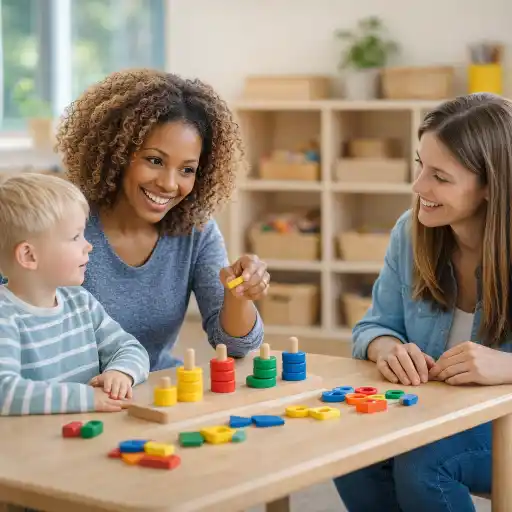
Use an example from the day rather than a general claim. You might say, “Today, Maya chose the number rods. She counted each section and checked the sequence. I noticed she stayed with it and asked to repeat it, so I’ll keep observing and decide what presentation may be useful next.” This gives the family a concrete picture of learning and professional guidance.
If a family worries that a child is repeating one activity or avoiding another, listen carefully before reassuring them. Share what you have observed, explain what you are monitoring, and invite the family’s perspective. A child’s repeated choice may signal confidence or interest, but observations over time—not one moment—help educators decide what support to offer.
- Describe the activity and the skill it invites the child to practice.
- Explain how you decide when to introduce a new challenge.
- Share examples of progress, including effort, problem-solving, and persistence.
- Ask what the family is noticing at home and what questions remain.
The aim is neither to defend every choice nor to suggest that choice means “anything goes.” It is to make clear that meaningful choice occurs within a thoughtfully planned classroom and responsive adult guidance.
How can educators answer questions about the teacher’s role?
When adults are not leading every activity, families may wonder whether teachers are teaching. Explain that guidance can include observing, demonstrating how to use an activity, helping a child choose an appropriate next step, and supporting respectful interactions. The teacher’s work may be quieter than a whole-group lesson, but it is intentional and active.
Try wording such as: “I showed Leo how to use the activity, then gave him time to try it himself. I stayed close enough to support him and watched how he approached the challenge.” This describes the educator’s actions and the child’s opportunity to practice. If you use observation notes or portfolios, share a brief example so families can see how you track learning and plan follow-up.
It is also helpful to distinguish independence from being left alone. Children are supervised, supported, and guided according to their development and the needs of the group. Independence means opportunities to attempt manageable tasks, not an expectation that young children should solve every problem without help.
Respectful partnerships rely on two-way communication. Give families time to finish their questions, reflect back what you heard, and respond with specific information. If you do not know an answer, say that you will check and follow up rather than improvising. When families speak another language, use accessible communication and qualified interpretation when needed; never ask a child to interpret sensitive information.
Programs may find Engaging Parents in the Montessori Toddler Classroom Buy Now $16.00 useful for exploring family partnership strategies in toddler settings.
What common communication pitfalls should you avoid?
Even caring educators can make a conversation harder by using insider terms, speaking in broad assurances, or responding to a question as if it were a challenge to their expertise. A family asking “Why is my child washing a table?” may be seeking a connection between the activity and learning—not questioning the educator’s commitment.
Replace vague statements such as “She’s doing great” with a short example: “She carried the small pitcher carefully, poured water into the cup, and wiped a few drops when they spilled.” Then explain the purpose: “That gives her practice with coordination and caring for the space.” Avoid overstating results or using comparisons that can create unnecessary pressure between children.
- ⚠️ Instead of: “That’s just the Montessori way.” Try: “Here is what this activity gives children a chance to practice.”
- Instead of: “He can do it himself.” Try: “We give him a chance to try, and we step in when he needs support.”
- Instead of: “You’ll see the benefits later.” Try: “Here is what I observed today, and here is what I’ll continue to watch.”
- Instead of: correcting a family’s assumptions, ask: “What have you heard or noticed that makes you wonder about this?”
Keep explanations culturally responsive and free of assumptions about what families value or know. Share information in clear, accessible formats, respect family preferences, and protect children’s privacy. State requirements vary - check your state licensing agency for applicable rules on records, communication, supervision, and classroom practice.
How can you make family conversations practical and ongoing?
Build explanations into ordinary contact rather than waiting for a formal conference. At pickup, share one specific observation and invite a question. During conferences, connect classroom examples with family priorities and agree on any follow-up. A photograph or sample of a child’s work can support the conversation, provided your program’s permissions and privacy practices are followed.
Directors can help by giving staff shared plain-language descriptions of core practices, time for family communication, and opportunities to practice responses together. A short team exercise can be effective: choose a Montessori term, identify the practice it describes, then write one sentence that explains its purpose to a family. Review the wording for clarity and avoid promising outcomes beyond what staff can observe.
Use a simple conversation structure:
- Notice: “I saw Amira choose the matching cards several times this morning.”
- Explain: “She was comparing pictures and naming what she saw.”
- Connect: “That gives her practice with attention and language.”
- Invite: “What kinds of matching or naming games does she enjoy at home?”
Family perspectives can help educators understand a child’s interests, language, routines, and strengths. The ChildCareEd article on family knowledge in a Montessori toddler classroom offers further ideas for turning family input into responsive practice. For additional professional learning, providers may also explore The Montessori Classroom: Theory to Practice Buy Now $25.00, The Prepared Environment: Montessori Class Design Buy Now $16.00, and The Montessori Assistant’s Toolkit Buy Now $40.00.
Conclusion: What should families understand about Montessori choices?
How can you explain Montessori classroom choices without jargon? Begin with what the child is doing, describe the skill or purpose, and explain how an educator observes and guides the learning. Clear examples make choices, materials, classroom routines, and teacher support easier for families to understand.
Keep the conversation collaborative: listen to questions, invite family knowledge, share observations rather than sweeping promises, and follow up when you need to find an answer. These everyday practices help families see the thoughtful learning behind classroom choices and strengthen a partnership centered on each child’s growth.
- 45 Hour Child Growth and Development
- Moving About the Classroom: Effective Transitions for Everyday
- CDA Family Child Care Credential with Portfolio Review
- 45 Hour School Age Methods and Materials
- CDA Bridge Bundle: Family Child Care
- CDA Bridge Bundle: Family Child Care without Portfolio Review
- Texas Director Credential
- Every Moment Matters: Schedules and Transitions
- Moving About the Classroom: Effective Transitions for Everyday
- 💛🧩 ¿Cómo puedo hacer que mi enseñanza sea inclusiva para los niños con autismo?
- 👶 ¿Cuáles son las proporciones y grupos requeridos en Dakota del Norte? 🏫
- Recursos en Español sobre el Sueño Seguro del Bebé
- 10 Ejemplos de Cómo la Cultura Influye en el Desarrollo Infantil
- Actividades de Fiesta para Niños de Preescolar y Primaria
- Reglas de Cuidado Infantil en Illinois
- Proporciones de Cuidado Infantil y Tamaños de Grupo por Edad en Maryland (Guía Rápida para Centros y Hogares)
- Proporciones de Cuidado Infantil y Tamaños de Grupo por Edad en Nueva Jersey (Guía Rápida para Centros y Hogares)
- Proporciones de Cuidado Infantil y Tamaños de Grupo por Edad en Virginia (Guía Rápida para Centros y Hogares)
- ¿Cuál es la Diferencia Entre la Crianza Respetuosa y la Crianza Permisiva?
- Retraso del Habla en la Guardería: Cómo Pueden Ayudar los Proveedores
- Capacitación Previa al Servicio para Proveedores de Cuidado Infantil en Dakota del Norte
- Capacitación Previa al Servicio para Proveedores de Cuidado Infantil en Nevada
- Celebrando la amistad en el cuidado infantil durante el Día de los Mejores Amigos
- What can the National Mall teach us about building a classroom where every child has a voice?
- Canciones, juegos y preguntas de círculo para niños
- Cómo simplificar la capacitación para sus empleados de daycare
- How Can Providers Keep a Referral Conversation Focused on Support, Not Labels?
- How Can You Explain Montessori Classroom Choices to Families Without Jargon?
