When children approach the same activity with different skills, a flexible plan can help each one participate, feel capable, and keep learning. The ChildCareEd course Tailoring Instruction to Children’s Needs  Buy Now $24.00 offers practical guidance on differentiation and scaffolding, while Planning for Every Child: Responsive Strategies in Action Buy Now $55.00 explores using observation and individualized planning to make activities accessible. Explore these trainings as a next step, and use the strategies below to make tomorrow’s classroom plans more responsive.
Why does planning for different skill levels matter?
Children in one group may differ in language, motor coordination, prior experience, attention, interests, and confidence. An activity designed around a single assumed level can leave some children waiting without challenge and others unsure how to begin. Planning for variation is not about writing a separate lesson for every child; it is about preserving a shared purpose while offering flexible routes into the learning.
Developmentally appropriate practice asks educators to consider what is generally known about children’s development alongside each child’s characteristics and social and cultural context. When children have meaningful ways to join and show what they know, they are more likely to experience belonging and productive challenge.
Responsive planning can also make the day easier for staff. A prepared visual cue, alternative tool, or extra challenge is often simpler than improvising after a child becomes frustrated. The goal is not to label children by ability, but to notice what helps each child participate and take a next step.
How can observation guide your activity plan?
Start with evidence from ordinary classroom moments. Observe children during play, routines, and guided activities—not only during a formal assessment. Notice what captures attention, how a child starts a task, what they can do independently, and where a small prompt helps. This approach is consistent
Keep documentation brief and descriptive. Record what happened rather than interpreting the child’s character: “Matched three picture cards after I modeled the first pair” is more useful than “not good at matching.” Then identify one attainable learning goal and one possible next step. Ask families what interests or strategies are useful at home, and consult relevant specialists or plans when appropriate.
- Watch for signs the activity is too challenging: a child cannot get started, disengages, or repeatedly needs help.
- Notice when the task may be too familiar: a child completes it quickly and seeks another challenge.
- Look across contexts; a child may show a skill in play that is not yet visible in a group lesson.
- Use observation to plan opportunities, not to assign fixed ability labels.
These small notes help you plan for real children rather than an imagined “average” learner. They also give the team a shared basis for adjusting activities over time.
How do you set one goal with multiple levels of challenge?
Choose a common learning purpose, then make participation flexible. For example, if the goal is to explore quantity, children might count objects, match groups to number cards, or compare which collection has more. Everyone engages with the same big idea, but the entry point and degree of challenge differ.
One simple planning sequence is to define the goal, prepare two or three ways to engage with it, and decide what support or extension could be offered. For a block-building activity, a child might explore stacking and balance; another might copy a simple structure from a picture; a child ready for an added challenge might design a bridge and explain how it stays up. Avoid presenting these options as public rankings. Offer them naturally and let children move between approaches.
Children can also demonstrate understanding in varied ways. After a story, one child may retell events with picture cards, another may act out a scene, and another may describe a character’s choices. The shared objective remains meaningful even when the response differs. The CLI Engage activity collections similarly show how a common learning theme can be adapted across ages and forms of instruction; see Activities & Materials.
- Use open-ended materials that allow simple exploration and more complex problem-solving.
- Offer choices in tools, partners, or ways to express learning.
- Keep expectations ambitious but achievable, with room to extend the task.
This layered approach supports #learning without requiring several unrelated lesson plans.
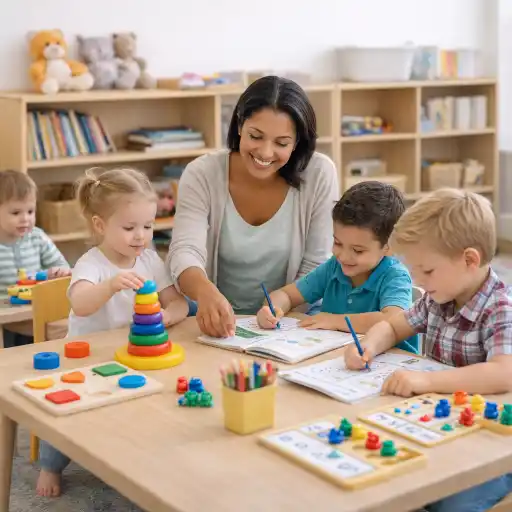
Which adaptations help children participate together?
Before the activity begins, consider the space, materials, and steps. Small, purposeful changes can remove barriers while preserving the shared goal. The Illinois Early Learning Project describes modifications such as environmental supports, adapted materials, simplified steps, child preferences, adult support, and peer support.
- 🧩 Space: Reduce distractions, create a quieter option, or arrange a smaller group when that supports participation.
- Materials: Offer larger manipulatives, an easy-grip tool, picture cues, real objects, or a tray to contain materials.
- Steps: Break a task into manageable parts, model the first step, and allow processing time.
- Communication: Pair spoken directions with gestures, visuals, or key words in children’s home languages when possible.
- Social support: Invite peer collaboration or provide a specific adult prompt, then reduce the support as independence grows.
For instance, during a collage activity, some children may cut their own shapes, while others choose from pre-cut pieces or use stickers. Each can make decisions about color, placement, and meaning. Adaptations should increase access, not unnecessarily single out a child. If a child has an IEP or IFSP, coordinate classroom strategies with the family and appropriate providers, and follow the plan’s requirements.
How can you scaffold without taking over?
Scaffolding means providing temporary, targeted assistance that helps a child do something just beyond their current independent performance. Support can begin with a pause or a question, then increase only as needed: offer a hint, model a step, provide a visual cue, or briefly help with a tool. As the child gains confidence or skill, gradually withdraw the assistance.
During a puzzle, for example, you might first ask, “What could you look for on the edge?” If the child remains unsure, point to a matching color or demonstrate turning one piece. Give the child time to try again rather than completing the puzzle for them. Teachstone’s examples of prompting, offering choices, modeling, and physical assistance illustrate how scaffolding can vary with the situation; read 5 Strategies for Scaffolding in an Early Childhood Classroom.
Use feedback that names the child’s strategy and invites further thinking: “You turned the piece until the picture matched. What might fit next?” This helps children notice their own actions and persist through manageable challenges. Avoid overhelping, rushing to correct every attempt, or treating support as a sign of failure. A child who uses a picture cue or adaptive tool is participating meaningfully; the support is part of thoughtful teaching.
How do you review, collaborate, and keep improving?
After an activity, take a brief moment to reflect: Who joined in? What did children try? Which supports helped, and which may need changing? A photo, short anecdotal note, or quick checklist can capture useful evidence without creating an excessive paperwork burden. Review patterns with colleagues so adaptations are consistent and practical across the day.
Share specific, strengths-based observations with families and invite their perspective. Ask what the child enjoys, how they communicate preferences, or what makes a similar task easier at home. If a child has an individualized plan, collaborate with the family and relevant professionals to align everyday activities with agreed goals and supports. Family knowledge adds context and helps avoid assumptions about a child’s abilities or needs.
Common pitfalls are usually fixable: trying to address too many goals at once, relying on one format for everyone, or providing help so quickly that children lose the chance to try. Start with one clear goal and a small number of flexible options. Check local rules for documentation, accommodations, and training; state requirements vary—check your state licensing agency.
For additional professional learning, consider Assessing through Observation Buy Now $35.00, Inclusive Lessons for Preschoolers Buy Now $16.00, and Roadmapping Preschool Curriculum Buy Now $24.00. Each connects with observation, inclusive planning, or developmentally appropriate curriculum.
Conclusion: What are the essentials of planning for different skill levels?
Effective planning begins with knowing children as individuals, then using a shared learning goal to create several accessible ways to participate. Observe before you plan, offer layered challenges and choices, adapt the space, materials, or steps, and scaffold with only as much help as needed. Document a small amount of evidence, reflect with your team, and partner with families to refine what comes next.
Planning activities for children with different skill levels does not require a different lesson for every child. It requires responsive choices that preserve belonging while making learning attainable and worthwhile. Begin with one activity this week: identify its goal, prepare an easier entry and a meaningful extension, and notice how children respond. Small adjustments can make a shared classroom experience richer for everyone.
- 45 Hour Child Growth and Development
- Tailoring Instruction to Children's Needs
- Balancing Physically Active Play in Child Care
- 45 Hour Preschool Methods and Materials
- Birth to Five CDA Credential with Portfolio Review
- 45 Hour Infant and Toddler Methods and Materials
- 45 Hour School Age Methods and Materials
- Texas Director Credential
- Theories on How I Grow
- Building Social Foundations
- DIY Snow Globes: The Fine Motor Craft That’ll Keep Kids (and Adults) Busy for Hours
- CDA Certification en Español: Recursos y Consejos para Educadores Bilingües
- 💛🧩 ¿Cómo puedo hacer que mi enseñanza sea inclusiva para los niños con autismo?
- Actividades de Fiesta para Niños de Preescolar y Primaria
- Regulaciones de Cuidado Infantil en Maryland para Centros y Hogares de Cuidado Infantil Familiar
- Proporciones de Cuidado Infantil y Tamaños de Grupo por Edad en Maryland (Guía Rápida para Centros y Hogares)
- Proporciones de Cuidado Infantil y Tamaños de Grupo por Edad en Nueva Jersey (Guía Rápida para Centros y Hogares)
- Proporciones de Cuidado Infantil y Tamaños de Grupo por Edad en Virginia (Guía Rápida para Centros y Hogares)
- Lista para Guardería en Casa en Illinois: Cómo Iniciar una Guardería en el Hogar
- How can North Dakota classrooms build toddler fine motor skills with simple activities?
- How can I teach colors, shapes & numbers through play in Michigan classrooms?
- Celebrando la amistad en el cuidado infantil durante el Día de los Mejores Amigos
- Canciones, juegos y preguntas de círculo para niños
- After School Lesson Plans That Don’t Feel Like More School
- After School Activities for Elementary Kids Who Finish Homework Early
- How Can Child Care Providers Plan a Balanced Summer Learning Routine for Young Children?
- How Can You Plan Activities for Children With Different Skill Levels?
- How Can You Adapt Classroom Activities for Mixed-Age Groups?
- How Can You Make a Math Activity Work for Children at Different Skill Levels?
