When children finish an activity in a flash, it can be tempting to add more work or hurry the whole group along—but speed alone does not tell you what a child has learned. Explore practical ways to respond with curiosity, offer meaningful next steps, and protect time for deeper play; ChildCareEd’s Lesson Planning for Preschoolers  Buy Now $24.00 can help you strengthen developmentally appropriate planning. For strategies to make learning experiences responsive to children’s needs, you can also explore Balance Act: Teacher & Child ONLINE Buy Now $24.00 as you read on.
Why might children rush through activities, and why does it matter?
A child who completes an activity quickly may be confident, already familiar with the task, eager to move toward another choice, or unsure what the directions mean. Some children prefer brief bursts of attention; others may be overwhelmed by noise, materials, social demands, or a task that does not connect with their interests. Rather than treating speed as a problem—or assuming it means mastery—consider it information about the match between the activity and the child.
The distinction between finishing quickly and learning deeply matters. A child may complete a worksheet or craft without much thought, while another child may spend a long time exploring one material and make several discoveries. Early learning is not a race through a sequence of products. As Edutopia’s discussion of appropriate pacing in preschool learning explains, learning develops through revisiting, experimenting, and building connections over time.
Notice the context before changing the plan. Is the child engaged, focused, and ready for a new challenge? Or are they rushing, distracted, or trying to escape an uncomfortable task? A strengths-based response starts with observation, not comparison. This approach supports #curiosity and helps teachers respond to children as individual learners.
How can teachers tell whether a child is finished or ready for more?
Pause before assigning another task. Watch what the child does when they reach the apparent end: Do they look pleased and explain their thinking? Do they repeat the activity in a new way? Do they leave materials untouched or ask what comes next? A brief conversation and careful observation can reveal more than the finished product alone.
NAEYC recommends that teachers intentionally watch and listen, document what children do and say, and use those observations to adjust teaching and plan future experiences. Consider a few simple prompts:
- “Tell me about what you made or tried.”
- “What did you notice?”
- “Would you like to try another idea, change something, or choose a different activity?”
- “What might happen if we add this material?”
Keep questions open and conversational rather than turning the moment into a quiz. Some children may show their thinking through gestures, actions, or play instead of explaining verbally. Record a short factual note when useful: what the child attempted, how they approached it, and what they chose next. These small observations can guide individualized planning, as described in using observation to guide teaching.
Also consider whether the activity was too easy, too difficult, or unclear. A child who races through a familiar matching task may benefit from a more complex variation; a child who scribbles quickly and leaves may need a clearer invitation, different tools, or a chance to observe first.
What meaningful next steps can early finishers choose?
Plan a small set of accessible options that extend play without making fast completion a reason to receive extra work. The goal is not to reward speed with more demands. Instead, offer choices that sustain engagement and allow children to explore an idea at a different level or in another mode.
- Revisit: Invite the child to tell a story about their work, add details, or try the activity with a new material.
- Investigate: Add a safe, related object or tool—such as a ramp and toy car after block building—and wonder together about what might happen.
- Represent: Offer paper, drawing tools, blocks, or dramatic play props so the child can express the same idea in another way.
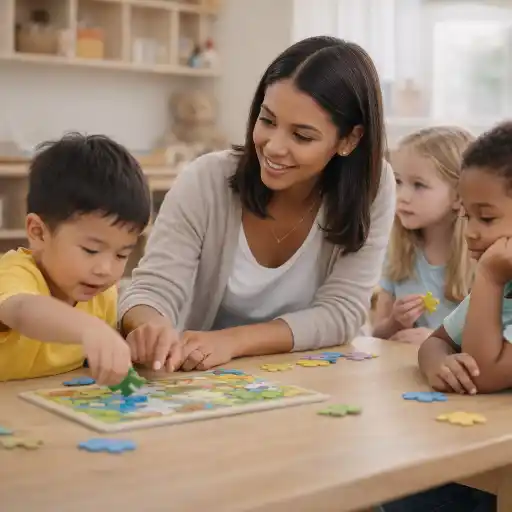
- Choose: Provide a familiar selection of open-ended materials, books, puzzles, or center choices for independent exploration.
- Connect: Invite the child to share an idea with a peer, if the child is interested, or help prepare materials for the next play experience.
🎨 For example, a child who quickly paints a single shape might choose to mix colors, paint on a larger surface, or use the same colors to create a story—without needing to copy a teacher’s sample. Child-led exploration can build language and sustained thinking when educators allow time and respond thoughtfully. For further ideas, see open-ended activities for young children.
Keep the options simple and teach children how to use them. A few familiar choices are generally easier to navigate than a crowded shelf or a long list of directions. Let the child’s interests guide whether to extend, repeat, or move on.
How can activities be adjusted without making the day feel rushed?
Begin by reviewing the activity itself and the rhythm of the day. If many children finish quickly, the task may be too short, too familiar, or overly directed. Consider whether it could become a longer investigation, connect to center play, or offer different levels of challenge. If only one child finishes early, an individual option may be more appropriate than changing the whole group’s schedule.
Protect uninterrupted time for play when possible. Back-to-back adult-led activities and frequent transitions can interrupt children just as they begin to develop an idea. Research summarized by the National Institute for Early Education Research found that more time in choice, literacy, and math—and less time in whole-group instruction and transitions—was associated with higher classroom quality ratings in the studied settings. This finding supports reviewing how the day is organized, rather than simply adding more tasks.
- Build flexible time into activity blocks so children can continue when they are engaged.
- Use clear, predictable cues to help children understand when an experience is ending and what comes next.
- Prepare a few accessible materials in advance so an extension does not require a major setup.
- Allow children to observe before joining and to participate in different ways.
Routines should provide security without becoming rigid. NAEYC’s guidance on daily routines and classroom transitions emphasizes that transitions are a meaningful part of supportive classroom practice. When an activity repeatedly feels hurried, check whether the schedule allows enough time for cleanup, self-help routines, and children to settle into the next experience. State requirements vary - check your state licensing agency when considering schedule changes.
What common responses should teachers avoid?
When a child finishes early, adults often respond automatically: “Do another one,” “Help your friend,” or “You must not have tried hard enough.” These comments can turn completion into a performance contest or make children feel responsible for keeping themselves busy. They may also obscure whether the activity was engaging, accessible, or appropriately challenging.
- Do not equate speed with ability. Ask what the child understood and observe how they approached the experience.
- Avoid adding repetitive work as a default. Offer a meaningful choice or a related extension instead.
- Do not require a child to help peers. Peer interaction can be invited, but it should not become a routine obligation for early finishers.
- Avoid interrupting deep engagement. If a child is focused and the schedule allows, give them time to continue.
- Do not compare children publicly. Children develop at different rates and demonstrate understanding in varied ways.
For directors, it can help to discuss these patterns as a team: Which activities often end quickly? Who is rushing, and in what circumstances? Are adults giving consistent cues and providing enough choice? Brief staff reflection can turn a recurring challenge into a practical planning adjustment. The goal is not to fill every moment, but to support meaningful participation and a calm classroom rhythm.
Summary: How should preschool teachers respond when children rush?
When a preschooler rushes through an activity, treat the behavior as a cue to observe and respond—not as proof of poor effort or complete mastery. Consider the child’s engagement, understanding, interests, and the demands of the activity. Ask a genuine question, listen to the child’s response, and offer a meaningful next step when it fits.
Prepare a few open-ended choices, adjust activities when a pattern emerges, and protect time for sustained play. Avoid turning early completion into extra mandatory work, comparisons, or an expectation that one child manage another. Small, thoughtful changes—paired with observation and team reflection—can make activities more responsive and the day less hurried. When teachers ask what the child’s pace is communicating, they can better decide whether to extend, adapt, or simply let the child move on.
For additional professional learning, consider ChildCareEd’s Moving About the Classroom: Effective Transitions for Everyday Buy Now $24.00, which focuses on using transitions as intentional classroom experiences. You may also explore The Best Promotion is Play Buy Now $35.00 to deepen your understanding of play-based learning. These are practical next steps for educators who want to support children’s choices and classroom engagement.
- 45 Hour Child Growth and Development
- CDA Home Visitor Subject Area 3 Part 3 Birth to 5
- CDA Preschool Credential with Portfolio Review
- Moving About the Classroom: Effective Transitions for Everyday
- Birth to Five CDA Credential with Portfolio Review
- CDA Bridge Bundle: Preschool
- Pediatric RSV First Aid & CPR/AED
- CDA Bridge Bundle: Family Child Care
- CDA Bridge Bundle: Infant/Toddler
- Texas Director Credential
- Recursos en Español sobre el Sueño Seguro del Bebé
- ¿Cómo puedo usar escenarios de juego de roles de primeros auxilios en mi aula?
- Capacitación en Salud y Seguridad Preventiva en Línea para Proveedores de Cuidado Infantil
- Cómo Celebrar el Día Nacional del Kindergarten
- Lista para Guardería en Casa en Illinois: Cómo Iniciar una Guardería en el Hogar
- Lista para Guardería en Casa en California: Cómo Iniciar una Guardería en el Hogar
- Retraso del Habla en la Guardería: Cómo Pueden Ayudar los Proveedores
- Cómo Ser Maestra de Preescolar en Dakota del Norte
- Capacitación Previa al Servicio para Proveedores de Cuidado Infantil en Dakota del Norte
- DCF Training for Preschool Teachers: Required Courses and Next Steps
- Calabazas, hojas y manzanas: actividades de otoño para preescolares
- Celebrando la amistad en el cuidado infantil durante el Día de los Mejores Amigos
- After School Activities for Elementary Kids Who Finish Homework Early
- How Can Preschool Routines Create Calmer, More Independent Classrooms?
- How Can Printable Activities Save Teachers Hours of Prep Time?
- What Are the Best Print-and-Play Activities for Substitute Teachers?
- How Do Color-Word Activities Support Reading Automaticity?
- How Do You Get a Child Development Associate (CDA) Credential?
- What Should Preschool Teachers Do When Children Rush Through Activities?
