A matching game should invite preschoolers to think—not leave them bored or overwhelmed. The right level of challenge grows from close observation, flexible materials, and responsive teaching; the [Play, Learn, Grow Online Version] offers a deeper look at development, milestones, and developmentally appropriate practice. Use the ideas below to turn a simple summer matching activity into an engaging opportunity for learning and professional reflection.
Why does the right level of challenge matter?
A preschool matching game can look simple, but children are doing complex work: noticing visual features, comparing choices, remembering information, and making decisions. When the task is within reach but still calls for effort, children can practice persistence and experience the satisfaction of solving a problem. If the game is far too easy, interest may fade; if it is too difficult, children may guess, disengage, or become discouraged.
The goal is not to make every child play at the same level. A thoughtful educator keeps the learning purpose steady—such as comparing visual details—while adjusting the materials, the number of choices, or the support offered. This reflects developmentally appropriate practice: begin with what children can do, then offer a manageable next step. As ChildCareEd’s guidance on adapting learning activities explains, observing each child and making small changes helps keep an activity in a productive learning zone.
This responsive approach also supports belonging. Children can participate in different ways, and each child’s progress can be noticed without comparing them to classmates. A warm, low-pressure game gives providers useful insight into #development, attention, and confidence while keeping play joyful.
How can you tell whether the game is too easy or too hard?
Watch before changing the game. A short observation can reveal more than a quick judgment based on whether a child finds every pair. Notice how the child approaches the cards: Do they scan the whole set, compare details, remember where a picture appeared, or ask for help? Consider engagement and effort alongside accuracy.
- Possible signs the game is too easy: the child matches instantly without looking closely, loses interest, or asks for a more complicated task.
- Possible signs the game is too difficult: the child repeatedly guesses, leaves the activity, appears frustrated, or needs frequent adult direction to continue.
- Signs the challenge may be a good fit: the child stays engaged, tries a strategy, accepts a hint, and can recover after an incorrect choice.
These are prompts for reflection, not labels. A child may struggle because the cards are visually busy, the directions are unclear, the pieces are hard to handle, or the setting is distracting. Try observing for five minutes and recording one objective note, such as, “Matched three pairs with the cards face up; needed a reminder to take one turn at a time.” The note can help you decide whether to adjust the task or provide another kind of support.
Development varies from child to child, so avoid treating age alone as a precise measure of readiness. The [Play, Learn, Grow Online Version](https://www.childcareed.com/courses-play-learn-1.html) can strengthen your understanding of development and appropriate practice for children ages one to five.
How should you build challenge gradually?
Change one feature at a time so you can see what helps. Start with the simplest version that lets the child understand the purpose, then increase complexity after the child shows interest and growing independence. A progression might look like this:
- Begin with objects: offer two identical, familiar items, such as toy shells or blocks.
- Move to picture pairs: place two or three pairs face up and model how to compare them.
- Add choices: increase the number of pairs gradually while keeping images clear and distinct.
- Introduce a memory element: turn a few pairs face down once children understand the matching rule.
- Deepen the comparison: invite children to match by a shared feature, category, pattern, or function rather than by identical appearance.
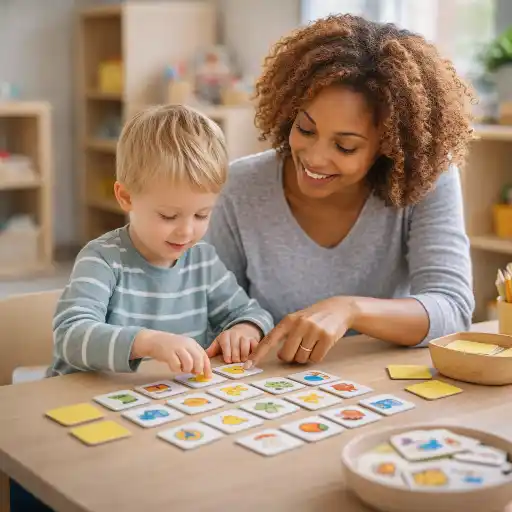
A themed resource such as Flip-Flop Matching: Summer Visual Matching Activity can provide a familiar, seasonal starting point. Use only a small selection of cards at first; later, add pairs or invite children to describe how they know two images belong together. You might ask, “What did you notice?” or “Which detail helped you decide?” Such questions encourage reasoning without turning play into a test.
Keep sessions brief enough for children to remain engaged. If a new step leads to repeated guessing or visible frustration, return to the previous level, model a strategy, or offer a hint. Progress is not a race; repeated, successful practice can be a meaningful step forward.
How can you adapt the game so every child can participate?
Adapt access and response methods while preserving the learning goal. If the goal is visual comparison, children do not need to name every picture or use a particular hand movement to show what they know. They can point, gesture, use eye gaze, select a symbol, communicate in a home language, or work alongside a partner.
- Reduce visual clutter and present just a few cards at a time.
- Use large, high-contrast pictures and provide adequate lighting.
- Place cards on a nonslip surface or use larger pieces that are easier to grasp.
- Offer a visual sequence such as “look, compare, choose, check.”
- Let children play seated, standing, on the floor, or with a peer or adult partner.
- Pair colors with shapes, patterns, pictures, or textures rather than relying on color alone.
🧩 Invite children to cooperate toward a shared goal, such as finding all the pairs together, when taking turns or competition adds unnecessary pressure.
Inclusive adaptations are not shortcuts or lower expectations. They remove barriers so children can engage with the intended idea. ChildCareEd’s article on adapting activities for developmental levels offers a practical way to think about adjusting the space, materials, and steps. For more focused professional learning, explore [Inclusive Lessons for Preschoolers](https://www.childcareed.com/courses-inclusive-lessons-for-preschoolers.html).
How can you extend learning and observe progress?
Matching does not have to end when every pair is found. Follow children’s interest and connect the game to language, early mathematics, movement, or social learning. Talk about similarities and differences using words such as same, different, pair, pattern, shape, and color. Invite children to count the pairs, sort them into groups, or find a classroom object that shares a feature with a picture.
These extensions keep the activity playful while making children’s thinking visible. A child might explain a match with words, demonstrate it by placing two cards side by side, or show a strategy by returning to a card’s location. The response can be meaningful even if it is not spoken. Playful games also offer practice with attention, working memory, turn-taking, and flexibility; NAEYC discusses these connections in its article on executive-function skills through games.
Keep observation notes brief and specific. Record what the child did and the support that helped, rather than making broad conclusions from one game. For example: “Matched five face-up pairs; described two as having the same pattern,” or “Matched with a partner after the choices were reduced to two.” Review notes over time to plan a useful next step and share positive observations with families.
What common pitfalls should educators avoid?
Even a well-chosen activity can become frustrating when the game rules or expectations take over. Keep the focus on exploration and learning, not speed or a perfect score. Children need time to look, think, and try again; an incorrect choice is information about the task or the child’s current strategy, not a reason to rush in with the answer.
- Too many cards at once: Begin with a small set and add choices as children become comfortable.
- Increasing difficulty too quickly: Change one feature at a time and watch how the child responds.
- Turning play into a race: Offer a cooperative version and recognize careful observation and persistence.
- Correcting every error immediately: Pause, invite another look, or offer a gentle clue.
- Assuming one successful round proves mastery: Observe the skill in other games and everyday situations as well.
- Using one participation method for everyone: Accept gestures, pointing, partner support, and other accessible responses.
Directors can help staff by agreeing on a simple learning goal, keeping materials accessible, and making room for brief observations during planning. If an activity repeatedly causes difficulty, first check whether the materials, directions, group size, or environment need adjustment. State requirements vary - check your state licensing agency when determining whether professional development or documentation meets local expectations.
Conclusion: How do you choose the right level of challenge?
Choose a matching-game challenge by observing how each child engages, beginning with an accessible version, and adjusting one feature at a time. Look for a balance: enough support for the child to participate, with enough complexity to invite curiosity and effort. The right level may differ across children and can change as skills, interests, and confidence grow.
Keep the experience inclusive and playful: use clear materials, offer flexible ways to respond, provide calm prompts, and value persistence as much as correct matches. Use brief notes to identify what the child can do and what small next step could extend learning. With this responsive approach, a summer flip-flop game can become a purposeful opportunity to practice comparison, memory, language, and collaboration—without losing the fun that makes play matter.
- CDA Certification en Español: Recursos y Consejos para Educadores Bilingües
- 🤯 ¿Por qué este niño está teniendo un comportamiento difícil de repente?
- Recursos en Español sobre el Sueño Seguro del Bebé
- Niveles de credencial de Maryland: qué significan
- Cómo ser director de cuidado infantil en Maryland
- 10 Ejemplos de Cómo la Cultura Influye en el Desarrollo Infantil
- Proporciones de Cuidado Infantil y Tamaños de Grupo por Edad en Virginia (Guía Rápida para Centros y Hogares)
- Ejemplos de Crianza Respetuosa vs. Crianza Permisiva
- Cómo Ser Maestra de Preescolar en Illinois
- Cómo Ser Maestra de Preescolar en California
- Celebrando la amistad en el cuidado infantil durante el Día de los Mejores Amigos
- Canciones, juegos y preguntas de círculo para niños
- How Can Printable Activities Save Teachers Hours of Prep Time?
- How Can You Create Easy Preschool Math Centers with Print, Prep, and Start Learning?
- Why Is Beginning-Sound Bingo a Smart Step Toward Reading?
- How Do Memory and Matching Games Support Visual Discrimination?
- How Can Juneteenth Symbols Build Visual Memory in Young Children?
- Why Do Memory Games Support Attention and Working Memory?
- How Can Dinosaur-Themed Group Games Build Vocabulary and Turn-Taking?
- How Can You Choose the Right Level of Challenge in a Preschool Matching Game?
