A few leaves, a shallow tray, and a thoughtful question can turn a tight corner into a seasonally rich learning space. Explore the Creating the Natural Outdoor Classroom  Buy Now $16.00 course to strengthen your nature-based classroom practices and gain practical ideas for supporting children’s sensory exploration, inquiry, and connection with the natural world. Read on for a small-space plan you can adapt with materials you already have.
Why does a fall nature station matter, even in a small space?
A nature station gives children a predictable place to observe, touch, compare, and wonder. Fall offers a changing collection of colors, textures, shapes, and sounds; a few carefully selected objects can prompt rich conversations and repeated discoveries without requiring a dedicated room or large outdoor area. For providers, this kind of focused setup can bring the natural world into a busy daily routine in a manageable way.
Hands-on exploration supports learning across domains. Children might sort leaves by color, describe a pinecone’s texture, notice how a seedpod opens, or draw a pattern they see. These moments build vocabulary, early math and science thinking, fine-motor control, attention, and social skills as children share tools and ideas. As highlighted in creative ways to use nature as your classroom, natural objects can inspire art, sensory play, classification, observation, and imaginative play.
Keep the goal simple: create an inviting, safe place for children to notice and investigate—not a display they are told not to touch. A small station can be a meaningful extension of the curriculum when adults make room for child-led exploration and responsive conversation.
How do you choose and arrange a station in a tight footprint?
Start by looking at the space through children’s eyes. Choose a calm, accessible spot where educators can supervise and children can approach without blocking a walkway or disrupting another activity. A low shelf, a tray on a sturdy table, or a rolling cart can all work. Limit the display to a few items at a time; a simple arrangement helps children focus and makes rotation easier.
- Use a shallow tray or basket to define the station and contain loose materials.
- Place a small number of sturdy objects—such as a large leaf, a clean pinecone, a smooth piece of bark, or a child-safe gourd—on a neutral cloth.
- Keep magnifiers, picture cards, sketch paper, or clipboards nearby, but offer only a few tools at once.
- Leave space for children to sit or stand comfortably, and make a clear route for access.
- Store extra items in a labeled container so staff can rotate the display without clutter.
A station does not need permanent furniture. The same tray can move between a classroom shelf, a covered porch, or an outdoor table, depending on your program’s schedule and supervision plan. The small-space outdoor play ideas article also offers practical inspiration for portable setups and organized zones.
Which fall materials and invitations work well for young children?
Choose materials that are interesting to explore, appropriate for the ages in your group, and easy for staff to inspect and maintain. Start with familiar natural objects: broad leaves, large pinecones, bark pieces, seedpods, and small pumpkins or gourds. Add useful tools such as magnifiers, sorting bowls, picture labels, and paper for drawing or rubbings. A thoughtfully designed fall nature table can also give children opportunities to notice details, classify objects, and express ideas through art.
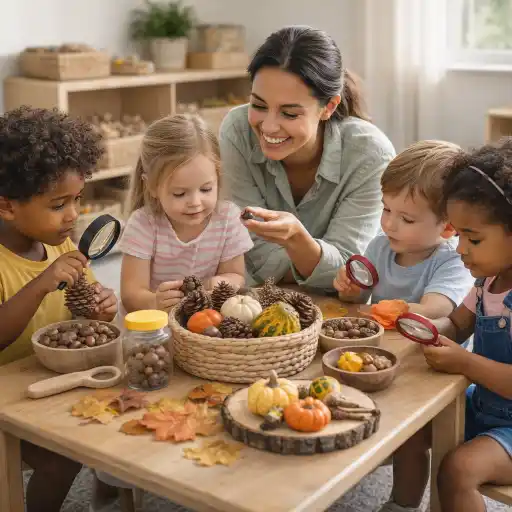
Offer one clear invitation at a time, then follow children’s interests. For example:
- 🍂 “What differences do you notice?” Invite children to compare leaves by color, shape, size, or texture.
- “Which objects feel smooth, rough, light, or heavy?” Provide words and time for children to describe what they find.
- “Can you make a pattern?” Offer larger, safe objects for arranging and repeating sequences.
- “What might be inside this seedpod?” Encourage observation and predictions; do not require children to open or taste materials.
- “Can you draw what you see?” Provide paper and crayons for close observation and representation.
For infants and toddlers, use fewer, larger objects and close adult support. For preschoolers, add sorting, measuring, drawing, and children’s questions. Adapt the invitation so every child can participate through looking, listening, pointing, touching, or using an adapted tool.
How can you make the station safe, inclusive, and easy to maintain?
Safety begins with selecting and checking materials, not just supervising once children begin. Inspect natural objects before use and remove items that are sharp, moldy, contaminated, unstable, or potentially toxic. Consider choking hazards, allergies, sensitivities, and the ages and developmental abilities of the children. Avoid unknown berries, mushrooms, and plants. Do not assume a natural item is automatically safe because it came from outdoors.
Plan active supervision around how children will use the station. Keep materials within staff sight, maintain clear pathways, and set simple expectations such as “materials stay on the tray” or “we look closely, then wash hands.” Clean reusable objects and surfaces according to program procedures, and store materials where they stay dry and protected between uses.
- Offer a visual choice card or picture labels for children who benefit from added communication support.
- Provide a seated way to explore and tools with varied sizes or grips.
- Allow children to observe before touching; participation should not depend on handling every object.
- Use a short daily check to confirm the tray and materials are clean, intact, and appropriate.
State requirements vary - check your state licensing agency, especially when program rules address natural materials, small parts, food, or sanitation. A clear routine supports both children’s exploration and staff confidence.
How can you connect nature exploration to curriculum and documentation?
A nature station becomes more than seasonal decoration when educators connect children’s discoveries to meaningful learning goals. Choose one or two intentions—such as descriptive language, comparison, counting, observation, or creative expression—and use open-ended prompts rather than turning the experience into a quiz. If children become fascinated by leaf shapes, for example, you might add a matching activity, invite them to make a class chart, or read a related book together.
Documentation can be brief and useful. Write down a child’s question, photograph a grouping the child created, or record a sentence about what the child tried. These small observations help staff plan what to offer next and give families a glimpse of the learning behind play. The preschool science center ideas resource suggests using simple tools and natural materials to encourage observation and inquiry.
To keep the station manageable, establish a weekly rhythm: observe what children use, remove worn or unsuitable items, and rotate in a few new objects. Invite children to help care for and organize the materials. If staff would like a deeper foundation for nature-rich outdoor learning, the online CDA: Creating the Outdoor Classroom Buy Now $16.00 course explores intentional outdoor-environment planning and strategies for supporting children’s learning.
Conclusion: What is the simplest way to begin?
To build a fall nature station in a small child care space, choose a supervised corner, define it with a tray or basket, and offer a few safe, interesting objects with one simple invitation to explore. Keep the setup accessible, inclusive, and easy to reset; adapt the materials and prompts for children’s ages, interests, and abilities. Ask questions that encourage noticing, and capture a brief observation to guide what comes next.
A modest station can support language, early science and math, creativity, and connection with nature without adding a complicated project to an already full day. Start with one tray, watch what children do, and let their curiosity shape the next rotation. For expanded ideas and professional learning, explore the Creating the Natural Outdoor Classroom Buy Now $16.00 course.
Related ChildCareEd courses:
- Creating the Natural Outdoor Classroom Buy Now $16.00
- CDA: Creating the Outdoor Classroom Buy Now $16.00
- Building Early Science Foundations Buy Now $16.00
- Basic Science in Early Childhood Buy Now $25.00
- Lesson Planning for Preschoolers Buy Now $24.00
These courses offer further learning related to nature-based environments, outdoor classroom planning, early science inquiry, and developmentally appropriate lesson planning.
- Creating the Natural Outdoor Classroom
- CDA: Creating the Outdoor Classroom
- What Makes Me Special: An Overview of Autism and ADHD
- Spaces that Support Discovery
- Building Equity: Inclusionary Practices in Preschool
- Sensitive Periods in Montessori: Guiding Natural Learning
- Texas Director Credential
- Building Early Science Foundations
- Family Child Care: Building, Premises, and Outdoor Safety
- Raising Peaceful Learners: The Montessori Advantage
- 👶 ¿Cuáles son las proporciones y grupos requeridos en Dakota del Norte? 🏫
- Curso de Comunicación de 9 Horas de Maryland
- Cómo ser director de cuidado infantil en Maryland
- 10 Ejemplos de Cómo la Cultura Influye en el Desarrollo Infantil
- Capacitación en Salud y Seguridad Preventiva en Línea para Proveedores de Cuidado Infantil
- Normas de Licenciamiento de Cuidado Infantil en Virginia para Centros Diurnos Infantiles y Hogares Diurnos Familiares
- Proporciones de Cuidado Infantil y Tamaños de Grupo por Edad en Maryland (Guía Rápida para Centros y Hogares)
- Proporciones de Cuidado Infantil y Tamaños de Grupo por Edad en Virginia (Guía Rápida para Centros y Hogares)
- Capacitación Previa al Servicio para Proveedores de Cuidado Infantil en Dakota del Norte
- Fall Sensory Activities for Toddlers and Preschoolers
- Pumpkin, Leaves, and Apples: Fall Activities for Preschoolers
- Celebrando la amistad en el cuidado infantil durante el Día de los Mejores Amigos
- Cómo simplificar la capacitación para sus empleados de daycare
- How can seasonal activities (spring, summer, fall, winter) combine fun with clear educational goals?
- How can childcare programs celebrate the harvest season in ways that are inclusive, safe, and sensory-rich?
- How Can Preschool Teachers Use Fall Activities to Strengthen Family Engagement?
- How Can Child Care Providers Make Fall Activities Inclusive for Every Child?
- How Can Fall Activities Build Kindergarten Readiness Skills?
- How Can You Plan a Fall Celebration That Welcomes Families with Different Holiday Beliefs?
- How Can You Build a Fall Nature Station in a Small Child Care Space?
