When a child avoids a texture, sound, or scent, the activity can still be an invitation to learn—not a test of willingness to participate. Explore practical ways to honor children’s sensory preferences while keeping curiosity and connection at the center, and build your inclusive teaching skills with Effective Approaches for Autism and Inclusion  Buy Now
$55.00$45.00 and Inclusive Lessons for Preschoolers Buy Now $16.00. These courses offer strategies for adapting materials and activities, supporting diverse learners, and making classroom participation more accessible.
Why does sensory choice matter in a five-senses activity?
A five-senses activity can make learning vivid: children notice colors, listen for sounds, compare safe textures, identify familiar scents, and talk about flavors. But the same input can feel enjoyable to one child and uncomfortable or overwhelming to another. A child who pulls away from glue, covers their ears, or declines to smell an unfamiliar item is communicating something about their experience—not necessarily refusing to learn.
Children may respond differently across senses and situations. A child might enjoy looking at paint but dislike touching it, or happily listen to a quiet shaker but avoid a loud group sound. Sensory preferences may also shift with fatigue, hunger, illness, stress, or the activity’s setting. Avoid assuming a diagnosis based on one response; focus instead on what helps each child access the learning goal.
Inclusion means preserving the purpose of the activity while offering more than one route into it. A child can learn about texture by watching a material move, comparing it with a tool, or describing what a peer notices. These alternatives protect agency and keep the child part of the group. As the ChildCareEd article on responding when a child avoids messy or sensory play emphasizes, access and belonging matter more than getting every child to touch every material.
How can providers plan one activity with multiple ways to participate?
Start with a clear, manageable learning goal: for example, noticing that objects can sound different, or using words to compare textures. Then prepare a few choices that let children explore that goal with different levels of contact and stimulation. Explain what will happen, show the materials before beginning, and let children know where they can pause or clean up.
- For touch: offer a brush, scoop, tongs, or gloves where appropriate, alongside optional hands-on exploration.
- For hearing: let children listen from farther away, choose a quieter instrument, or observe while an adult makes the sound.
- For sight: invite children to look closely, sort pictures, or use a magnifier without handling the featured material.
- For smell: keep scents mild and familiar, offer a choice to observe without sniffing, and avoid scented products if sensitivities or allergies are a concern.
- For taste: make tasting optional. Children may observe, describe, or sort food pictures instead; check allergies and family dietary or cultural guidance before offering food.
“You can use the spoon, watch, or choose the picture cards” is a useful invitation because every option is a real form of participation. This approach aligns with the ChildCareEd resource on exploring the five senses, which presents sensory learning through observation, discussion, and hands-on experiences.
What adaptations make each sense more accessible?
Adapt one feature at a time, then observe the child’s response. A smaller group, a quieter location, a defined tray, or a familiar material can make an activity feel more predictable. Keep the setup simple: too many new objects, strong scents, unexpected sounds, or crowded choices can increase the sensory load rather than invite exploration.
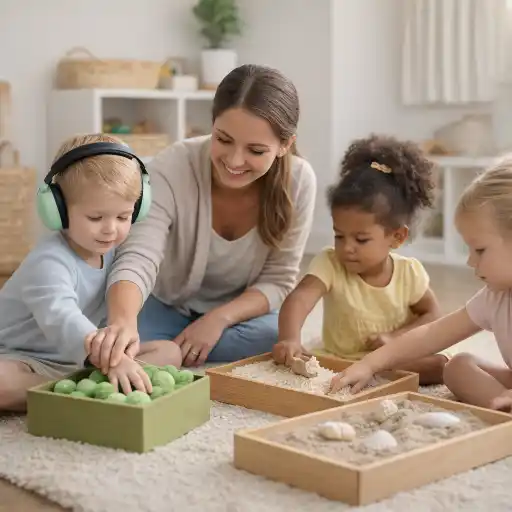
- Sight: Reduce visual clutter and use uncluttered picture cards, large objects, or a focused color hunt.
- Hearing: Avoid sudden or amplified sounds; offer a warning, a quiet listening spot, or a visual sound-making demonstration.
- Touch: Begin with dry or familiar materials, use tools to create distance, and keep a cloth and handwashing option nearby.
- Smell: Use unscented options or sealed containers that children can choose to open; never require close smelling.
- Taste: Treat tasting as an invitation, not a learning requirement. Follow allergy, food-handling, choking-prevention, and family-provided dietary guidance.
Offer children control over starting, stopping, and changing their approach. A child may participate by watching first, then choosing a tool—or may prefer observation throughout. The goal is not to make a child tolerate an unwanted sensation. It is to preserve meaningful learning and agency while respecting individual cues.
How can observation and family partnership guide your choices?
Brief, objective observations can help a team distinguish between a one-time preference and a recurring barrier. Record the activity, material, setting, what the child did, what support was offered, and what happened next. Include conditions that supported participation, not only moments of difficulty. For example: “Ari watched the water pour, then used a cup to transfer it” offers more useful information than “Ari would not join.”
Use those notes to make a small adjustment and see whether access improves. If a child avoids scented jars, try unscented objects or picture choices; if the sound activity is too loud, lower the volume or move farther away. Change one element at a time when practical so the team can notice what made a difference.
Families can share important context about a child’s preferences, allergies, food restrictions, familiar materials, and communication. Ask with curiosity: “We noticed the strong scent seemed uncomfortable, while looking at the picture cards worked well. Have you seen something similar at home? What helps?” The ChildCareEd family note on safe five-senses exploration Buy Now $1.50 is designed to prompt communication about sensitivities, allergies, and dietary or religious considerations.
Providers can observe, adapt, and share information; they do not diagnose or prescribe clinical treatment. If a persistent pattern significantly affects a child’s comfort, safety, or participation across daily routines, discuss observations respectfully with the family and consider whether they would like to consult an appropriate professional.
Which common pitfalls should providers avoid?
It is understandable to hope every child will try the activity, particularly when materials are ready and the group is excited. Still, pressure can turn exploration into a stressful demand. Keep the invitation warm, give children time to decide, and make alternatives part of the plan from the beginning.
- Do not place a material on a child’s skin or guide their hand into it without consent.
- Do not frame avoidance as defiance, lack of curiosity, or evidence of a diagnosis.
- Do not repeatedly coax after a child declines; offer a choice and remain available.
- Do not treat watching or using a tool as “less than” participation.
- Do not assume one adaptation will suit every child or work the same way every day.
- 🧼 Check age suitability, allergies, choking hazards, hygiene, food safety, and active supervision before setting out materials.
Keep children connected to peers even when they choose a different way to engage. A provider can narrate shared discoveries—“You heard the soft tap; Maya noticed the louder one”—without directing attention to a child’s difference. Directors can support staff by agreeing on inclusive language, safe material procedures, and a consistent approach to documenting what works. State requirements vary - check your state licensing agency.
Avoid turning a five-senses activity into a goal of getting children to “overcome” discomfort. Instead, ask: What can this child explore comfortably today, and how can we keep the learning meaningful?
How can a five-senses activity welcome every child?
A five-senses activity is inclusive when children can explore its ideas without being required to accept every sensation. Offer real choices, adapt the environment and materials, and value looking, listening, describing, using tools, and taking a break as legitimate ways to participate. Observe responses over time, share specific information with families, and adjust based on what helps.
The central question is not whether each child touches, tastes, or smells every item. It is whether every child has a safe, respectful way to participate in learning and community. When providers make choice and comfort part of the design, children can stay curious while building trust in the classroom. For additional professional learning, consider Play with Purpose: Supporting Children with Autism Buy Now $55.00$45.00, The ABCs of Behavior: Turning Challenges into Learning Opportunities Buy Now $55.00$45.00, and Special Needs: From Referral to Inclusion Buy Now $24.00.
- 45 Hour Child Growth and Development
- CDA Home Visitor Subject Area 3 Part 3 Birth to 5
- 45 Hour Preschool Methods and Materials
- Birth to Five CDA Credential with Portfolio Review
- Pediatric RSV First Aid & CPR/AED
- 45 Hour School Age Methods and Materials
- Texas Director Credential
- Bienvenido! Welcoming All Families
- Pumpkin Spice and Sensory Delight: Easy Autumn Sensory Bins for Early Learners
- CDA Certification en Español: Recursos y Consejos para Educadores Bilingües
- Preschool Lesson Plans for Learning, Creativity, and Growth
- How Can Simple Cooking Activities Teach Skills in North Dakota Child Care Programs?
- Why Does Sensory Play Matter and How Can My Child Care Program Start?
- How Can Child Care Providers Understand and Support Sensory Needs in Young Children?
- Crayon Colors Meaning: Favorite Color, Feeling, or Just the Crayon They Grabbed?
- How Can Child Care Providers Support Children with Sensory Processing Differences?
- How Can Daycare Providers Support Children with Sensory Processing Differences?
- How Can Tracing and Painting Build Multisensory Prewriting Skills?
- How Can Teachers Help Preschoolers Recognize When They Need a Break?
- How Can Preschoolers Learn to Explain Hunger, Thirst, and Other Body Needs?
- How Can Child Care Providers Make Fall Activities Inclusive for Every Child?
- How Can Child Care Providers Make Dental Health Lessons Fun for Preschoolers Who Resist Brushing?
- How Can Child Care Providers Bring Autumn Indoors Through Texture Hunts and Open-Ended Art?
- How Can a Five-Senses Activity Include Children Who Avoid Certain Sensations?
- How Can Simple Movement Breaks Help Restless Preschoolers Reset?
