A classroom mailbox can turn early writing from an adult-assigned task into a message children are eager to create, send, and receive. With simple routines and accessible materials, providers can nurture communication, print awareness, and peer connection through everyday play. For practical ways to strengthen these classroom experiences, explore Classroom Tools for Emergent Literacy Buy Now $25.00, a course that offers strategies for building literacy-rich environments and supporting children’s emerging skills.
Why can a classroom mailbox make writing feel meaningful?
Children are more likely to experiment with writing when it serves a purpose they understand. A note to a friend, a picture postcard for a family member, or a pretend delivery gives marks and words an audience. Children begin to see that writing can carry an idea from one person to another—not simply fill a page because an adult asked.
This purpose can motivate children who are still developing confidence or pencil control. A message may begin as a drawing, a string of marks, a name, dictated words, or recognizable letters. Each attempt communicates something. Research on early writing emphasizes that young children compose ideas using drawings, scribbles, and letter-like forms as they learn how oral and written language connect; see Gerde’s discussion of promoting early writing across the school day.
A mailbox can also support relationships. Children think about what a recipient might enjoy, notice classmates’ names, take turns delivering messages, and respond to the excitement of receiving something addressed to them. These social exchanges make the writing center feel alive.
- Children encounter writing as purposeful #communication.
- They practice names, print concepts, drawing, and early letter forms.
- They build connection, perspective-taking, and classroom belonging.
How do you set up a mailbox children can use independently?
A useful mailbox system does not need elaborate furniture or expensive supplies. A shoebox, recycled cartons, labeled pockets, or small bins can become mailboxes. Set them at children’s height, make the opening easy to use, and identify each one with a name card. Photos paired with names can help younger children recognize where mail belongs.
Place the mailbox near a small writing station so children can move naturally from making a message to sending it. Keep the materials visible and manageable, and show children how to return them when they are finished. For inspiration on connecting mail to hands-on classroom play, see post office and mailing activities for preschool.
- Paper in several sizes, blank cards, and postcards
- Crayons, pencils, markers, and child-safe writing tools
- Envelopes, reusable stickers as pretend stamps, and name cards
- A class mailbox for outgoing messages and individual mail slots for delivery
- Optional picture prompts or word cards that reflect children’s interests
Make the system accessible to every child. Offer larger paper or tools, allow dictation, and provide picture or name supports when helpful. Keep small materials supervised and follow program safety practices. State requirements vary - check your state licensing agency.
What can children write when they are not yet writing words?
Children do not need conventional spelling or handwriting to participate. For young writers, writing is an evolving way to represent and share an idea. A drawing, scribble, symbol, copied name, or dictated sentence can all be a message worth sending. The goal is meaningful expression, not a polished product.
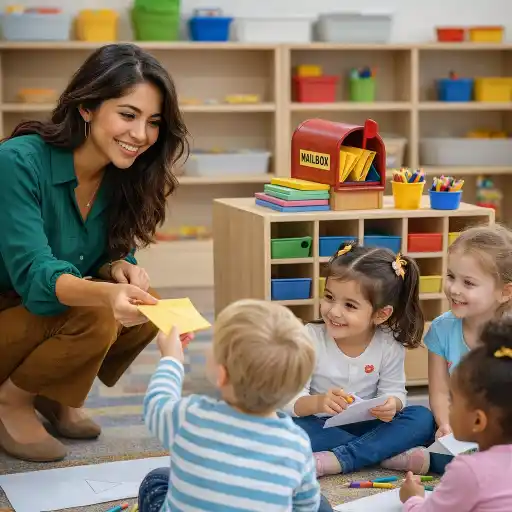
Offer a few prompts, then let children choose their content. They might draw a favorite block construction, invite a friend to the pretend post office, send a thank-you note, or tell a classmate about a book. If a child dictates, write their words clearly and read the message back. This helps connect spoken language to print while preserving the child’s authorship.
As children show interest, add gentle scaffolds. A name card can support a signature; picture-word cards can help a child label a drawing; a teacher can model how to address an envelope. You might say, “Who would you like to send this to?” or “What do you want your friend to know?” Avoid turning the moment into a spelling quiz. Notice the message and effort first.
- Invite children to draw, scribble, dictate, trace, or write independently.
- Use familiar names and meaningful words as optional supports.
- Respond to the child’s intended message before offering a writing model.
- Honor home languages and alternative communication methods.
How can mail routines support literacy, learning, and belonging?
A mailbox creates opportunities for much more than pencil practice. When children make and deliver mail, they encounter a sequence: create a message, identify a recipient, sort the mail, and deliver it. These steps invite planning and problem-solving, along with early understandings of how communication systems work.
Children can also explore names, initial letters, counting, sorting, and spatial language as part of play. A mail carrier might sort envelopes by recipient or color; another child may count deliveries or decide which route to follow. Dramatic play around mail can bring literacy, fine-motor activity, language, and social interaction together. Pre-K Pages notes that mail-themed dramatic play offers opportunities for authentic pre-reading, writing, fine-motor practice, and empathy through role-play: delivering mail dramatic play.
Make fairness part of the routine. A mailbox system can unintentionally leave a child out if some classmates receive many notes and others receive none. Model inclusive choices: children can write to someone whose slot is empty, create a class-wide message, or make a card for a rotating helper. Never require a child to disclose personal information or exchange messages they do not want to share.
- 📬 Invite children to take turns as writers, sorters, and mail carriers.
- Use names and photos to support recognition and correct delivery.
- Offer class messages or inclusive recipient choices so everyone can participate.
- Let children decide whether they want a message read aloud or kept private.
How can educators guide the center without taking over?
The educator’s role is to prepare an inviting environment, model how writing can be used, and respond to children’s ideas. Introduce the mailbox with a short demonstration: write a quick note, place it in a mailbox, and show how it can be delivered. Then make room for children to transform the activity according to their interests.
Observe before adding more directions. Do children know where materials belong? Are they choosing recipients, making marks, or discussing what a message says? A brief observation can reveal a helpful next step—perhaps adding envelopes, name cards, or more time for delivery play. Documentation may include a child’s exact words, a photo of a message when permitted, or a short note about how the child used print.
Common pitfalls are manageable. Avoid expecting every child to write the same thing, correcting every invented spelling, or making a note mandatory. Keep the center open-ended, maintain appropriate supervision, and establish simple norms for kind and respectful messages. If incoming classroom mail is delivered publicly, consider privacy and children’s comfort before sharing its contents.
To extend the learning, invite children to help decide how the post office works: What should the mail carrier do? How will we know where each letter goes? These questions support agency and make the mailbox a continuing classroom project rather than a one-day theme.
Conclusion: How does a mailbox give children a reason to write?
A classroom mailbox makes writing meaningful by giving children a purpose, a recipient, and a chance to see their ideas travel. With simple supplies, accessible choices, and thoughtful routines, providers can support drawing, dictation, early print knowledge, social connection, and playful problem-solving in one welcoming center.
Remember the essentials: value the message before its form, make participation possible for children at different stages, support fair and respectful exchanges, and observe what children do so the environment can respond to their interests. A child’s first note may be a picture or a few marks—but when it reaches a friend, it is already doing important work. For a more complete learning experience, Science of Reading Foundations in the Pre-K Classroom Buy Now $16.00 explores emergent writing alongside other foundations of early literacy.
Further ChildCareEd courses for providers
- Reading Aloud and Storytelling
 Buy Now $16.00 — strategies for interactive stories and language development.
- Language Development in Early Childhood Buy Now $16.00 — approaches to supporting young children’s communication and language growth.
- Assessment of Language and Literacy Skills Buy Now $24.00 — guidance on observation and using documentation to plan responsive support.
- Moving About the Classroom: Effective Transitions for Everyday
- Early Mathematics Through Play
- CDA Home Visitor Subject Area 3 Part 3 Birth to 5
- CDA Home Visitor Subject Area 2 Part 3 Birth to 5
- Beyond the Classroom: Connecting Families to Essential Services
- CDA Infants/Toddlers: Lesson Planning Made Easy
- Teach with Respect!
- Pediatric RSV First Aid & CPR/AED
- Creating Engaging and Meaningful Learning Experiences
- Texas Director Credential
- CDA Certification en Español: Recursos y Consejos para Educadores Bilingües
- 💛🧩 ¿Cómo puedo hacer que mi enseñanza sea inclusiva para los niños con autismo?
- 👶 ¿Cuáles son las proporciones y grupos requeridos en Dakota del Norte? 🏫
- Recursos en Español sobre el Sueño Seguro del Bebé
- 10 Ejemplos de Cómo la Cultura Influye en el Desarrollo Infantil
- Proporciones de Cuidado Infantil y Tamaños de Grupo por Edad en Maryland (Guía Rápida para Centros y Hogares)
- Proporciones de Cuidado Infantil y Tamaños de Grupo por Edad en Nueva Jersey (Guía Rápida para Centros y Hogares)
- Proporciones de Cuidado Infantil y Tamaños de Grupo por Edad en Virginia (Guía Rápida para Centros y Hogares)
- Lista para Guardería en Casa en Illinois: Cómo Iniciar una Guardería en el Hogar
- Retraso del Habla en la Guardería: Cómo Pueden Ayudar los Proveedores
- Cómo Trabajar en el Cuidado Infantil en Carolina del Norte: Requisitos y Pasos
- Celebrando la amistad en el cuidado infantil durante el Día de los Mejores Amigos
- Canciones, juegos y preguntas de círculo para niños
- Cómo simplificar la capacitación para sus empleados de daycare
- How Can Child Care Providers Support Early Writing Without Using Worksheets?
- ¿Todos los niños deben participar en el tiempo de círculo?
- Do Your Automatic Email Replies Still Send Families to Former Staff?
- ¿Faltan Materiales o Falta una Nueva Estrategia? Cómo Revisar los Rincones del Aula
- How Can a Classroom Mailbox Help an Absent Friend Feel Remembered?
- How Can a Classroom Mailbox Give Children a Meaningful Reason to Write?
