Building a program that fits young children is doable. This guide helps child care providers and directors plan clear, kind, and smart programs. It shows simple steps for using Developmentally Appropriate Practice so your #children learn through #play, feel safe, and grow. You will see links to helpful ChildCareEd pages and other trusted resources. Remember: state requirements vary - check your state licensing agency.
What is a developmentally appropriate program?
A developmentally appropriate program meets three things at once. It fits the child’s age, the child as an individual, and the child’s family and culture. 1) Age-appropriate: what most children this age can do; 2) Individual-appropriate: each child’s interests and needs; 3) Culturally-appropriate: what families bring from home. For a clear overview see What Is Developmentally Appropriate Practice in Early Childhood Education?.
Here are 4 quick ideas to remember:
- 😊 Watch children first. Let their choices guide you.
- 📝 Pick 1–2 small goals each week (language, sharing, walking, fine motor).
- 🎲 Use play as the main teaching tool. Play builds thinking and language.
- 🤝 Work with families. Invite their songs, food ideas, and stories.
Why this matters: When programs match children, children stay engaged, calm, and learn more. For more classroom ideas and why play matters, see DAP Delight. Keep these hashtags in mind: #DAP #children #inclusion #play #assessment.
How do I design the room, routine, and daily schedule so learning happens?
Design makes a big difference. A good room helps children make choices, move safely, and do real work. Follow these steps to set up your space and day.
- Observe and map the room: note cozy spots, open floor space, and active areas.
- Set clear centers: blocks, art, reading, dramatic play, and a sensory table. Rotate materials weekly.
- Make routines predictable: arrival, free play, group time, outdoor play, and rest. Children do best when they know what comes next.
- Use visuals: picture schedules and labeled shelves help children choose and return toys.
- Plan transitions: short songs, warnings, or a countdown reduce stress on mixed ages.
Practical room checklist (easy to use):
- 📚 Cozy reading corner with books in home languages.
- 🧱 Clear block area with floor space for building.
- 🎨 Art table with loose parts and many tool sizes.
- 🌿 Outdoor/active zone for running and gross motor play.
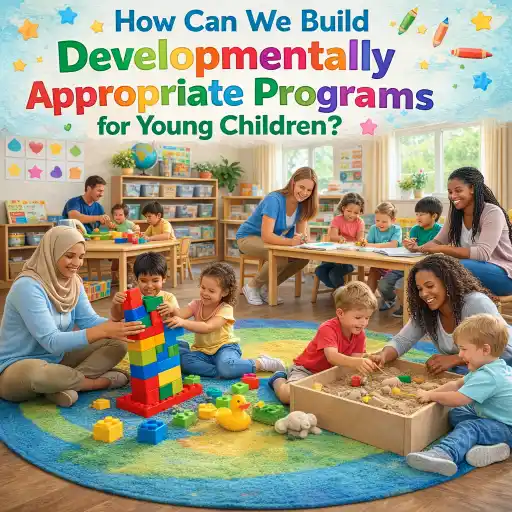
For templates and weekly plans, see How can I create developmentally appropriate lesson plans. For infant and toddler ideas, check materials like The Creative Curriculum for Infants, Toddlers, and Twos. For focused guidance and training specifically for infant and toddler care, see Building Up Infants and Toddlers. Design that matches development lowers behavior problems and supports learning.
How do I plan lessons, assess progress, and adapt for different ages and needs?
Lesson planning with DAP is simple. Start with what you see and build small goals. Use short notes and photos to track progress. Follow this 5-step plan:
- 🔍 Observe for 10 minutes to find interests and strengths.
- 🎯 Choose 1–2 learning goals for the week (for example: new words or taking turns).
- 📋 Plan one main activity and two alternatives so different ages can join.
- 📸 Record one photo and one sentence about what each child did. Use it to plan next steps.
- 🗣️ Share a short note with families about progress and ask for ideas at home.
Assessment tools: Use simple checklists and anecdotal notes. The CDC offers helpful milestone tracking tools—see Learn the Signs. Act Early.. For more program tools and activity packs, visit ChildCareEd resources like Children's Keepers resources and lesson templates.
Adapting for ages and needs (quick tips):
- 🔁 Layer materials: easy, medium, hard options in the same activity.
- 🧩 Offer roles: sorter, builder, recorder so children join at their level.
- 🛠️ Use adaptations: larger crayons, adaptive scissors, quiet corners.
- 🤝 Partner with families and specialists for children with special needs.
Common mistakes and fixes:
- ❌ Skipping observation. ✅ Fix: schedule a daily 10-minute watch slot.
- ❌ Too many goals. ✅ Fix: focus on 1–2 skills each week.
- ❌ Letting screens replace play. ✅ Fix: use tech as a small tool, not the main activity.
How do we include every child, handle behavior, and support staff learning?
Inclusion and positive guidance are part of DAP. Use strength-based steps that welcome every child. The OECD report on inclusion explains why program practices must adapt to help all children thrive—see Supporting inclusion in ECEC. Also review NAEYC program standards for strong relationships and curriculum (NAEYC Program Standards).
Steps to support inclusion and behavior:
- 🙂 Prevent problems by organizing the room: clear centers, duplicate popular toys, visual rules.
- 🙌 Use routines and warnings for transitions to reduce upset.
- 👍 Praise specific behaviors ("You waited your turn—thank you!").
- 🧘 Offer calm-down areas instead of harsh time-outs.
- 🤝 Partner with families and specialists to adapt activities.
Staff training and support:
- 1) Offer short, focused trainings like DAP for Preschool Buy Now $35.00.
- 2) Use peer coaching and walk-throughs to build skills.
- 3) Meet weekly to review notes and plan small next steps.
FAQ (short):
- Q: How many goals per week? A: 1–2 goals work best.
- Q: Can mixed-age groups use the same activity? A: Yes—offer layered roles and materials.
- Q: How to talk with parents who want academics only? A: Share examples and child work showing growth from play (see DAP Delight).
- Q: Where to find quick activities? A: Use themed packs and activity lists at ChildCareEd resources.
Why it matters: Developmentally appropriate programs help children learn, feel safe, and get ready for school. They also make staff feel confident and show families your program cares. Small, steady steps—observe, plan one goal, use play, and reflect—make big differences. For more tools, check ChildCareEd lesson plans and resources.
Conclusion
Building a developmentally appropriate program is about simple choices. 1) Watch children. 2) Pick small goals. 3) Use play and good room design. 4) Track progress with short notes or photos. 5) Train and support staff. Use the ChildCareEd guides linked above, and trusted sources like NAEYC and CDC for more help. Remember: state requirements vary - check your state licensing agency. You and your team can make a warm, strong program—one small change at a time.
- 45 Hour Child Growth and Development
- 45 Hour Preschool Methods and Materials
- Children at the Wheel: Emergent Curriculum
- Pediatric RSV First Aid & CPR/AED
- 45 Hour School Age Methods and Materials
- CDA Bridge Bundle: Family Child Care without Portfolio Review
- CDA Bridge Bundle: Infant/Toddler without Portfolio Review
- CDA Bridge Bundle: Preschool without Portfolio Review
- Emergent Learning & Development
- Texas Director Credential
- Celebrating International Women's Day
- Tiny Tots, Big Learning: Crafting Curriculums for the Littlest Learners!
- CDA Certification en Español: Recursos y Consejos para Educadores Bilingües
- Teaching with Purpose
- ☀️Sunny Side Up: Smart & Safe Summer Fun for Kids!
- How can we build developmentally appropriate programs for young children?
- How do we build developmentally appropriate programs for young children?
- Canciones, juegos y preguntas de círculo para niños
- How can we teach community and country to young children in simple, respectful ways?
- How do I select developmentally appropriate digital resources for young children?
- Can You Build a Leaf Bridge? Fall STEM Challenges for Pre-K
- Time-In or Time-Out? 7 Real Classroom Scenarios and What to Try
- How Can Child Care Providers Support Healthy Brain Development in Young Children?
- How Can Child Care Programs Build Meaningful School Readiness?
- How Can Child Care Providers Use Natural and Logical Consequences with Young Children?
- How Can Child Care Providers Use Project-Based Learning to Deepen Young Children’s Learning?
- How Can Child Care Providers Build Healthy Habits for Young Children?
- How Much Screen Time Is Appropriate for Preschool Children?
- How Can Meaningful Juneteenth Vocabulary Support Early Writers?
