Every greeting, transition, and moment of comfort can help a child feel understood and learn how to connect with others. The 10-hour CDA Subject Area 3 course  Buy Now $80.00 offers a deeper professional learning experience focused on social-emotional development, self-regulation, positive guidance, and responsive care. Explore the course as you consider how small, intentional changes in daily practice can help children feel secure and ready to learn.
Why does social-emotional development matter in early childhood?
Social-emotional development includes children’s growing ability to form relationships, recognize and express feelings, regulate behavior, show empathy, and solve problems with others. These skills are not separate from learning: they help children participate in routines, communicate needs, persist through challenges, and explore with confidence. NAEYC emphasizes that social-emotional health is as significant as physical health and influences children’s capacity to learn and engage.
Children build these abilities over time through repeated experiences with responsive adults and peers. An infant who is comforted when distressed begins to experience relationships as dependable. A toddler who is helped to ask for a turn practices communication and impulse control. A preschooler who works through a disagreement learns that conflict can lead to problem-solving rather than rejection.
The goal is not to prevent every difficult feeling or expect children to manage emotions independently before they are ready. It is to provide safety, connection, and developmentally appropriate opportunities to practice. These everyday experiences strengthen #relationships, nurture #empathy, and lay a foundation for #selfregulation, #communication, and #belonging. State requirements vary - check your state licensing agency.
How do responsive relationships create a foundation for growth?
Children learn about trust, communication, and emotional safety within their relationships with caregivers. Warm, consistent interactions help children feel secure enough to explore, ask for help, and recover from stress. ZERO TO THREE describes nurturing relationships as essential to children’s ability to experience and regulate emotions, form relationships, play, communicate, and learn.
Responsive caregiving begins with noticing and interpreting a child’s cues, then responding with sensitivity. For infants and toddlers, that may mean pausing to answer a sound or gesture, offering comfort during separation, or narrating what is happening during care routines. With older children, it can mean listening closely, reflecting a feeling, and helping the child find words for a need.
- Greet each child by name and offer a predictable welcome.
- Move to the child’s level, use a calm tone, and allow time for a response.
- Reflect feelings without judgment: “You seem disappointed that the blocks fell.”
- Make brief one-to-one connections during play, meals, arrival, and departure.
- Learn each family’s language, routines, and values rather than assuming one definition of independence or cooperation.
Warmth and boundaries belong together. “You’re angry, and I won’t let you hit. I can help you say, ‘I need space’” communicates acceptance while protecting everyone’s safety. Providers who want focused strategies for trust, guidance, and family partnership can explore Connections That Count: Building Relationships in Child Care Buy Now $55.00.
How can educators teach emotional literacy and regulation?
Children are more able to express needs and understand others when they have accessible words, images, gestures, and experiences for feelings. Emotional literacy can be nurtured throughout the day—not only during a planned lesson. Label emotions you observe, connect feelings with body cues, and model simple, healthy ways to respond. For example: “Your face looks worried. I’m here, and we can look at the schedule together.”
Choose activities that make feelings concrete and give children low-pressure ways to participate. Children may speak, point to a picture, use a gesture, draw, or observe. Practice calming strategies during calm periods so that the routines are familiar when stress rises.
- 📚 Read a story about friendship or frustration and ask, “What might the character need?”
- Use emotion photos, mirrors, puppets, and dramatic play to explore expressions and body cues.
- Teach a few simple strategies, such as bubble breathing, stretching, squeezing play dough, or asking an adult for help.
- Offer a cozy regulation space as a supportive choice, never as punishment or forced isolation.
- Use a feelings chart or visual cards so children can communicate when words are difficult.
Regulation is relational before it becomes independent. Infants and toddlers usually need co-regulation: an adult’s steady presence, voice, and sensitive response. Preschoolers may begin selecting strategies, yet still need reminders and practical help. The From Tantrums to Triumphs course Buy Now $25.00 provides focused learning on self-regulation and responding to challenging behavior in preschool settings.
How can routines and play strengthen social skills?
Predictable routines help children anticipate what comes next and reduce uncertainty. Visual schedules, transition warnings, familiar songs, and clear expectations can support security and independence. Rather than adding a separate SEL lesson to every day, educators can make existing moments opportunities to practice cooperation, communication, and responsibility.
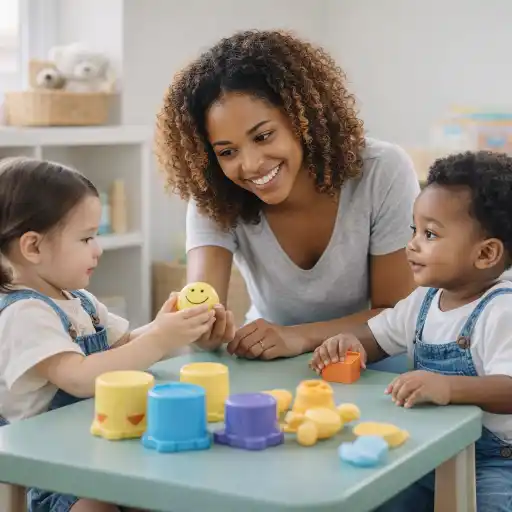
Play provides authentic practice with turn-taking, negotiation, empathy, and flexible thinking. Observe before stepping into a disagreement; children may be working toward a solution already. When they need support, offer language without taking over: “You both want the truck. What could you try?” This approach helps children experience themselves as capable problem-solvers.
- Provide materials that invite cooperation, such as blocks, dramatic-play props, puppets, and shared art materials.
- Use visual prompts for entering play, requesting a turn, or asking for help.
- Give transition warnings and describe what happens next in brief, concrete language.
- Use descriptive feedback: “You waited while Sam finished, then asked for a turn.”
- Adapt participation with quiet spaces, visual cues, sensory tools, or adult modeling when helpful.
How should providers respond to challenging behavior?
Behavior communicates, even when a child does not yet have the words to explain what is happening. Hitting, withdrawing, yelling, or throwing materials may reflect frustration, fatigue, sensory overload, an unpredictable transition, difficulty communicating, or an unmet need. Instead of asking only how to stop the behavior, consider what the child may be communicating and which skill or environmental support could help.
Start with safety and connection. Use a calm voice, get close without crowding, reduce verbal demands, and set a clear limit. When the child is calm and ready, briefly name what happened and practice an alternative: “You wanted the shovel. Next time, you can say, ‘Can I have a turn?’” A child should not be expected to use a skill that has not been taught and practiced.
- Observe patterns: what happened before, during, and after the behavior?
- Prevent predictable difficulties with visual cues, transition warnings, manageable choices, and reduced waiting.
- Teach replacement communication such as “help,” “my turn,” or “stop.”
- Document concrete observations and note what supports the child.
- Collaborate with families and qualified consultants when concerns persist or safety is affected.
Avoid public shaming, vague commands, rigid expectations, and consequences that do not match the child’s developmental abilities. Trauma-sensitive practice prioritizes predictability, choice, empathy, and emotional safety for all children. Providers seeking more focused learning can explore Trauma-Sensitive Care: Supporting Young Children with Empathy Buy Now $16.00.
How can programs individualize support and partner with families?
Children’s development is shaped by temperament, culture, language, disability, relationships, and experience. Milestones can guide observation, but they are not a rigid checklist or a reason to compare children. Consider a child’s strengths and needs in context: Is the space accessible? Are expectations clear? Can the child communicate in a familiar language or through gestures and visuals?
Family partnership should be collaborative rather than corrective. Share specific observations, ask families what they notice, and invite them to share strategies that work at home. Use strengths-based language and culturally and linguistically responsive communication. For example: “We notice that Alex watches the other children before joining play. What helps Alex feel comfortable entering a group at home?”
Directors can support consistent practice by:
- Including social-emotional goals in program planning and staff meetings.
- Agreeing on shared, respectful language for feelings, boundaries, and problem-solving.
- Making time for staff reflection, coaching, and discussion of observations.
- Connecting families with screening, early intervention, mental health consultation, or community resources when appropriate.
- Reviewing discipline practices to identify patterns and avoid inequitable or exclusionary responses.
If a child has persistent difficulties despite consistent support, collaborate with the family and appropriate professionals to consider next steps. Screening is not a diagnosis; it can help a team decide whether additional consultation may be useful.
Conclusion: What practices make the biggest difference?
To support social-emotional development, providers build trusting relationships, create predictable environments, teach emotional language, coach regulation, and treat challenging behavior as meaningful communication. Children need repeated opportunities to practice with adults who are calm, respectful, and responsive. The work is gradual, and progress may appear in small steps: a child asking for help, waiting briefly, or returning to play after a difficult moment.
Start with one manageable change this week: add a brief feelings check-in, strengthen transition cues, practice a calming strategy while children are settled, or set aside short individual connection time. Reflect with your team, listen to families, and adapt strategies to children’s developmental and cultural contexts. These steady, caring interactions answer the central question: providers support social-emotional growth by helping children feel safe, understood, and increasingly capable of connecting with others.
For another practical professional-learning option, Social Foundations and Responsive Classrooms Buy Now $24.00 focuses on positive guidance, self-regulation, relationships, and age-appropriate problem-solving. Review course details and choose learning that fits your goals and program needs.
- CDA Home Visitor Subject Area 3 Part 3 Birth to 5
- Pediatric RSV First Aid & CPR/AED
- CDA Bridge Bundle: Family Child Care without Portfolio Review
- Healing Young Hearts: Stress and Grief
- CDA Bridge Bundle: Infant/Toddler without Portfolio Review
- CDA Bridge Bundle: Preschool without Portfolio Review
- CDA Home Visitor Credential Birth to 5
- Texas Director Credential
- Staying Positive: Guidance for Preschoolers
- Every Moment Matters: Schedules and Transitions
- Celebrating International Women's Day
- Bye Bye Winter: The Role of Outdoor Play in Early Childhood Development
- Building Social Foundations
- Supporting Social Relationships Among Young Children
- The Family Day Care Chronicles: Tales of Laughter, Learning, and Unexpected Adventures
- The Guardian of Giggles: The Magic of Child Care Professionals, How Can You be One?
- Exploring the Cognitive Benefits of Movement in Early Childhood Classrooms
- Frosty Fun: Trauma-Informed Play for Resilient Young Learners
- CDA Certification en Español: Recursos y Consejos para Educadores Bilingües
- 🔍 ¿Qué ves cuando observas a un niño aprender?
- Proporciones de Cuidado Infantil y Tamaños de Grupo por Edad en Virginia (Guía Rápida para Centros y Hogares)
- How Can Child Care Providers Help Parents Sort Fact from Fad Online?
- Happy or Sad? Preschool Activities That Help Children Read Emotional Clues
- What Does Compassion Look Like in Child Care? 10 Everyday Moments That Matter
