When a child hears a direction differently from what you intended, the moment can become a correction—or an inviting chance to listen, explain, and try again. A playful puppet who gets instructions mixed up gives children a low-pressure reason to clarify meaning, practice language, and build confidence. For a deeper foundation in children’s verbal and nonverbal communication, explore Language Development in Early Childhood  Buy Now $16.00; the course offers practical strategies you can carry into everyday classroom routines.
Why does a puppet’s mistake make clarification easier?
Children may understand a direction imperfectly for many reasons: they missed a word, are still learning the vocabulary, need more processing time, or are managing competing sounds and activity. If an adult simply repeats the instruction or says “You weren’t listening,” a child may feel corrected without learning how to repair the misunderstanding. A puppet changes the social feel of the interaction: the character can make the mistake, and children become capable helpers who notice, explain, and suggest what to do.
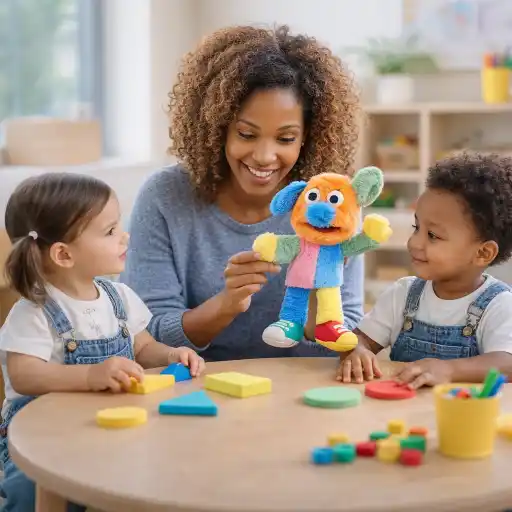
This is not a trick to catch children out. It is a playful way to make communication visible. The puppet might hear “Put the blue block beside the red one” and place the blue block on top. Children can compare the spoken message with the puppet’s action, then use words, gestures, signs, or pictures to show what needs to change. This naturally practices listening, vocabulary, sequencing, and perspective-taking.
As puppet-based communication and literacy experiences illustrate, puppets can invite participation without turning an activity into a performance. Keep the moment warm and brief, and let children decide how they want to contribute.
- 🧸 The puppet can misunderstand; children can choose to correct it, demonstrate, or simply observe.
- Model a respectful repair: “I heard something different. Can you tell me again?”
- Celebrate clear communication, not only a perfectly completed task.
How can educators give children a clear direction to repair?
A useful puppet activity begins with directions children can understand. Move close enough to be heard, use a calm voice, and offer a short, concrete instruction with familiar words. For example: “Put the spoon in the cup.” Once children know the routine, the puppet can carry out a plausible mix-up—perhaps placing the spoon beside the cup—and ask, “Is that what you meant?”
Pause long enough for children to think. Avoid immediately supplying the answer; the pause gives them time to notice the difference and decide how to communicate it. Accept different responses: a child might say “inside,” point to the cup, move the spoon, or use a picture cue. Then restate the child’s message clearly: “You mean put the spoon inside the cup.” This expansion affirms the child’s contribution and provides a useful language model.
Begin with one action and one contrast, such as in/on or beside/under. Add a second step only when the group is engaged and the first concept is familiar. The CDC’s guidance on giving directions likewise emphasizes simple, specific language and telling children what to do. Clarity from the adult makes the puppet’s deliberate confusion easier to interpret as play rather than a confusing demand.
- Say the child’s name or otherwise gain attention before giving the direction.
- Use observable action words and demonstrate unfamiliar ideas.
- Wait, then invite clarification: “What should the puppet do instead?”
How can the Mixed-Up Puppet Listening and Direction Cards guide play?
Direction cards can help providers plan a short, repeatable activity without having to invent every prompt in the moment. Select a card suited to children’s current vocabulary and the group’s interests. Read the direction naturally, let the puppet act it out—accurately or with one intentional mix-up—and invite children to explain what they heard and what the puppet should do next. The Language Development in Early Childhood resource page lists language materials and activities, including direction-themed resources that can complement classroom practice.
Use a simple progression. Start with one familiar action, then introduce a spatial word such as under or next to. Later, try two connected steps, using “first” and “then” to make the order explicit. Keep the learning target narrow: in one round, focus on positional vocabulary; in another, focus on asking for repetition. Children can take turns being the puppet’s coach, giving the character a direction, or choosing a visual card to communicate the correction.
Turn-taking matters. A child should not have to speak in front of the whole group to participate. Offer pairs or small groups, and allow children to point, gesture, use home-language words, or demonstrate with objects. As NAEYC’s discussion of communicating with clarity notes, visuals and multiple ways to express understanding help make learning accessible.
- Choose a few cards rather than moving rapidly through a full set.
- Use real classroom objects so the direction has a meaningful context.
- Invite children to create a card or dictate a direction for the puppet.
How can providers adapt the activity for different communicators?
Inclusive practice starts by recognizing that communication is broader than speech. Children may show understanding through eye gaze, pointing, facial expression, movement, signs, pictures, communication boards, or spoken words. Keep these response options available to everyone, rather than asking one child to use a separate method in public. The goal is shared participation and meaning-making—not a particular kind of response.
For a child learning English or another classroom language, pair spoken directions with gestures, objects, photos, and repeated key words. Invite families to share useful words or phrases in the child’s home language. A child may understand a direction before they can say a full explanation; modeling a phrase such as “No, under the chair” can give them language to borrow without pressure.
Adapt the physical setup, too. Use light, easy-to-handle puppets; provide a tabletop option; reduce background noise; and make sure all children can see the puppet’s actions. If a child finds the character overwhelming, offer the choice to watch from a comfortable distance or use a picture character instead. The T-TAC guidance on enhancing classroom communication highlights visuals, assistive communication, and individualized supports as ways to widen access.
- Offer spoken, visual, gestural, and action-based ways to clarify.
- Keep the puppet’s tone friendly; never use it to shame or pressure a child.
- Ask families and colleagues what communication supports are already helpful.
How can teams notice progress and avoid common pitfalls?
Observe what the child does rather than judging whether the child is “a good listener.” Note the direction, context, and supports offered: Did the child notice the mismatch? Did they point, explain, repeat a word, or ask for clarification? Did a visual or gesture help? Brief, neutral observations help staff identify what to adjust and share useful information with families. They also make small advances visible—such as a child independently saying “again, please” or showing the puppet where to place an object.
Common pitfalls include making the puppet’s error too subtle, changing several parts of a direction at once, or turning every mistake into a test. Keep the contrast obvious and playful. Do not make the puppet “wrong” in a way that mocks a child’s speech, home language, disability, or knowledge. If children seem confused or frustrated, pause the game, demonstrate the intended action, and return to a simpler direction. The purpose is to strengthen communication, not to measure compliance.
For directors, a shared plan can help staff use the activity consistently: identify the language goal, select accessible props, agree on supportive phrases, and decide how children can opt in or observe. If a child has persistent difficulty understanding familiar directions across routines, share objective observations with the family and follow program procedures for consultation. Providers observe and support; they do not diagnose. State requirements vary - check your state licensing agency.
- Watch for attempts to repair a message, not only correct answers.
- Keep sessions short, predictable, and responsive to children’s cues.
- Reflect with staff: What made the direction clearer, and who had an easy way to join?
Conclusion: What can a mixed-up puppet teach children?
A puppet’s intentional mistake can turn a missed direction into a shared communication problem to solve. With clear instructions, a warm invitation to clarify, and time for children to respond in their own ways, providers can support listening, vocabulary, sequencing, and confidence without making the activity feel like a test.
Start small: choose one familiar direction, make one obvious mix-up, and invite children to help the puppet repair it. Use cards, real objects, gestures, and home-language contributions to widen participation. Observe what helps each child communicate, then build on those successes in daily routines. The central aim is not perfect compliance; it is helping children understand, express, and clarify meaning with growing independence.
To deepen your understanding of how these everyday interactions support communication growth, explore Language Development in Early Childhood Buy Now $16.00. The course provides a broader professional-learning foundation for supporting young children’s language and literacy across the day.
Explore five relevant courses:
- Birth to Five CDA Credential with Portfolio Review
- 45 Hour Infant and Toddler Methods and Materials
- Pediatric RSV First Aid & CPR/AED
- CDA Bridge Bundle: Family Child Care without Portfolio Review
- CDA Bridge Bundle: Infant/Toddler without Portfolio Review
- CDA Bridge Bundle: Preschool without Portfolio Review
- Texas Director Credential
- CDA Certification en Español: Recursos y Consejos para Educadores Bilingües
- Proporciones de Cuidado Infantil y Tamaños de Grupo por Edad en Maryland (Guía Rápida para Centros y Hogares)
- Proporciones de Cuidado Infantil y Tamaños de Grupo por Edad en Nueva Jersey (Guía Rápida para Centros y Hogares)
- Proporciones de Cuidado Infantil y Tamaños de Grupo por Edad en Virginia (Guía Rápida para Centros y Hogares)
- Cómo Trabajar en el Cuidado Infantil en Carolina del Norte: Requisitos y Pasos
- How can rainy day indoor activities help preschoolers learn kindness and cooperation in Georgia?
- Celebrando la amistad en el cuidado infantil durante el Día de los Mejores Amigos
- Canciones, juegos y preguntas de círculo para niños
- What creative activities work best for school-age daycare programs?
- After School Lesson Plans That Don’t Feel Like More School
- After School Activities for Elementary Kids Who Finish Homework Early
- What School-Age Activities Create Engaging, Inclusive, and Well-Managed Programs?
- What Makes Task Cards a Great Tool for Mixed-Age Classrooms?
- Why Are Reusable Printables a Smart Investment for Child Care Providers?
- How Can You Design an After-School Schedule for Children Who Are Tired of Being Directed?
- What Should Co-Teachers Do When They Give Children Opposite Directions at the Same Moment?
- How Can Teachers Make Circle Time Work for Children with Short Attention Spans?
- How Can Child Care Providers Teach Children to Ask for Help Appropriately?
- How Can Child Care Providers Keep Classroom Routines Steady During Holiday Events?
- How Can a “Mixed-Up” Puppet Help Children Clarify Directions?
