Fall outdoor play invites children to pull, gather, explore—and sometimes all want the wagon at once. A predictable, engaging turn-taking routine can make the wait safer and more manageable while building children’s social skills; for deeper practice in developmentally appropriate responses, explore Viewing Guidance in a Positive Light  Buy Now $24.00, a three-hour online training focused on positive guidance and classroom behavior.
Why does waiting for the wagon deserve intentional teaching?
A wagon can be a wonderfully social outdoor material: children coordinate pushing and pulling, share discoveries, and invent destinations together. Its appeal also creates a real challenge when several children want a turn. For young children, waiting involves more than following a rule; it draws on emerging impulse control, communication, emotional regulation, and an understanding of time.
Instead of treating impatience as deliberate defiance, consider it a signal that children need support with a still-developing skill. The adult’s role is to keep everyone safe and make the expectation understandable, not to demand that a child simply “be patient.” A calm routine turns the moment into supported practice.
Purposeful planning can also encourage peer interaction. The CSEFEL brief on environmental strategies to promote positive social interactions identifies wagons as materials that can invite children to coordinate and play together. With thoughtful supervision, a shared wagon can become more than a coveted ride: it can be a setting for communication, cooperation, and belonging.
- Children learn to express what they want and hear what peers need.
- Predictable turns reduce uncertainty and help educators prevent conflict.
- Short, repeated practice supports growing #patience and self-regulation.
How can a wagon turn board make waiting visible and fair?
Children often find an abstract promise—“You’ll get a turn soon”—hard to interpret. A simple turn board makes the sequence concrete. Use children’s photos, names, or symbols in the order turns will happen, and place a clear marker beside the child who is riding. Move the marker when each turn ends so children can see what is happening now and who is next.
Keep the board flexible and respectful. A child may communicate a choice by pointing, gesturing, signing, using a home language, speaking, or using AAC. The visual should support understanding; it should not require silence, speech, or perfect compliance. The ChildCareEd printable Pumpkin Patch: Wait with a Plan Buy Now $1.99 offers an example of pairing a seasonal play context with visual waiting choices.
- Agree on what counts as a turn: a short route, a brief timer, or one trip to a landmark.
- Show who is riding, who is next, and what the waiting children can choose to do.
- Use the same board and language across educators, while adapting the visual to children’s communication needs.
- 🍁 Invite children to help move the marker or choose a waiting activity when they are ready.
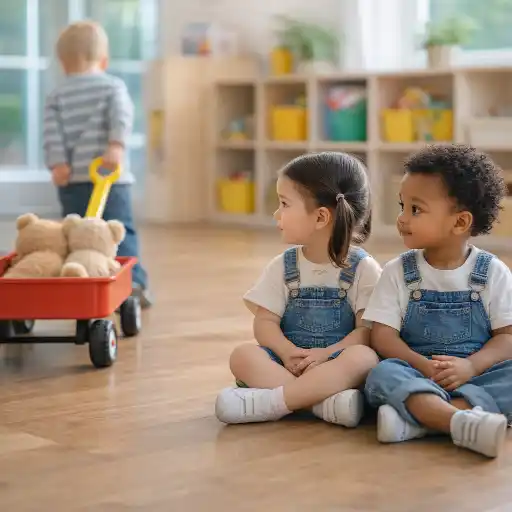
A visual is a support, not a guarantee that every child will feel comfortable immediately. Stay nearby, acknowledge feelings, and adjust the length or structure of turns when observations show the routine is not working well.
What can children do while they wait outdoors?
Waiting is easier when children have a purposeful, appealing alternative instead of being asked to stand still and watch. Offer a small menu of activities near the wagon area, within active supervision. Let children select an option and return to the board or adult when the next turn is available. These activities should be invitations, not rewards that children must earn.
- 🍂 Fall color search: Look for a leaf or natural object of a chosen color without collecting unfamiliar plants.
- Wagon helper: Choose a safe role, such as pointing out the route or helping carry a light, approved item.
- Sound detective: Pause and notice one outdoor sound, then share it through words, gestures, or a picture.
- Movement game: Try a brief “freeze and go” or animal walk in a clearly marked, safe space.
- Nature picture match: Match a picture card to a visible leaf shape, tree, or other familiar feature.
Keep the choices simple and close enough for supervision. Offer accessible options, including seated observation or a partner role, and check that materials do not introduce choking or other hazards. A waiting activity can extend outdoor learning while giving children a meaningful way to manage the pause.
What should educators say when a child struggles to wait?
Use brief, warm language that recognizes the child’s goal and points to the next step. Long explanations in the middle of frustration may overwhelm a child. Get close enough to supervise, keep your voice steady, name the situation without blame, and refer to the visible plan.
- “You want the wagon. Mateo is riding now; you’re next on the board.”
- “Waiting is hard. Would you like the leaf search or the helper job?”
- “The wagon is moving. I’ll keep everyone safe. Your turn comes after this trip.”
When children are calm, practice simple phrases through puppets or role-play: “Can I have a turn next?” “I’m waiting,” or “Can you help me?” Notice the specific effort you see: “You checked the board and chose a leaf hunt while you waited.” Support from a regulated adult is part of the learning process; Head Start describes this kind of responsive adult-child support as co-regulation in its self-regulation strategies.
If conflict occurs, stop unsafe actions first, acknowledge each child’s perspective, and coach one next step. Avoid forced sharing or public shaming. Offer a clear choice—wait with a visual, take a different activity, or ask for help—and return to teaching once the children are calm.
How can providers make the wagon routine inclusive and safe?
Plan the route and turn system before outdoor play begins. Check the wagon and play area, define a route with clear boundaries, and position adults so children and moving equipment remain in view. Follow the program’s procedures for outdoor supervision, equipment use, and children’s mobility or health needs. State requirements vary - check your state licensing agency.
Inclusion means providing meaningful ways for every child to participate, not expecting all children to wait or communicate in the same way. Some children may need shorter turns, a first-then cue, a personal visual, extra processing time, or an alternate role. Work with families and relevant specialists when an individualized support would help, and use strengths-based observations to guide adjustments.
Common pitfalls are preventable: avoid vague turn limits, unexpectedly changing the order, leaving children with nothing to do, or using the board as a behavior chart. A consistent system should clarify access and expectations—not rank children or withhold play as punishment. For broader professional learning, Staying Positive: Guidance for Preschoolers Buy Now $24.00 explores positive discipline and social-emotional development, while Creating the Natural Outdoor Classroom Buy Now $16.00 focuses on planning nature-rich outdoor environments.
Conclusion: What helps children wait for a wagon turn?
Children learn to wait through supportive practice, not pressure. Make turns visible with a simple board, define a brief and understandable turn, provide engaging outdoor choices, and use calm scripts that acknowledge both the child’s feelings and the plan. Keep active supervision and accessibility at the center of the routine.
The goal is not a perfectly quiet line; it is growing confidence, communication, and cooperation. Observe what helps each child succeed, adjust the routine, and celebrate small steps—checking the board, choosing an activity, asking for a turn, or encouraging a peer. These everyday moments can turn fall wagon play into a shared opportunity to learn #turntaking, #guidance, #outdoorplay, and #cooperation.
- Moving About the Classroom: Effective Transitions for Everyday
- CDA Home Visitor Subject Area 3 Part 3 Birth to 5
- CDA Home Visitor Subject Area 2 Part 3 Birth to 5
- The ABCs of Behavior: Turning Challenges into Learning Opportunities
- Birth to Five CDA Credential with Portfolio Review
- Emergent Learning & Development
- Creating Environments that Nurture Growth and Community
- Texas Director Credential
- Access for All: Inclusion and the ADA
- 45-Hour Infant and Toddler Curriculum
- CDA Certification en Español: Recursos y Consejos para Educadores Bilingües
- 🪁¿Cómo puede el juego apoyar de manera poderosa a los niños con autismo?🧩
- 💛🧩 ¿Cómo puedo hacer que mi enseñanza sea inclusiva para los niños con autismo?
- Cómo Abrir Una Quardería En Casa Sin Dinero?
- ¿Cuáles son las habilidades principales que toda maestra de guardería necesita?
- Cómo Empezar una Guardería en Casa: Requisitos y Pasos
- Regulaciones de Licenciamiento de Cuidado Infantil en California para Centros y Hogares de Cuidado Infantil Familiar
- Proporciones de Cuidado Infantil y Tamaños de Grupo por Edad en Maryland (Guía Rápida para Centros y Hogares)
- Proporciones de Cuidado Infantil y Tamaños de Grupo por Edad en Nueva Jersey (Guía Rápida para Centros y Hogares)
- Proporciones de Cuidado Infantil y Tamaños de Grupo por Edad en Virginia (Guía Rápida para Centros y Hogares)
- Lista para Guardería en Casa en Illinois: Cómo Iniciar una Guardería en el Hogar
- Cómo Trabajar en el Cuidado Infantil en Carolina del Norte: Requisitos y Pasos
- Cómo Trabajar en el Cuidado Infantil en Wisconsin: Requisitos y Pasos
- Cómo Ser Maestra de Preescolar en Illinois
- Capacitación Previa al Servicio para Proveedores de Cuidado Infantil en Virginia
- Celebrando la amistad en el cuidado infantil durante el Día de los Mejores Amigos
- Canciones, juegos y preguntas de círculo para niños
- How Can Child Care Providers Teach Young Children to Take Turns?
- How Can Child Care Providers Teach Preschoolers to Wait Their Turn?
- How Can Providers Teach Patience While Children Wait for a Turn With the Wagon?
