Rolling balls and sliding blocks can turn an ordinary ramp into a toddler’s first physics lab—but only when materials are chosen and checked with care. Explore practical ways to support safe, playful investigation, and consider Tomorrow’s Einsteins: Infant and Toddler Science  Buy Now $16.00 to deepen your understanding of how young children learn through scientific inquiry. For a consistent inspection routine, the Daily Toy Inspection Checklist for Child Care Buy Now $1.49 can help your team record concerns and keep materials ready for discovery.
Why do rolling and sliding activities matter for toddlers?
Toddlers learn about the physical world by acting on it. When a child releases a ball, watches it travel, and tries again, the child is noticing motion and cause and effect—even without explaining the process in words. Repeated play also builds coordination, attention, early vocabulary, and confidence in trying ideas.
Rather than aiming for a formal lesson or a correct answer, providers can follow children’s curiosity. Offer a simple ramp and a few safe objects, then observe what children choose to repeat. Narrate what happens: “The ball rolled down,” or “The block slid a little and stopped.” Such comments connect actions with outcomes without taking over the exploration. NAEYC describes infants and toddlers as natural scientists who investigate through repeated actions, careful observation, and attempts to solve problems.
These experiences work best when curiosity and safety are planned together. Thoughtful material selection creates an environment where children can explore while adults remain attentive to changing risks. The goal is not to eliminate all challenge; it is to make the invitation appropriate for the children, materials, and supervision available.
How can you choose objects that roll or slide safely?
Start with sturdy, age-appropriate items that are large enough not to pose a choking risk and durable enough to withstand toddler play. A toddler might mouth, drop, bang, twist, or pull an object, so consider how it could change during use—not just how it looks on the shelf. CPSC guidance advises keeping small balls and toys with small parts away from children younger than three.
- Choose large, one-piece balls, solid blocks, and robust toy vehicles with firmly attached wheels.
- Avoid marbles, small balls, loose wheels, detachable decorative pieces, button batteries, and small magnets in toddler-accessible areas.
- Check every surface for cracks, sharp edges, splinters, peeling coatings, loose parts, and other damage.
- Consider cleaning needs and whether the item can be cleaned according to your program’s procedures.
- Use products as intended and check age guidance, but also consider the children’s actual developmental behaviors and who can access the activity.
If you are uncertain about an object’s safety, set it aside rather than offering it. State requirements vary - check your state licensing agency.
How should you prepare a safe ramp investigation?
Keep the setup simple and stable. Use a low, smooth ramp secured so it cannot slip or tip, and provide clear floor space at the bottom for objects to travel. Begin with a small selection of safe materials—perhaps a large ball, a solid block, and a large toy vehicle—so toddlers can notice differences without becoming overwhelmed.
Before play, inspect the ramp and objects. Check for splinters, rough or sharp edges, loose attachments, cracks, and small parts. Make sure the ramp does not block walkways or encourage children to climb on furniture. Position yourself where you can see and reach the children and the full path of moving objects. Keep other small items out of the investigation area, particularly in mixed-age rooms.
- Set out materials within children’s reach, with enough room to take turns safely.
- Demonstrate releasing an object rather than throwing it, then let children explore.
- Stay close and watch how children use the objects; adjust or pause the activity if the play changes in an unsafe way.
- Afterward, collect, inspect, and clean materials according to your program’s procedures.
Keep the activity flexible. If children are captivated by one object, repeating the same action is meaningful exploration—not a reason to rush them to the next step.
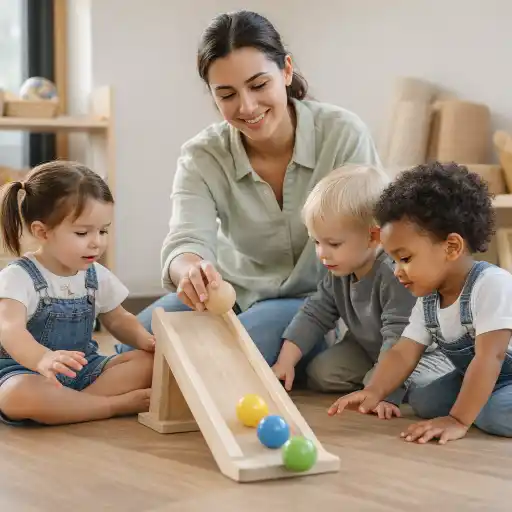
What can educators say and do to extend the science?
For toddlers, short comments and invitations are often more helpful than lengthy explanations. Describe what you observe, pause, and give the child time to respond through words, gestures, facial expressions, or another action. Early Science Matters recommends adapting ramp experiences for toddlers by starting with objects that roll easily and commenting on how far they travel, rather than expecting extended discussion.
- “You let go, and the ball rolled down.”
- “The block slid slowly. What do you want to try next?”
- “That car went farther. Shall we bring it back?”
- “You chose the round one again. I wonder what you noticed.”
Follow the child’s lead: offer another safe object or a small change in surface only when interest continues and the change can be supervised safely. Avoid turning the activity into a race or insisting every toddler make a prediction. Some children may prefer to watch, touch the ramp, or repeat one action. Each can be a valid way to participate.
Simple documentation can help you plan what comes next. Record a brief observation, child comment, or photo (following program privacy procedures). Notice which materials held children’s interest and whether the setup needs adjustment. These observations can guide future invitations without requiring formal testing.
How can daily toy inspections support this activity?
Materials that are safe at the beginning of the week may become damaged through frequent toddler use. A quick, consistent inspection helps staff spot loose wheels, cracks, sharp edges, and other changes before objects return to play. It also gives the team a shared process for handling questionable items instead of relying on memory.
Build the check into classroom preparation and repeat it when materials have been used heavily, cleaned, or moved between rooms. Look closely at both the object and its parts: tug gently on attached components, check seams and edges, and confirm that the ramp remains stable. If an item is damaged, contaminated, or uncertain, remove it from children’s access and place it in a designated area for review. Document the concern and follow your program’s repair, replacement, or disposal procedures.
The Daily Toy Inspection Checklist for Child Care Buy Now $1.49 offers a practical way to note inspection status and follow-up. A checklist supports—not replaces—careful observation, active supervision, cleaning procedures, or applicable licensing rules.
- 🔍 Check the ramp and objects before use, then recheck items that show wear.
- Keep questionable materials out of circulation until an authorized staff member has reviewed them.
- Share relevant findings with colleagues so damaged objects do not move unnoticed between rooms.
- Record specific concerns, such as “vehicle wheel loose,” rather than a vague note like “toy unsafe.”
Consistent checks help preserve children’s access to engaging materials while making safety an everyday team practice.
Conclusion: How can providers make rolling and sliding play safe and meaningful?
Providers can support safe toddler science by selecting large, durable, age-appropriate objects; preparing a stable, uncluttered ramp area; staying close and attentive; and inspecting materials before and after use. During play, follow children’s interests, use simple descriptive language, and allow repetition. Rolling and sliding activities do not need complicated equipment or lengthy explanations: a thoughtful setup and responsive adult support are enough to invite meaningful exploration.
Daily inspection and documentation help the team catch damage and communicate follow-up, while a relevant professional-learning course can strengthen your understanding of early scientific inquiry. Revisit the central question—how can toddlers explore objects that roll and slide safely?—by combining curiosity with preparation, supervision, and regular checks. Keep the experience joyful, flexible, and grounded in the needs of the children in your care.
Related professional learning: Tomorrow’s Einsteins: Infant and Toddler Science Buy Now $16.00; Intentional Safety for Infants/Toddlers Buy Now $24.00; Using Toys to Support Learning Buy Now $16.00; Effective Supervision in Child Care Buy Now $25.00; Building Early Science Foundations Buy Now $16.00. Course availability and training-hour acceptance may vary; verify details with the provider and your licensing agency.
- 45 Hour Child Growth and Development
- Basic Health & Safety and Breastfeeding Awareness
- 45 Hour Infant and Toddler Methods and Materials
- 45 Hour School Age Methods and Materials
- CDA Bridge Bundle: Infant/Toddler without Portfolio Review
- CDA Bridge Bundle: Infant/Toddler
- 45-Hour Infant and Toddler Curriculum
- Positive Attention: Interactions & Supervision for Infants & Toddlers
- Texas Director Credential
- CDA Certification en Español: Recursos y Consejos para Educadores Bilingües
- 💛🧩 ¿Cómo puedo hacer que mi enseñanza sea inclusiva para los niños con autismo?
- Recursos en Español sobre el Sueño Seguro del Bebé
- Capacitación en Salud y Seguridad Preventiva en Línea para Proveedores de Cuidado Infantil
- Proporciones de Cuidado Infantil y Tamaños de Grupo por Edad en Maryland (Guía Rápida para Centros y Hogares)
- Proporciones de Cuidado Infantil y Tamaños de Grupo por Edad en Nueva Jersey (Guía Rápida para Centros y Hogares)
- Proporciones de Cuidado Infantil y Tamaños de Grupo por Edad en Virginia (Guía Rápida para Centros y Hogares)
- Cómo Trabajar en el Cuidado Infantil en Wisconsin: Requisitos y Pasos
- Canciones, juegos y preguntas de círculo para niños
- Cómo simplificar la capacitación para sus empleados de daycare
- Hello, Fall! Cozy Activities to Help Babies Explore the Season
- Proporciones para guarderías en casa bajo el Título 22: Cómo la mezcla de edades cambia su capacidad en California
- How Can Child Care Providers Understand and Support Infant Milestones?
- How Can Early Math Activities Build Young Children’s Mathematical Thinking?
- How Can Preschool Sorting Activities Teach Temperature Concepts Safely?
- How Can Providers Safely Explore Objects That Roll and Slide with Toddlers?
- How Can One Floor Mat Offer Two Experiences for Crawlers and Walkers?
- How Can Children Investigate Which Everyday Shapes Roll, Wobble, or Stop?
- What Do Different Box Lids Invite Toddlers to Discover?
- What Are Simple Ways to Strengthen Hand-Eye Coordination Through Classroom Activities?
