A shared floor mat can support both a baby learning to crawl and a toddler practicing first steps—if the space is planned with each child’s movement, safety, and supervision in mind. Explore the Playful Spaces for Infants & Toddlers  Buy Now $24.00 course to build practical skills in selecting materials and creating inclusive play areas, then use the strategies below to make your mat work harder without making the room feel crowded.
Why should a shared mat be planned for different movers?
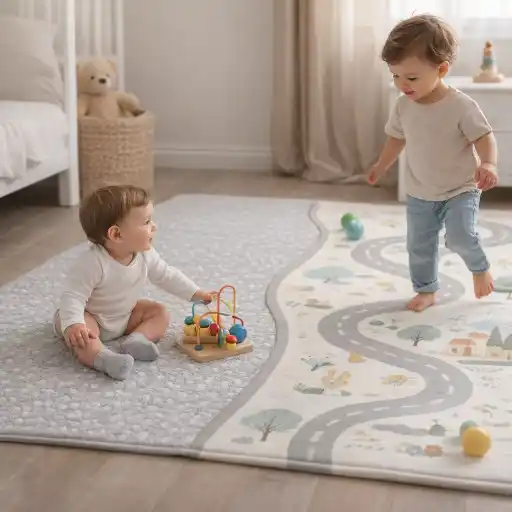
In an infant-toddler room, one floor mat may serve children at very different points in physical development. A crawler needs reachable objects, clear space to move toward them, and a stable surface for shifting weight and coordinating limbs. A new walker needs room to stand, balance, take short steps, and recover from a wobble. Designing for both is not about pushing children toward a milestone; it is about making the environment responsive to the skills and interests they already show.
Movement is also a way young children investigate their world. When caregivers provide safe, interesting opportunities to crawl, pull up, cruise, and walk, children can practice at their own pace while adults observe and respond. The Virtual Lab School’s guidance on environments that support physical development emphasizes open space, safe materials, and appropriate challenges that build on children’s current abilities.
A well-planned shared mat can offer:
- A reachable exploration zone for children who crawl or scoot.
- A stable, uncluttered edge for supported standing and cruising.
- Clear routes that reduce collisions between children moving in different ways.
- More opportunities for adults to notice cues and scaffold play without taking over.
Think of the mat as a flexible learning area, not simply a soft surface. Its arrangement communicates what children can do, where they can move, and how adults will support their exploration.
How can the mat serve crawlers and early walkers at the same time?
Begin with a clear base. Choose a firm, washable, nonslip mat that lies flat and does not bunch or slide. A surface that is too soft or unstable can make it harder for children to push up, shift their weight, and find balance. Check the mat and surrounding floor regularly for moisture, loose seams, small objects, and anything that could trip a child.
Then create distinct but connected opportunities. Keep the central portion open for crawling and floor-level exploration. Place a small number of safe, graspable objects where a crawler can see and reach them, with a little space to move toward an item without forcing the child to stretch too far. Along one edge, position a low, sturdy, anchored piece of furniture or other approved support where a child who is ready can pull up and cruise. It must not tip, slide, or create a gap where a child could become trapped.
Try arranging the area so that the two movement experiences complement each other:
- Keep crawling routes wide and free of toys that roll into traffic paths.
- Offer stable, low support only where adults can supervise closely.
- Place a few duplicated or similar materials nearby to reduce competition.
- Leave space around the mat for adults to sit, observe, and reach children promptly.
Head Start’s environment-as-curriculum guidance encourages providers to treat layout as part of children’s learning and to adapt spaces as interests and abilities change. Avoid turning the mat into an obstacle course: a few carefully selected features are more useful than a crowded collection of equipment.
What safety and supervision checks matter most?
A shared mat needs more than a quick glance before play. Get down to children’s eye level and look for what a mobile infant or toddler can see, reach, mouth, pull, or climb. Check that the mat is clean and intact, its edges lie flat, and it does not block exits or create a slippery transition with the surrounding floor. Remove damaged toys, choking hazards, cords, and objects that are not appropriate for the children using the space.
Consider how children’s paths intersect. A crawler moving across the center may not be visible to a standing toddler turning toward the edge. Likewise, a child pulling up on furniture needs room to lower safely and should not be crowded by passing children. Position adults so they can see and hear every child, move promptly when needed, and maintain required supervision practices. A thoughtfully arranged area supports supervision but never replaces it.
Use a brief before-play check:
- Is the mat stable, clean, and appropriate for the activity?
- Can children move without crossing a busy route or colliding?
- Is any support furniture sturdy, secured, and positioned safely?
- Can staff see and reach all children from their supervision positions?
- Are materials suitable for each child’s age, ability, and mouthing behavior?
Head Start’s infant and toddler environment design guidance connects safe traffic patterns, supervision, and adequate movement space. State requirements vary - check your state licensing agency, and follow your program’s safety policies and applicable standards.
How should educators adapt the setup to each child?
Observe before rearranging. Notice how each child approaches the mat: Does the crawler move toward a particular object, pause to watch others, or need more room to turn? Does the new walker use a stable edge, carry an object, or prefer repeated short trips between an adult and a support surface? These details help staff make purposeful, modest adjustments instead of relying on age alone.
Children develop at individual rates, and the mat should not become a stage for comparison. Better questions are: What can this child do comfortably now? What interests them? What small environmental change could invite a next attempt while preserving safety? A caregiver might move a familiar toy slightly closer to encourage a crawler’s purposeful movement, or clear extra space beside a stable support for a child practicing cruising.
Adult interaction can add support without directing every move. Sit nearby, describe what the child is doing, offer encouragement, and wait. If a child shows frustration or fatigue, respond to the cue rather than insisting on another attempt. NAEYC’s article on scaffolding infants’ and toddlers’ learning highlights the value of following a child’s lead and offering just-right support. Thoughtful observation helps staff plan for #crawlers, early walkers, and children whose movement patterns do not fit a simple age-based expectation.
What common setup mistakes can providers avoid?
When a room serves children who move differently, it is understandable to want one arrangement that solves every challenge. In practice, a few common choices can limit exploration or create avoidable risks. The goal is not to make the space elaborate; it is to make it usable, safe, and adjustable.
- Overfilling the mat: Too many toys and cushions interrupt movement and make pathways hard to read. Start with a small selection and rotate materials based on observation.
- Using unstable furniture as a walking aid: Lightweight shelves, rolling carts, or unanchored pieces can shift. Use only sturdy, appropriate supports that meet program safety procedures.
- Putting crawlers in the traffic lane: A mat placed beside a doorway or busy route can lead to repeated interruptions and collisions. Choose a location with clear movement space and supervision.
- Making the surface too soft: Plush or uneven padding may interfere with balance and can introduce hazards. Select a stable, cleanable surface suited to the activity.
- Leaving the setup unchanged: As children become more mobile, a once-effective arrangement may need to change. Reassess after new skills emerge or the group changes.
🌱 Keep a short team note about what worked, where congestion occurred, and what children repeatedly tried to do. Small, collaborative adjustments can make the room safer and more inviting without requiring new equipment or a full redesign.
How can a simple review turn into a practical plan?
A quick, repeatable review helps staff make decisions based on children’s actual experiences. Before changing the mat, sketch its location and the nearby furniture, walkways, and supervision positions. Then observe during more than one part of the day: a calm play period may look very different from a transition or a time when several children want the same toy.
Use the observation, documentation, and reflection resource Buy Now $0.00 as a reminder to record what children do and what the environment makes possible. A brief note might say, “Two crawlers met at the mat’s narrow entrance; one early walker practiced cruising along the shelf.” From there, a team can widen the approach, reposition materials, or shift the mat away from a high-traffic path, then observe whether the change helped.
The topic’s Crawling and Walking Space Review Workbook can serve as a practical planning resource for reviewing how the space works for both groups and noting changes to try. Pair the review with a brief staff discussion and a follow-up check, rather than treating any single layout as final.
For additional professional learning, explore these English-language ChildCareEd courses:
- Playful Spaces for Infants & Toddlers Buy Now $24.00 — planning stimulating, inclusive play environments.
- Playful Spaces: Designing the Infant & Toddler Classroom Buy Now $35.00 — room arrangement, materials, and equipment selection.
- Playful Learning: Infant & Toddler Activities Buy Now $25.00 — planning experiences suited to children’s ages and abilities.
- Positive Attention: Interactions & Supervision for Infants & Toddlers Buy Now $35.00 — responsive interaction and supervision practices.
- CDA Infants/Toddlers: Stages of Development Buy Now $24.00 — development stages and age-appropriate experiences.
Conclusion: How can one mat offer two experiences?
One mat can work for crawlers and early walkers when its surface is stable, its pathways are clear, materials are chosen intentionally, and any standing support is secure. Keep an open area for crawling, provide a safe edge for practicing balance and cruising, and arrange the space so children’s routes do not collide. Above all, pair thoughtful design with active supervision and observation.
There is no single arrangement that will suit every group. Watch how children use the space, invite staff observations, and make small changes as abilities and interests evolve. With a responsive plan—and practical tools such as the Crawling and Walking Space Review Workbook—your shared floor mat can offer meaningful movement opportunities while helping educators feel more confident about how the room supports play and safety.
- 45 Hour Child Growth and Development
- Basic Health & Safety and Breastfeeding Awareness
- 45 Hour Preschool Methods and Materials
- Pediatric RSV First Aid & CPR/AED
- CDA Bridge Bundle: Infant/Toddler
- Risk Reduction: Infants and Toddlers in Family Child Care
- Texas Director Credential
- Mindful Supervision: Balancing Safety & Independence in Montessori
- CDA Certification en Español: Recursos y Consejos para Educadores Bilingües
- 💛🧩 ¿Cómo puedo hacer que mi enseñanza sea inclusiva para los niños con autismo?
- Recursos en Español sobre el Sueño Seguro del Bebé
- 10 Ejemplos de Cómo la Cultura Influye en el Desarrollo Infantil
- Proporciones de Cuidado Infantil y Tamaños de Grupo por Edad en Maryland (Guía Rápida para Centros y Hogares)
- Proporciones de Cuidado Infantil y Tamaños de Grupo por Edad en Nueva Jersey (Guía Rápida para Centros y Hogares)
- Proporciones de Cuidado Infantil y Tamaños de Grupo por Edad en Virginia (Guía Rápida para Centros y Hogares)
- Cómo Trabajar en el Cuidado Infantil en Carolina del Norte: Requisitos y Pasos
- Cómo Trabajar en el Cuidado Infantil en Wisconsin: Requisitos y Pasos
- Capacitación Previa al Servicio para Proveedores de Cuidado Infantil en Maryland
- Celebrando la amistad en el cuidado infantil durante el Día de los Mejores Amigos
- Canciones, juegos y preguntas de círculo para niños
- La mejor manera de hacer seguimiento a la capacitación de su equipo de daycare How to Organize Staff Training for Your Child Care Center Cómo organizar la capacitación del personal para su centro de cuidado infantil
- Cómo simplificar la capacitación para sus empleados de daycare
- From Tummy Time to First Steps: Free Lesson Plans for Infants 0–12 Months
- Animal Relay Race for Kids: 10 Wild Ways to Race Without Running
- ¿Todos los niños deben participar en el tiempo de círculo?
- How Can One Shape Exploration Engage a Mixed-Age Montessori Group?
- How Can One Floor Mat Offer Two Experiences for Crawlers and Walkers?
