Play-based learning is how young children learn when they play. For child care providers and directors, this approach helps children grow language, thinking, social skills, and confidence. In your #classroom you can arrange materials, time, and teacher moves so #children lead learning through play. When adults support with observation and tiny nudges, play becomes strong #learning for #preschoolers. This short guide gives clear steps you can use tomorrow. Note: state requirements vary - check your state licensing agency.
What is play-based learning and why does it matter?
2. Why it matters (short list):
- 🧠 Brain practice: Play gives children chances to try ideas and solve problems.
- 🗣️ Language practice: Pretend games grow new words and storytelling.
- 🤝 Social practice: Playing with others teaches sharing, turn-taking, and empathy. For practical strategies—like cooperative play activities, empathy-building prompts, and conflict-resolution moves—see our guide on building strong social skills in preschool.
3. Quick evidence + voice for leaders: Many ChildCareEd articles show how play supports school readiness and everyday skills. See How can we use play-based learning in preschool?. Policy reviews also support play as part of quality programs (for system context see the OECD review).
How do I set up a preschool classroom for strong play-based learning?
- 🧱 Offer clear stations: blocks, dramatic play, art/sensory, book corner, messy table, and a quiet spot. (See What are play-based learning approaches?.)
- 🎨 Use open-ended materials: loose parts, fabric, boxes, and simple props so children invent many uses. (See Open-Ended Activities That Help Preschoolers Learn.)
- 🔁 Rotate materials weekly to keep play fresh and interesting.
- 📋 Label bins with pictures and words so children choose and return items easily.
- ⏱ Protect long play blocks: aim for at least one 30–60 minute uninterrupted play time each day.
- 🌳 Include daily outdoor play for movement and exploration — use safety tips from the CDC.
2. Room tips that save time and support children:
- Keep materials in baskets so kids can choose and help clean up.
- Place small print or number cards in centers so math and literacy appear inside play.
- Make wide paths and clear sight lines so staff can observe and stay safe.
How should teachers support play without taking over?
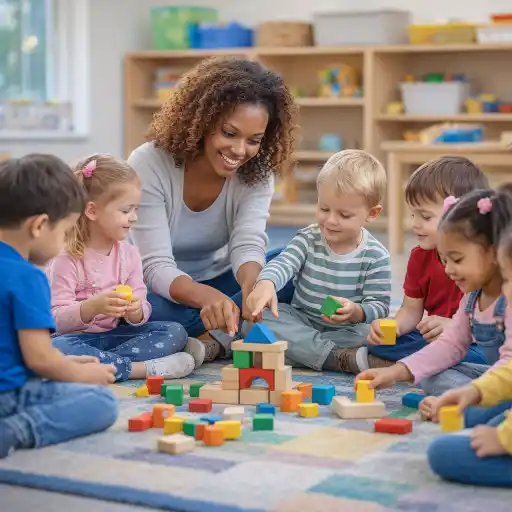
1. Five simple teacher moves you can practice:
- 👀 Observe first — watch to learn what each child is doing and thinking.
- 🤝 Join briefly — add a new word, show one quick idea, or place a prop, then step back.
- 🗣️ Ask open questions — “What are you building?” or “How will you share?”
- ⏸ Step back — let children try, fail, and fix problems with peers.
- 📝 Record learning — take a photo or a short note linking play to a skill.
2. Common mistakes and how to avoid them:
- ⚠️ Too much adult control — Fix: model once, then let the child lead most of the play. See How can we use play-based learning in preschool?.
- ⚠️ Rushing play time — Fix: protect longer, uninterrupted play blocks.
- ⚠️ Single-purpose toys — Fix: choose open-ended materials that invite many uses (see Open-Ended Activities).
3. Inclusion tip: adapt props, give small supports, and use peers as helpers so all children join in. For coaching and practice, consider ChildCareEd training like Play, Learn, Grow.
How do we document play, involve families, and meet rules?
1. Four quick steps to share play-based outcomes:
- 📸 Take a photo or short video of play linked to one skill (counting, new words, sharing).
- 📝 Write a one-line note: what the child did and what skill you saw.
- 🔁 Suggest a simple home play activity to extend the skill.
- 📆 Keep 2–3 examples per child each month to show growth to families and leaders.
2. Tips for talking with families and directors:
- Use plain language: “Play builds language, math, and social skills.” Point to friendly ChildCareEd pages like What Is Play-Based Learning in Preschool.
- Share quick wins: photo + one-line note + a home idea — families love concrete examples.
- Keep records for licensing and quality reviews. Remember: state requirements vary - check your state licensing agency.
3. FAQ (short):
- Q: Will play delay academics? A: No — play builds the skills children use for reading and math. See Playful Learning.
- Q: How long should play blocks be? A: Aim for 30–60 minutes when possible.
- Q: How do I include children with special needs? A: Use small adaptations, collaborate with families and specialists, and document progress.
Conclusion
1. Quick checklist to try tomorrow:
- 🧰 Set up clear centers with open-ended materials.
- ⏱ Protect at least one long play block and daily outdoor time.
- 👀 Practice observing, joining briefly, then stepping back.
- 📸 Document small wins and share with families.
2. For staff training and tools, explore ChildCareEd courses like Play, Learn, Grow and articles across ChildCareEd. Small changes in your #classroom help #children learn more through joyful #play. You are doing important work — protect play and the learning will follow.
1. Play-based learning means children learn while they play — building, pretending, exploring, and solving problems. For a clear explanation, see What Is Play-Based Learning and Why Does It Work? and the research summary Play-Based Learning and Cognitive Growth.- 45 Hour Preschool Methods and Materials
- 45 Hour School Age Methods and Materials
- CDA Bridge Bundle: Family Child Care without Portfolio Review
- CDA Bridge Bundle: Infant/Toddler without Portfolio Review
- The Best Promotion is Play
- Classroom Setup for Child Care
- CDA Bridge Bundle: Preschool without Portfolio Review
- Play with Purpose: Supporting Children with Autism
- Texas Director Credential
- Montessori Cultural Activities: Exploring the World Through Play and Learning
- Preschool Curriculum
- Child Care Professionals
- CDA Certification en Español: Recursos y Consejos para Educadores Bilingües
- Celebrando la amistad en el cuidado infantil durante el Día de los Mejores Amigos
- Canciones, juegos y preguntas de círculo para niños
- Is the CDA Right for You?
- How can I bring a Forest Preschool (nature-based learning) to my program?
- California Preschool Ratios: How Many Children Can One Teacher Supervise?
- Preschool Classroom Schedule: A Full-Day Example from Arrival to Pick-Up
- Teacher-Directed or Child-Directed? Finding the Right Classroom Balance
- Which Low-Cost Printables Make the Biggest Classroom Impact?
- How Can Child Care Providers Support Preschool Development?
- How Can Child Care Providers Create Effective Learning Centers in Small Spaces?
- How Much Structured Learning Do Preschoolers Really Need?
- What Should a 3-Year-Old Be Learning at Preschool?
- How Can You Set Up Learning Centers in a Preschool Classroom?
- What Should Child Care Providers Prioritize When Preschool Readiness Goals Compete for Time?
