A toddler sensory activity does not need a matching craft or a picture-perfect result to be meaningful; the learning happens as children notice, test, repeat, and make choices. Explore the Meaningful Lesson Planning for Infants/Toddlers  Buy Now $24.00 course to build practical skills in age-appropriate planning, then use the strategies below to turn children’s curiosity into a safe, flexible experience.
For an easy planning aid, pair that learning with the Simple Daily Lesson Plan Template for Early Childhood Educators, featured in ChildCareEd’s lesson-planning resource. A consistent format can help you prepare materials, clarify a learning intention, and capture useful observations without scripting every moment.
Why should a sensory experience prioritize curiosity over a finished product?
Toddlers learn by acting on the world: touching, mouthing when developmentally expected and safely supervised, listening, watching, smelling, moving, and repeating. A sensory invitation gives them a reason to investigate—What happens when I pour? Does this feel different? Can I make that sound again?—rather than a set of steps to copy. The aim is not to produce identical results but to create conditions where children can explore and adults can notice their thinking.
That shift matters for educators, too. When the focus is a particular craft or outcome, adults may hurry children through exploration or intervene to make the work look “right.” An open-ended plan instead leaves space for different approaches, developmental paces, and interests. NAEYC describes educators in play as observers and guides who use what children do to extend learning; its discussion of observing, planning, and guiding through play offers a useful frame.
A thoughtfully arranged environment supports this agency. Head Start notes that infants and toddlers are drawn to inviting spaces where responsive adults help them feel secure and free to explore. The experience can be simple; your attention and the child’s discoveries are the heart of it.
How do you turn a toddler’s interest into a clear, flexible plan?
Begin with an observation, not a craft idea. Perhaps several toddlers are tipping cups in the water table, pressing hands into damp soil outdoors, or pausing to listen when a container rattles. Record what you actually see and hear. Then choose one modest intention—such as exploring cause and effect, practicing scooping, comparing textures, or using new descriptive words.
Use a brief planning cycle: observe, choose a focus, prepare an invitation, and reflect. A daily template can keep the plan practical without overloading it with objectives. Include the children’s interest, one observable goal, materials, a flexible sequence, safety and access considerations, and a space for a short observation afterward. As ChildCareEd’s infant and toddler lesson-planning guide emphasizes, planning for this age group should respond to children’s developmental needs and interests.
- Write the goal as something you can notice: “Children will explore how water moves between containers.”
- Prepare only a few materials to start, leaving room to add a prop if children’s play suggests it.
- Plan an invitation, not a required sequence: “I wonder what we can do with these cups.”
- Allow children to watch, join briefly, return later, or choose another area.
A flexible plan is still intentional. It gives staff a shared purpose while treating the child’s response as valuable information—not as a test of whether the planned activity succeeded.
What materials and adult interactions invite real sensory exploration?
Choose materials for the question or quality you want children to encounter, then keep the setup inviting and manageable. A shallow water tray with large cups and scoops invites pouring, filling, and noticing changes. A collection of large fabric squares offers contrasts in softness, weight, and movement. Natural objects such as large leaves or smooth stones can prompt close looking and gentle handling, when they are appropriate for the group and carefully inspected.
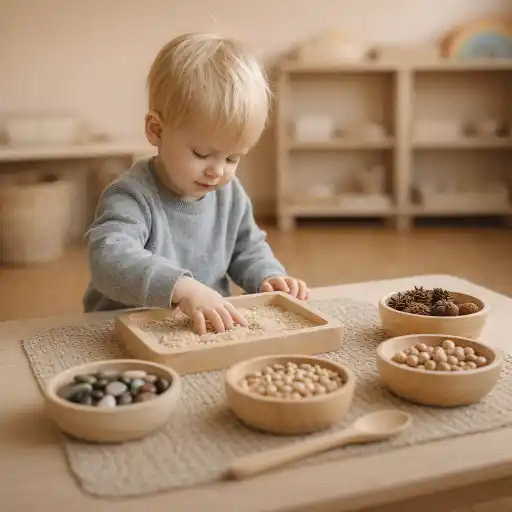
Offer a few choices rather than a crowded bin. Set materials at toddler height, define the play area with a tray or washable mat, and keep cleanup tools nearby. Then stay close, observe, and use language that describes rather than directs: “You tipped the cup. The water moved,” or “This cloth feels bumpy.” Pause to give children time to respond with words, gestures, gaze, or action.
Use open prompts sparingly; toddlers may need time, repetition, or a model more than a string of questions. Try:
- “What do you notice?”
- “What happens if you try it this way?”
- “You poured it in. Now the cup is full.”
- “Would you like the soft one or the rough one?”
Active exploration is supported when adults notice children’s interests and encourage them to investigate in their own way. The Active Exploration resource for infants and toddlers highlights sensory observation and autonomy—helpful reminders to follow the child’s attention instead of steering toward a display-worthy result.
How can you protect safety while making the experience inclusive?
Curiosity flourishes when the environment is thoughtfully prepared and adults can supervise closely. Choose materials based on the children’s ages, mouthing behaviors, allergies, individual needs, and program policies. Avoid small objects and other choking hazards for children who may mouth materials; inspect items for damage, clean them appropriately, and ensure that water play is actively supervised. Do not assume that a material is safe simply because it is common in sensory activities.
State requirements vary - check your state licensing agency. Also follow your program’s health, sanitation, allergy, and supervision procedures. For mixed-age groups, use separate, age-appropriate setups where needed rather than expecting one bin to meet everyone’s needs.
Inclusion means offering more than one way to participate. A child who prefers not to touch a wet material might watch, use a scoop, or explore a dry option nearby. A child who communicates with gestures or pictures can choose materials without needing to answer aloud. Adjust the texture, amount, tools, noise level, seating, and adult support in response to each child. For a practical overview of planning safe, adaptable sensory invitations, see ChildCareEd’s sensory play guide.
- 👀 Stay close enough to supervise actively and respond to children’s cues.
- Check allergies, family preferences, and center policies before using food-based materials.
- Offer a quieter or less tactile way to join, and respect a child’s choice to stop.
- Prepare cleanup and handwashing as part of the experience, not as an afterthought.
How can observation help you extend learning without taking over?
During play, notice the child’s actions, words, gestures, and repeated experiments. Rather than writing “enjoyed the activity,” capture observable details: “Leo poured water from the blue cup into the clear cup three times, watched the level rise, and said, ‘More.’” An objective note helps you understand what happened before deciding what it might mean or what to offer next. The guidance on open-ended observations recommends describing actions and language while leaving interpretation open for later reflection.
Use your notes to plan a small extension, not a bigger performance. If a child repeatedly fills and empties containers, you might offer containers of different sizes on another day. If children are drawn to sound, add a safe, larger object that makes a contrasting sound. If they compare textures, place two familiar materials side by side and give them time to revisit both.
Ask yourself:
- What held the child’s attention, and what did they repeat?
- What did the child communicate through words, gestures, or movement?
- Who needed a different tool, position, material, or amount of support?
- What is one manageable next step that follows the child’s interest?
Documentation can be brief: one observation and one possible next step are often enough to make tomorrow’s plan more responsive. Share meaningful details with families in strengths-based language, and invite them to tell you about materials or interests their child explores at home.
What common planning mistakes can you avoid?
A common pitfall is deciding the finished result first—then asking toddlers to reproduce it. That can narrow choice and shift attention from exploration to adult approval. NAEYC’s discussion of process-focused experiences describes open-ended work as child-directed, without a required sample or single correct result. Although the source focuses on preschool art, the distinction is useful when planning toddler sensory play: the experience and investigation matter more than uniform outcomes.
Another mistake is planning too many goals or introducing too many materials at once. A crowded setup can be harder to supervise and may make it difficult to see what interests children. Start with one intention and a few well-chosen, age-appropriate items. Add or remove materials based on children’s responses and your safety assessment.
Plans can also become too rigid. If a toddler walks away, watches instead of touching, or uses the materials in an unexpected but safe way, that response is information—not a failure. Avoid over-questioning, correcting children’s explorations toward an adult idea, or interpreting brief engagement as lack of learning.
- Instead of: “Everyone will fill the cup and make the same result.” Try: “Children can investigate the cups in ways that interest them.”
- Instead of: a long checklist of skills, choose: one observable focus and one next step.
- Instead of: leaving cleanup and safety until later, prepare: supervision, sanitation, and transitions in advance.
For deeper professional learning, explore Playful Learning: Infant & Toddler Activities Buy Now $25.00, which focuses on planning activities for children’s ages and abilities.
Conclusion: How do you keep curiosity at the center?
To plan a toddler sensory experience around curiosity, begin with what children already notice, choose one meaningful intention, and offer a safe, open-ended invitation. Prepare a few accessible materials, supervise actively, and use calm, descriptive language that helps children explore without prescribing a finished result. Let different children participate in different ways, and make adjustments as you observe.
Afterward, record a short, factual observation and use it to decide what to repeat, adapt, or extend. A simple daily plan can help you and your team prepare consistently while staying responsive to children in the moment. The central question is not “What did everyone make?” but “What did children explore, communicate, and try—and what might we offer next?” Keep that question in view, and curiosity, rather than a finished product, can guide the experience.
- CDA Infant/Toddler Credential
- Birth to Five CDA Credential with Portfolio Review
- CDA Bridge Bundle: Preschool
- CDA Infant/Toddler Credential with Portfolio Review
- CDA Bridge Bundle: Family Child Care
- CDA Bridge Bundle: Infant/Toddler without Portfolio Review
- CDA Preschool Credential with Portfolio Review
- CDA Bridge Bundle: Infant/Toddler
- Texas Director Credential
- 45-Hour Infant and Toddler Curriculum
- CDA Certification en Español: Recursos y Consejos para Educadores Bilingües
- 💛🧩 ¿Cómo puedo hacer que mi enseñanza sea inclusiva para los niños con autismo?
- 😫🧸 ¿Qué hacer cuando un bebé no quiere dormir la siesta en el aula?
- ⏰📘 ¿Cuáles son los requisitos de capacitación anual en el cuidado infantil en Dakota del Norte?
- ¿Cuáles son las mejores actividades del Día de la Tierra para niños en casa o en el aula?
- 10 Ejemplos de Cómo la Cultura Influye en el Desarrollo Infantil
- Cómo Empezar una Guardería en Casa: Requisitos y Pasos
- Proporciones de Cuidado Infantil y Tamaños de Grupo por Edad en Maryland (Guía Rápida para Centros y Hogares)
- Proporciones de Cuidado Infantil y Tamaños de Grupo por Edad en Nueva Jersey (Guía Rápida para Centros y Hogares)
- Proporciones de Cuidado Infantil y Tamaños de Grupo por Edad en Virginia (Guía Rápida para Centros y Hogares)
- Lista para Guardería en Casa en Illinois: Cómo Iniciar una Guardería en el Hogar
- Lista para Guardería en Casa en California: Cómo Iniciar una Guardería en el Hogar
- Cómo Trabajar en el Cuidado Infantil en Wisconsin: Requisitos y Pasos
- Capacitación Previa al Servicio para Proveedores de Cuidado Infantil en Dakota del Norte
- Celebrando la amistad en el cuidado infantil durante el Día de los Mejores Amigos
- Canciones, juegos y preguntas de círculo para niños
- Cómo simplificar la capacitación para sus empleados de daycare
- How to Write a Lesson Plan for Early Childhood Education: Start With the Skill, Not the Craft
- How Can Child Care Providers Help Families See the Learning Hidden Inside Messy Play?
- How Can You Plan a Toddler Sensory Experience Around Curiosity, Not a Finished Product?
