November displays can do more than mark a season: they can help children recognize that their stories, families, and ideas belong in the classroom. Explore practical ways to move beyond a wall of turkeys with the From Play to Planning: Building Culturally Competent, Child-Centered Curriculum  Buy Now
$55.00$45.00 course, which supports providers in connecting children’s interests with culturally responsive planning. For a hands-on classroom resource, consider My Little Museum of Me! All About Me & Preschool SEL Activity Pack; continue reading to see how everyday displays can strengthen identity, connection, and belonging.
Why should November displays reflect children’s identities?
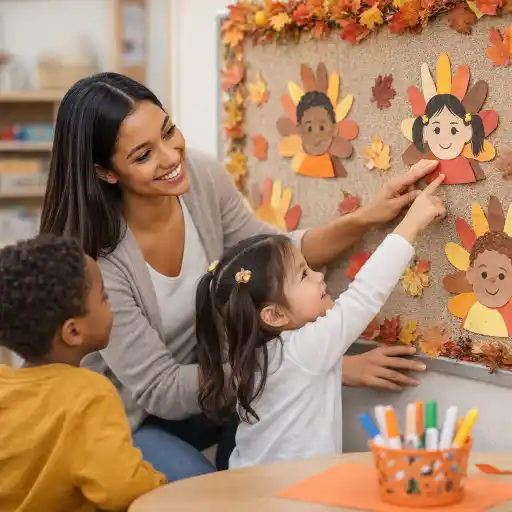
Classroom displays are part of the learning environment’s everyday message system. Children notice whose faces, families, languages, and experiences appear—and whether their own contributions are treated as meaningful. A seasonal board centered only on turkeys and harvest imagery may be cheerful, but a broader display can also communicate: “Your ideas matter here, and our community includes many stories.”
Representation is not about decorating for a single month or asking every child to explain their culture. It is an ongoing practice of making children visible as individuals, with varied interests, strengths, relationships, languages, and ways of expressing themselves. NAEYC’s discussion of representation emphasizes that children benefit when classroom materials and practices reflect their identities and lived experiences. The University of Minnesota’s article on culturally responsive practice likewise shows how children’s experiences can become meaningful starting points for curriculum.
November can be a useful moment to review what is already on the walls and what might be missing. Look beyond holiday themes to the children currently in your care. A display built from their voices and creations can encourage conversation, support peer connection, and make the classroom feel like a shared place rather than a seasonal backdrop.
How can educators move beyond a turkey-themed bulletin board?
Start by choosing a learning purpose rather than a craft template. Perhaps children are exploring what makes each person unique, how classmates care for one another, or what they notice in the changing season. Then invite children to contribute in ways that feel comfortable. Their work might include self-portraits, dictated words, drawings of favorite activities, photographs shared with permission, or symbols they select themselves.
An “All About Me” display can become a small classroom museum. Give each child a page or space to share a chosen detail: a favorite way to play, an important person, a home-language word, a strength, or something they are curious about. Children can speak, draw, use pictures, gesture, dictate, or simply choose an image. The ChildCareEd guide to “All About Me” activities offers additional ideas for turning individual sharing into community-building experiences.
- Offer open-ended prompts such as “What would you like your friends to know about you?”
- Use varied materials: paper, collage pieces, safe loose parts, photos, and drawing tools in diverse skin tones.
- 📸 Invite children to help choose where and how their work is displayed, and ask permission before posting personal photographs or information.
- Include children’s own words as captions when they want to share them.
Keep seasonal elements, if desired, as one part of a wider display. A few leaves or a nature collage can sit alongside children’s ideas and artwork without defining the entire November experience.
What makes identity displays authentic and inclusive?
Authentic displays reflect children as individuals instead of using one child or one object to stand for a whole group. Avoid assigning cultural traits, asking a child to speak for a community, or reducing identity to food, clothing, or holiday symbols. Use broad, respectful language and let families guide how they wish to be represented. A child’s chosen contribution may be a drawing of a pet, a favorite game, a name written in a home language, or a picture of people who care for them.
Review the classroom’s books, images, and materials for variety and accuracy. Include different family structures, skin tones, abilities, languages, and everyday experiences across the year. NAEYC’s article on representation highlights the importance of children seeing their families and identities reflected in meaningful ways. NAEYC’s guidance on linguistic diversity also encourages educators to treat home languages as strengths and to create opportunities for children to hear and use them without pressure.
- Ask families how they describe their child’s important relationships and whether they wish to contribute.
- Use phrases such as “some families” and “people who care for you,” rather than assuming every child shares the same traditions or household structure.
- Offer an alternative for children who do not have or wish to share family photographs.
- Revisit displays for tokenism, stereotypes, privacy concerns, and inaccessible participation.
Representation works best when it appears naturally in classroom life, not as a one-time showcase. A thoughtful display can be a starting point for conversations and play, but the everyday interactions around it are what help make respect visible.
How can a display support social-emotional learning?
A display becomes more than decoration when children can use it to communicate, connect, and learn about one another. When a child sees their work recognized, they may feel pride and a stronger sense of being part of the group. When peers notice shared interests or ask respectful questions, they practice listening, empathy, and curiosity. These moments can support social-emotional learning (SEL) while remaining grounded in children’s own experiences.
Plan simple ways to revisit the display. During small-group time, children might find classmates who enjoy a similar activity, tell a partner one thing they noticed, or choose a page for a class book. Educators can model affirming language: “You both like building tall towers,” or “Your pictures show different people who help care for you.” Avoid comparing contributions or treating one kind of family, language, or ability as the default.
Participation should be flexible. Some children may enjoy explaining their work to a group; others may prefer to observe, point, or share with an adult. Give children time and respect their choice not to disclose personal information. The goal is connection, not performance.
- Use brief partner conversations with prompts such as “What did you notice?” and “What would you like to ask?”
- Make a collaborative mural that combines individual contributions into a shared classroom picture.
- Invite children to dictate a kind or curious comment about a classmate’s work, with adult support.
Small, repeated interactions help children experience #belonging, practice #empathy, and recognize that individual #identity can be celebrated within a caring group.
How can teams plan, review, and sustain inclusive displays?
Directors and teachers can make identity-centered displays manageable by treating them as part of curriculum planning, not an extra project. Begin with observation: What are children playing, talking about, making, or wondering? Use those interests to decide what the display might invite children to explore. Then plan for access, consent, and different ways to participate.
Before putting items on the wall, review the materials and the message they convey. Are children represented accurately and respectfully? Can children reach or see the display? Have families approved photographs or identifying information? Does the display offer choices for children who prefer not to share personal details? When concerns arise, adjust the plan rather than expecting a child or family to accommodate the display.
- Observe: Collect children’s questions, play themes, and work samples.
- Invite: Offer optional, low-pressure ways to contribute; communicate in accessible language.
- Display: Place children’s work at their eye level and add context through their own words where appropriate.
- Reflect: Ask staff and families what feels welcoming and what could be improved.
Common pitfalls include relying on one themed board, assuming every family celebrates the same holiday, or displaying private information without permission. Keep the focus on children’s voices and everyday experiences. State requirements vary - check your state licensing agency for rules related to photographs, family information, and classroom displays.
Conclusion: What should providers remember about November displays?
A November display can be seasonal and joyful while making space for children’s real identities. The strongest displays are built with children rather than simply assembled for them: they reflect individual interests, family and language diversity, strengths, and varied ways of participating. They avoid stereotypes, protect privacy, and invite connection without requiring personal disclosure.
Start with one practical step: add a child-created page, invite children to choose captions, or review the classroom wall with colleagues and families. Then revisit the display in conversation, play, and planning so it becomes part of the learning community. More than a turkey on the wall, an inclusive display tells every child: you are seen, your contribution matters, and you belong.
For deeper professional learning, explore From Play to Planning: Building Culturally Competent, Child-Centered Curriculum Buy Now $55.00$45.00 and the hands-on My Little Museum of Me! All About Me & Preschool SEL Activity Pack.
- Moving About the Classroom: Effective Transitions for Everyday
- From Play to Planning: Building Culturally Competent, Child-Centered Curriculum
- Identifying ADHD in Child Care
- CDA Bridge Bundle: Family Child Care without Portfolio Review
- Building Equity: Inclusionary Practices in Preschool
- Connections That Count: Building Relationships in Child Care
- Texas Director Credential
- Mental Health in Early Childhood
- Moving About the Classroom: Effective Transitions for Everyday
- CDA Certification en Español: Recursos y Consejos para Educadores Bilingües
- 💛🧩 ¿Cómo puedo hacer que mi enseñanza sea inclusiva para los niños con autismo?
- 🩺 Cumplimiento de Salud e Inmunización en Cuidado Infantil de Nevada ✔️
- 10 Ejemplos de Cómo la Cultura Influye en el Desarrollo Infantil
- Normas de Licenciamiento de Cuidado Infantil en Virginia para Centros Diurnos Infantiles y Hogares Diurnos Familiares
- Proporciones de Cuidado Infantil y Tamaños de Grupo por Edad en Maryland (Guía Rápida para Centros y Hogares)
- Proporciones de Cuidado Infantil y Tamaños de Grupo por Edad en Nueva Jersey (Guía Rápida para Centros y Hogares)
- Proporciones de Cuidado Infantil y Tamaños de Grupo por Edad en Virginia (Guía Rápida para Centros y Hogares)
- Cómo Trabajar en el Cuidado Infantil en Carolina del Norte: Requisitos y Pasos
- Cómo Trabajar en el Cuidado Infantil en California: Requisitos y Pasos
- Celebrando la amistad en el cuidado infantil durante el Día de los Mejores Amigos
- Diversión fresca de verano: actividades del Día Nacional del Helado para niños
- Canciones, juegos y preguntas de círculo para niños
- Cómo simplificar la capacitación para sus empleados de daycare
- Toddler Classroom Ideas: What Should Be at a Child’s Eye Level?
- How Can You Plan a November Preschool Curriculum Around Gratitude and Community?
- How Can Child Care Providers Help Families Recognize Their Children’s Developmental Progress in November?
- How Can Child Care Providers Strengthen Family Engagement in November?
- How Can Everyday November Routines Grow Cooperative Play?
- How Can November Displays Make Room for Every Child’s Identity?
