Many small towns near the Great Lakes have too few child care spots. This article helps directors and #providers see clear steps to grow local #childcare and improve #access in #rural #Michigan communities. Providers who are thinking about opening or expanding care can strengthen their planning with Business Planning: Family Child Care, which covers business basics, budgeting, and planning for a sustainable child care program, and Child Care Administration  Buy Now
 $99.00$84.00, which helps leaders build skills in program planning, budgeting, staffing, marketing, and management. Programs can also use the purchasable Resource Guide for Starting and Operating a Child Care Business Buy Now $0.00 for practical guidance on planning, staffing, policies, budgeting, and opening or growing a program. State requirements vary - check your state licensing agency.
What is a rural child care desert, and where are they in Michigan?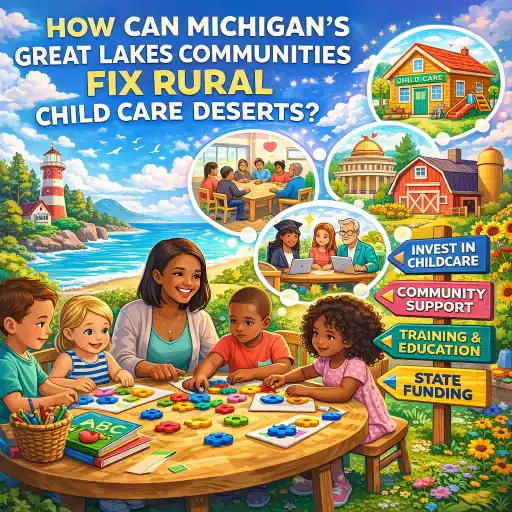
1) A child care desert means there are far more children than licensed slots nearby. In places called deserts, families often travel many miles or give up work to find care. Researchers found that when families live farther from licensed care, workforce participation drops — and that has been shown in Michigan data (Michigan State study).
2) In Michigan, deserts are common in rural counties and some small cities around the Great Lakes. These places may have no nearby infant or toddler care, or very few openings. See local updates and state news as part of ChildCareEd's Michigan news.
3) Why this matters right now: families struggle to work when reliable care is far away. Also, rural providers often face low pay and staff shortages that make it hard to open new spots. The University of Michigan explained how a lack of care hurts families and educators' well-being (UMich).
Why does solving rural child care deserts matter for Great Lakes communities?
1) Children: Good early care helps children learn and be ready for school. When care is missing, kids miss the early learning and attention they need.
2) Families and work: Reliable care helps parents keep jobs. A study showed that hundreds to thousands more women would join the workforce if care were nearby (MSU study). The economy also loses billions when parents miss work for care problems (Early Learning Policy Group). Improving access to child care also helps women pursue higher-skilled careers and leadership roles — milestones reflected in historic nominations such as the nomination of Ketanji Brown Jackson to the U.S. Supreme Court.
3) Community strength: Child care centers can be hubs for family help, health, and jobs. Investing in care can grow the local tax base, keep businesses stable, and give kids better futures. International research shows early childhood education helps reduce inequality when access is wide and fair (OECD).
What practical steps can providers and directors take now to increase slots and quality?
1) Map the need and start simple:
- 📍 Call local employers and ask how many workers need care.
- 📝 Survey families in your town about the hours and ages they need.
- 📊 Use public data and local news to find gaps — see the ChildCareEd Michigan updates for ideas and local program changes.
2) Build partnerships:
- 🤝 Partner with employers on shared-cost programs like MI Tri-Share and the newer MI Care-Share ideas — these help families pay and can stabilize enrollment. Read about state employer programs and updates at ChildCareEd (ChildCareEd).
- 🏥 Team up with health centers or schools for space, referrals, and family support. Federal program info can guide joint services (HHS programs).
3) Grow small and safe:
- ✅ Consider expanding home-based care or small-capacity sites to create infant/toddler spots. Michigan licensing updates support flexible settings — see guidance at ChildCareEd (ChildCareEd).
- 🔧 Use wage supports, stipends, and training grants where available to recruit staff. State wage pilots and benefits efforts are described in Michigan updates (ChildCareEd).
4) Use available funding and training:
- 💸 Explore CCDBG and state subsidies to help low-income families pay for care (CCDBG overview).
- 📚 Offer staff training through approved courses (ChildCareEd has Michigan-approved training and bundles) and ask about automatic reporting to MiRegistry to stay compliant (ChildCareEd training) Buy Now $189.00.
How can communities avoid common mistakes and build lasting partnerships?
1) Common mistakes (and fixes):
- ⚠️ Mistake: Starting a program without checking costs. ✅ Fix: Make a simple budget that includes wages, rent, supplies, and a safety buffer.
- ⚠️ Mistake: Relying only on parents to recruit staff or pay. ✅ Fix: Ask employers to share costs or sign contracts for employee spots; look into MI Tri-Share/MI Care-Share models (ChildCareEd).
- ⚠️ Mistake: Forgetting state rules. ✅ Fix: Keep training records current and remember stthat ate requirements vary - check your state licensing agency and upload certificates to MiRegistry.
2) Steps to build strong partnerships (quick list):
- 📞 Call 3 local employers and offer a short meeting about staff child care needs.
- 🏫 Invite the school or health clinic to co-host a family sign-up day.
- 💻 Use shared online pages (ChildCareEd resources, HHS program pages) to show families where to get help (ChildCareEd).
3) Funding and policy tips:
- 🔎 Learn about federal and state funding (CCDBG, stabilization grants) and local coalition grants. The CCDBG overview explains state-by-state funding and rules (CCDBG).
- 📈 Use economic research to talk with local leaders about how child care boosts the local economy (economic impact).
FAQ (quick):
- Q: How do I start small? A: Open a few infant/toddler spots or a mixed-age group and test the hours families need.
- Q: Where do I find training? A: Use Michigan-approved courses at ChildCareEd and upload to MiRegistry (ChildCareEd).
- Q: How do I talk to employers? A: Offer clear benefits: steady care helps staff be on time and reduces turnover.
Conclusion: Small actions add up. Map needs, form employer and school partnerships, use state and federal funds, and grow safe home or small-site care. Your program can make a big difference for families on the Great Lakes.
- 45 Hour Child Growth and Development
- Professional Presence in Early Childhood
- 45 Hour Infant and Toddler Methods and Materials
- CDA Bridge Bundle: Family Child Care without Portfolio Review
- CDA Bridge Bundle: Infant/Toddler without Portfolio Review
- CDA Bridge Bundle: Preschool without Portfolio Review
- Texas Director Credential
- Access for All: Inclusion and the ADA
- Capacitación Previa al Servicio en Michigan
- CDA Certification en Español: Recursos y Consejos para Educadores Bilingües
- 🚌🌄 Ideas de excursiones atractivas en Nevada
- 🚌❤️ Ideas de excursiones en Illinois
- Cómo Abrir Una Quardería En Casa Sin Dinero?
- Curso de Comunicación de 9 Horas de Maryland
- 10 Ejemplos de Cómo la Cultura Influye en el Desarrollo Infantil
- Cómo Empezar una Guardería en Casa: Requisitos y Pasos
- Proporciones de Cuidado Infantil y Tamaños de Grupo por Edad en Maryland (Guía Rápida para Centros y Hogares)
- Proporciones de Cuidado Infantil y Tamaños de Grupo por Edad en Nueva Jersey (Guía Rápida para Centros y Hogares)
- Proporciones de Cuidado Infantil y Tamaños de Grupo por Edad en Virginia (Guía Rápida para Centros y Hogares)
- Cómo Trabajar en el Cuidado Infantil en Carolina del Norte: Requisitos y Pasos
- Cómo Trabajar en el Cuidado Infantil en California: Requisitos y Pasos
- Requisitos para Guarderías en Casa en Georgia
- How can Michigan classrooms teach children about the Great Lakes with hands-on science activities?
- How can Michigan's Great Lakes communities fix rural child care deserts?
- Celebrando la amistad en el cuidado infantil durante el Día de los Mejores Amigos
- Cómo simplificar la capacitación para sus empleados de daycare
- How can Michigan providers keep kids safe around the Great Lakes and backyard pools?
- How Could Employer-Sponsored Child Care Reshape Demand for Michigan Providers?
