This short guide helps Michigan child care leaders plan for #severeweather, run #drills, find a safe #shelterinplace, and keep #safety top of mind in #Michigan. It is for directors and providers who care for young children. Read this with your team, save the links, and remember: state requirements vary - check your state licensing agency.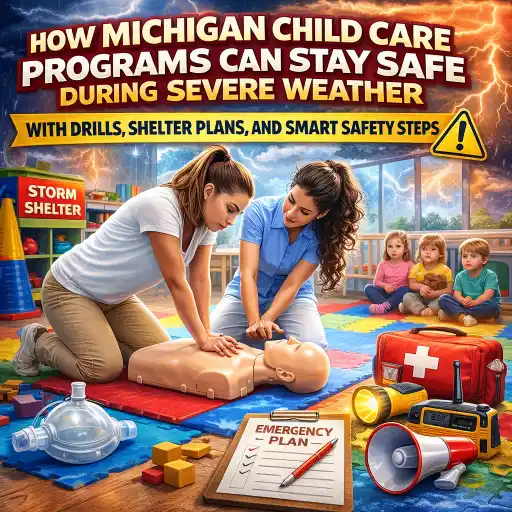
Why does severe weather preparedness matter for child care programs?
Children are small and count on adults to keep them safe. When the staff is ready, the children stay calmer. 2. Families trust you to protect their kids. Good plans build trust. 3. A plan helps staff act fast and keep the program running after the storm.
Simple reasons to prepare:
- Protect lives and reduce injuries.
- Keep families informed and calm.
- Meet licensing and safety standards (remember: state requirements vary - check your state licensing agency).
For a full course and templates, ChildCareEd offers training and an Emergency and Disaster Preparedness  Buy Now
 $55.00$45.00 course, and a ready plan form to fill out here Buy Now $0.00. FEMA and Red Cross also have useful checklists (links below).
How do I make a clear, simple severe weather plan for my center?
- Start with a risk check: list likely weather for your area (tornadoes, severe storms, heavy snow). Ask local emergency managers or use resources like ChildCareEd's guide and the CDC tornado tips.
- Choose three responses and where to do them:
- Evacuate — leave for a safer site.
- Shelter-in-place — move to an interior room with no windows.
- Lockdown/secure — keep people inside and locked if there is an external threat.
- Assign roles: who grabs the Go-Kit, who checks attendance, who calls 911, who updates families.
- Make one-page maps for each classroom and post them near exits. ChildCareEd has sample plans you can adapt: Emergency Preparedness Plans for Child Care Programs.
- Include children with special health needs and meds. Keep permissions and storage rules up to date.
Tip: Keep the plan short and practice it — long papers don’t help in the moment.
How should we run drills and train staff and children without causing fear?
- Schedule drills: at least monthly for fire and quarterly for severe weather or lockdowns. ChildCareEd suggests regular practice in its training.
- Use short, clear instructions when practicing with kids. Example script: “We are practicing our safe place. We walk quietly to the hallway and sit with our hands in our laps.”
- Common mistakes and how to avoid them:
- 🔔 Mistake: Skipping debriefs. Fix: After every drill, meet for 5–10 minutes and note what worked and what didn’t.
- ✅ Mistake: Using scary words. Fix: Use age-appropriate language and reassurance.
- ⚠️ Mistake: Not timing drills. Fix: Time each drill and set small goals to improve safety.
- Train new hires right away and give refreshers yearly. Include First Aid and CPR for staff (see ChildCareEd course Buy Now
$55.00$45.00). - Document each drill: date, time, who practiced, how long it took, and changes to make. Keep records for licensing and improvement.
Where do we shelter, what supplies do we need, and how will we communicate with families?
Pick safe rooms and pack easy-to-grab supplies. Plan how to tell families what happened and where to meet.
- Pick shelter locations:
- The lowest interior room with no windows for tornado or high wind (bathroom or hallway).
- Designated evacuation site off-site (park, church) if you must leave the building.
Guidance on safe rooms and signs of tornadoes is available from the Red Cross and CDC.
- Pack supplies in a Go-Kit and check quarterly. Include:
- Water (small bottles) and non-perishable snacks
- First-aid kit, medications, and allergy info
- Flashlight, batteries, battery radio (NOAA if possible)
- Spare diapers, wipes, and formula for infants
- Attendance sheets, emergency contact cards, copies of plans
- Comfort items and quiet activities (books, small toys)
- Plan communication and reunification:
- 🔔 Use a phone tree, text blast, or app to message families. Have an out-of-area contact number (Red Cross and FEMA suggest an out-of-town contact).
- 📋 Designate a reunification site and require photo ID before releasing children.
- 📣 Assign a staff member to keep updates for families and post status on your website or phone tree.
- Power outages: consider resources like the HHS emPOWER program to help plan for electricity-dependent needs in your community.
Frequently asked questions (FAQ)
- How often should we update our emergency plan? At least yearly, after drills, or after any big change in staff or building layout. ChildCareEd recommends regular review and updates.
- Do we need special permission to store medicines? Follow your state rules and licensing. Keep written permission from parents and store meds per policy.
- How do we include children with special needs? Plan for mobility, communication, and medical needs. Work with families and local responders to make a plan that fits the child.
- Can we run surprise drills? For very young children, it’s better to warn them that practice will happen to avoid trauma. Mix announced and unannounced drills for older groups with careful planning.
Conclusion
1. Take small steps: do a risk check, write a short plan, and pick safe rooms.
2. Practice: schedule drills, time them, and learn from each one.
3. Communicate: tell families your plan and where to meet.
Find ready-to-use tools and training at ChildCareEd: Emergency Preparedness in Child Care and the online course Buy Now $55.00$45.00. Also consult the Red Cross, FEMA, and the CDC for weather-specific guidance.
You're not alone. Start small, practice, and keep improving. Your work protects children and supports families every day.
- D.C. Emergency Preparedness Training
- CDA Certification en Español: Recursos y Consejos para Educadores Bilingües
- 🌪️Fire Drills, Flashlights & Fast Thinking: Why Emergency Preparedness Is a Must
- ❄️ ¿Qué actividades al aire libre funcionan bien para los niños de Illinois en cada estación? 🌷🍂
- Recursos en Español sobre el Sueño Seguro del Bebé
- ¿Cómo pueden los equipos de cuidado infantil practicar habilidades rápidas de primeros auxilios en situaciones reales?
- Proporciones de Cuidado Infantil y Tamaños de Grupo por Edad en Virginia (Guía Rápida para Centros y Hogares)
- Consejos de Supervisión Activa para Salones de Preescolar y el Juego al Aire Libre
- Cómo Trabajar en el Cuidado Infantil en Wisconsin: Requisitos y Pasos
- How can Minnesota child care providers prepare for severe weather and poor air quality?
- Canciones, juegos y preguntas de círculo para niños
- How can Michigan child care programs stay safe during severe weather with drills, shelter plans, and smart safety steps?
- How do I run a calm, safe tornado drill with toddlers and preschoolers in Michigan?
- How can Michigan providers help children stay calm during severe weather?
- One Year After the Enderlin Tornado: How Can North Dakota Child Care Programs Be Better Prepared?
- Daycare Storm Safety: When to Shelter, Close, or Evacuate
- How do I write an emergency preparedness plan that meets Michigan licensing rules?
- How can we run fire and weather drills with young children safely and calmly?
- Weather Alerts and Child Care: How to Protect Children During Unsafe Conditions
- How Can Child Care Programs Build Effective Emergency Preparedness?
