A handmade gift gives children a concrete, joyful way to communicate love, notice another person’s care, and experience the pride of contributing something personal. To strengthen the family-partnership practices behind these moments, explore Community and Family Engagement in Childcare  Buy Now $24.00, a focused course that can help providers create more inclusive relationships with families while building relevant professional knowledge.
Why do handmade gifts matter in early childhood?
For young children, appreciation is learned through relationships and repeated experiences rather than through abstract definitions. When a child draws, dictates a message, glues materials, or selects a coupon for a loved one, the activity connects emotion, language, fine-motor development, and social understanding. The finished item is meaningful because it preserves the child’s effort and voice—not because it looks perfect.
Handmade gifts also help children recognize the people who support them. A teacher might say, “You remembered that your grandfather reads with you,” or “You chose a helping coupon because you noticed how much your grown-up does for you.” Such comments make appreciation specific and help children connect actions with feelings.
As providers plan these experiences, it is useful to remember that families have many structures. A gift may be for a father, grandfather, uncle, stepparent, foster parent, mentor, sibling, or another caring adult. Inclusive language protects children from feeling that their family is somehow outside the classroom celebration.
How can educators turn a coupon book into an authentic expression of appreciation?
The Father’s Day Coupon Book Buy Now $1.25 offers nine coupons for experiences such as hugs, helping, meals, story time, games, and movie night. Rather than presenting it as a fill-in-the-blank product, use it as a starting point for conversation and choice.
- Invite children to identify a caring adult and explain what makes that person special.
- Read each coupon aloud and ask whether it fits the child’s relationship.
- Allow children to draw, dictate, write, decorate, or select symbols to personalize pages.
- Discuss realistic promises: a “help with dinner” coupon should describe an age-appropriate action.
- Attach the child’s words, such as “I like when you read me stories,” to preserve authentic voice.
For younger children, educators can offer two choices at a time and provide hand-over-hand support only when necessary. Older preschoolers may generate their own coupons, compare quantities, or sequence pages. School-age children can revise wording, illustrate instructions, and consider how the recipient might feel.
The goal is not performance. A child who chooses a quiet drawing instead of speaking publicly is still communicating appreciation. Multiple forms of expression make the activity accessible to children with different language, motor, sensory, and communication needs.
How can providers make the activity developmentally appropriate?
Effective planning begins with the child, not the craft sample. Infants may participate through photographs, footprints, or teacher-created dictation. Toddlers can use large stickers, washable crayons, stamps, and simple repeated phrases. Preschoolers can select materials, dictate messages, and connect coupons to familiar routines. School-age children can write, edit, illustrate, and discuss reciprocity.
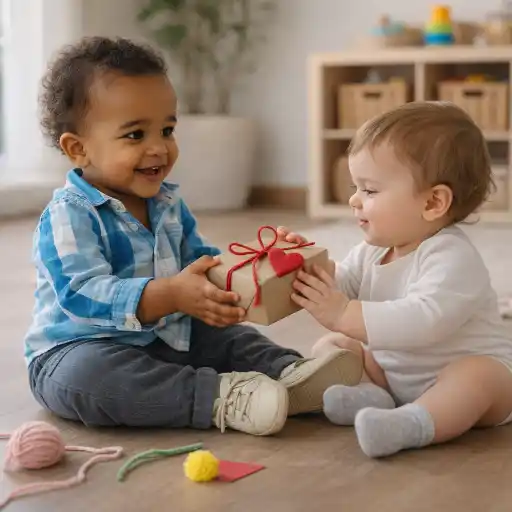 Keep the experience open-ended enough for children to make meaningful decisions. Process-focused art supports confidence because children are valued for exploring and making choices rather than copying an adult model. The related Open Heart, Open Art Buy Now $16.00 course can help providers deepen their understanding of how creative expression supports social-emotional development.
- 👋 Offer large, easy-to-grasp tools and pre-cut pieces for children who need them.
- Use visual examples without requiring children to reproduce the sample.
- Provide communication boards, gestures, home-language words, or assistive technology when appropriate.
- Invite children to work privately if public sharing feels uncomfortable.
- Document dictation exactly rather than correcting a child’s grammar or vocabulary.
Observe learning while children work. Are they persisting, making choices, requesting help, negotiating materials, or describing relationships? These observations can inform curriculum planning and help staff recognize strengths that may not appear during formal group discussions.
How can handmade gifts strengthen family engagement?
A gift activity becomes family engagement when families are treated as partners rather than as an audience. Send a brief note explaining that the project focuses on children’s expression and relationships. Invite families to share preferred language, recipient names, cultural considerations, or alternatives to a Father’s Day theme.
Some families may not celebrate Father’s Day, may have experienced loss, or may include important caregivers who do not fit the word “father.” Offer a choice such as “Special Grown-Up Coupon Book” and allow children to decide privately who will receive the gift. Providers should never ask a child to explain family circumstances in front of peers.
- Offer a take-home kit for families who cannot attend a classroom event.
- Provide translated directions or communicate through the family’s preferred method.
- Invite families to suggest meaningful activities for coupons.
- Share photographs only with appropriate permission and follow program privacy policies.
- Ask for feedback about whether the project felt welcoming and manageable.
These practices reflect reciprocal partnership: educators contribute developmental expertise, while families contribute knowledge about relationships, traditions, and children’s interests. For a broader professional-learning experience, Families, Communities, and Classrooms: Working Together for Children Buy Now $55.00 explores ways to represent families and communities in early learning settings.
How can directors organize a safe, inclusive, and low-stress gift project?
Directors can make the activity successful by building it into ordinary routines instead of adding an elaborate event. Prepare materials in labeled baskets, create a visual sequence, and schedule short work periods. A simple plan might include an introduction, a 15–20-minute creation period, drying or finishing time, and wrapping or labeling.
Use washable, non-toxic materials and supervise adhesives, scissors, and small components according to children’s ages. Keep small parts away from infants and toddlers, check allergy information, and store completed gifts securely until pickup. State requirements vary - check your state licensing agency for rules involving materials, photographs, visitors, and family communication.
Common mistakes are usually preventable:
- Too many steps: reduce the project to choosing, decorating, and sharing.
- Adult perfectionism: display children’s authentic work rather than silently remaking it.
- One family assumption: use flexible recipient language and offer alternatives.
- Unrealistic coupons: help children promise manageable acts of affection or assistance.
- Forced participation: provide observation, drawing, or take-home options.
Directors can also support staff reflection by asking: Which children had meaningful choices? Whose families were represented? Did the activity promote connection rather than compliance? These questions keep the project aligned with developmentally appropriate practice.
What should providers remember when helping children express appreciation?
Handmade gifts are most valuable when they help children notice relationships, express feelings, and experience themselves as capable contributors. The coupon book is a practical resource, but its educational value comes from the conversations and choices surrounding it.
Begin with one caring relationship, one accessible creative process, and one genuine message. Model appreciation in everyday language—“I appreciate how you helped put away the blocks”—so children learn that gratitude is not limited to holidays or expensive gifts. Accept words, drawings, gestures, signs, and quiet acts as valid communication.
Summary: Choose inclusive language, adapt materials by age and ability, preserve children’s authentic voices, and invite families into the planning process. When providers combine a classroom-ready resource such as the Father’s Day Coupon Book with thoughtful dialogue and family partnership, children learn that appreciation can be creative, relational, and expressed in many meaningful ways.
FAQ: What questions do providers commonly ask?
What if a child does not have a father to make a gift for?
Offer “special grown-up” language and let the child choose a trusted person, make a general family gift, or participate in a different activity.
Should every child complete the same coupon book?
No. Provide a common framework while allowing children to choose pages, materials, wording, and recipients.
How can infants participate?
Use safe sensory experiences, photographs, footprints, or teacher dictation. Keep small parts inaccessible and follow supervision requirements.
How do we avoid making gratitude feel forced?
Model appreciation, offer choices, and never require children to perform affection or say a specific phrase.
Can this project support learning goals?
Yes. It can promote language and literacy, fine-motor coordination, social-emotional development, decision-making, and family connection.
- Building Bridges for Dual Language Learners
- Building Bridges for Dual Language Learners: For Workforce Solutions
- Creating Environments that Nurture Growth and Community
- Texas Director Credential
- History, Policy, and Practice in ECE
- Equity-Centered Communication in ECE
- Every Moment Matters: Schedules and Transitions
- Supporting Families and Caregivers in Language and Literacy
- Gift of Gratitude: Fostering Emotional Intelligence in Children through Acts of Kindness
- Deck the Halls with Emotional Wellness: Family Traditions That Foster Connection
- CDA Certification en Español: Recursos y Consejos para Educadores Bilingües
- Celebrating Teachers
- 💛🧩 ¿Cómo puedo hacer que mi enseñanza sea inclusiva para los niños con autismo?
- 😤💬 ¿Qué Le Digo a un Niño que Acaba de Morder a Otro?
- 10 Ejemplos de Cómo la Cultura Influye en el Desarrollo Infantil
- Proporciones de Cuidado Infantil y Tamaños de Grupo por Edad en Maryland (Guía Rápida para Centros y Hogares)
- Proporciones de Cuidado Infantil y Tamaños de Grupo por Edad en Nueva Jersey (Guía Rápida para Centros y Hogares)
- Proporciones de Cuidado Infantil y Tamaños de Grupo por Edad en Virginia (Guía Rápida para Centros y Hogares)
- Lista para Guardería en Casa en Illinois: Cómo Iniciar una Guardería en el Hogar
- Cómo Trabajar en el Cuidado Infantil en Carolina del Norte: Requisitos y Pasos
- Mother’s Day Gifts and Crafts Children Can Make
- Celebrando la amistad en el cuidado infantil durante el Día de los Mejores Amigos
- Canciones, juegos y preguntas de círculo para niños
- Cómo simplificar la capacitación para sus empleados de daycare
- What Are Age-Appropriate Ways to Teach Gratitude Before Thanksgiving?
- How Can Handmade Gifts Help Children Express Appreciation?
- How Can Writing and Art Activities Help Children Name What They Appreciate?
- How Can Child Care Providers Respect Families Who Decline Handmade Classroom Gifts?
