Multiplication becomes more meaningful when children can see how numbers are organized rather than memorize isolated facts. The Early Mathematics Through Play Buy Now $24.00 course can help providers strengthen play-based math instruction, explore patterns and early operations, and earn practical professional learning for classroom use. As you build these experiences, the No Such Thing as Boring Math  Buy Now $24.00 course offers additional ideas for making mathematical thinking active, engaging, and accessible.
Why do visual patterns matter in multiplication?
Multiplication facts are easier to understand when children recognize relationships among quantities. A fact such as 3 × 4 = 12 can be represented as three equal groups of four, four equal groups of three, repeated addition, a number-line sequence, or a rectangular array. Each representation gives children another way to reason about the same relationship.
Visual patterns also reduce the pressure of fact recall. When a child forgets 4 × 6, an array or grouping model can help them reconstruct the answer instead of guessing. This supports #confidence and communicates that mathematics is about reasoning, not speed alone.
Pattern work matters because children learn to notice regularity, predict what comes next, and explain why a relationship holds. Research and professional guidance summarized in the references emphasize moving from concrete materials to visual representations and then to symbols. That sequence helps children connect what they can touch and see with the equations they eventually read and write.
For providers, the goal is not to turn early learners into rapid fact-recitation machines. It is to create short, purposeful experiences in which children investigate, describe, and apply numerical relationships.
How can equal groups and arrays make facts visible?
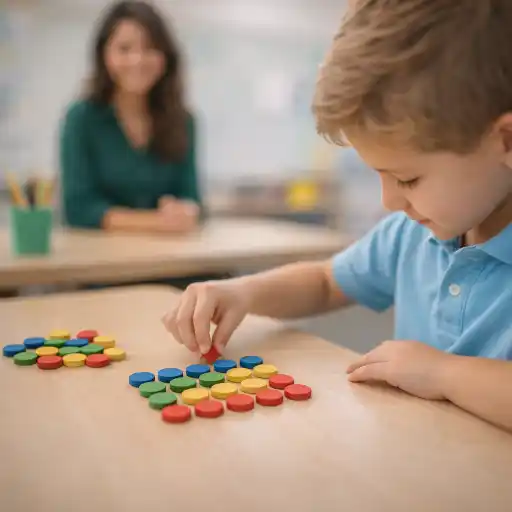
An array is an organized arrangement of objects in equal rows and columns. It makes the two factors visible: in a 3 × 4 array, children can see three rows with four objects in each row. They can count by fours, count by threes, or count all twelve objects. The same model supports the commutative relationship because rotating the array shows that 3 × 4 and 4 × 3 have the same product.
Begin with materials children can manipulate. Providers can also explore Montessori math’s hands-on, joyful approach to help young children develop an interest in numbers:
- Linking cubes arranged in rows.
- Counters placed on grid paper.
- Small toys organized on a tray.
- Tiles, buttons, or blocks found in the classroom.
Invite children to build a fact before asking them to write it. Say, “Can you make four groups of three?” Then ask, “How many are there altogether?” and “What multiplication sentence matches your model?” This language connects groups, factors, and products without reducing the experience to a worksheet.
Arrays also support connections to division. Once children build 4 × 5 = 20, they can discuss how 20 objects could be separated into four groups of five or five groups of four. The HMH reference explains that arrays help children understand multiplication and division as related operations, while Scholastic emphasizes progressing from concrete models to pictures and symbols.
How can color reveal multiplication patterns?
Color can make numerical structure easier to notice, especially when it is paired with explanation. Rather than coloring randomly, assign colors to products, factors, or groups. For example, children might color products that are multiples of five one color and products that are multiples of ten another. They can then compare the visual result and describe what they notice.
The featured Color by Product: Multiplication Practice Buy Now $0.99 resource provides 132 multiplication facts and asks children to color according to the size of the product, revealing a hidden heart picture. Its motivational design can make repeated practice feel purposeful, but the strongest learning occurs when providers add mathematical conversation.
Before children begin, model one or two problems:
- “I solved 3 × 4 and got 12. Which color represents 12?”
- “What array could show this fact?”
- “Do you see another fact that might have the same product?”
- “What pattern do you predict in the completed picture?”
🎨 After coloring, ask children to compare neighboring sections, identify repeated products, and explain how the key guided their decisions. This prevents the art component from becoming disconnected from the mathematical goal.
Color coding can also support children who benefit from strong visual organization. Use high-contrast colors, large print, and uncluttered examples when needed. State requirements vary - check your state licensing agency when connecting classroom resources to curriculum documentation or professional development expectations.
How can providers turn fact practice into playful investigation?
Children need repeated encounters with multiplication, but repetition does not have to mean identical drills. Short games and investigations allow providers to revisit the same facts through movement, talk, construction, and visual analysis.
- Array detectives: Invite children to photograph or sketch arrays in windows, shelves, floor tiles, cubbies, or trays. Ask them to write a matching equation.
- Product hunt: Call out a product such as 24. Children find as many factor pairs as they can build with counters.
- Human arrays: Have children stand in equal rows. The group says the factors and product together.
- Pattern prediction: Display 2 × 5, 3 × 5, and 4 × 5. Ask children to predict the next product and explain the additive pattern.
- Fact-family cards: Match an array with its multiplication and related division sentences.
- Color-by-product follow-up: Select three completed problems and represent each with an array, repeated addition, and a number line.
Math pattern activities are most effective when children create and explain patterns, not merely copy them. Invite partners to build a pattern, cover one part, and ask a peer to infer what is missing. This develops #reasoning and mathematical language.
Movement is especially helpful for children who need a physical entry point. Children can clap skip-counting sequences, hop along a floor number line, or pass one object into each equal group. Keep activities brief and observe whether movement helps children connect actions to quantities.
How can providers differentiate multiplication learning?
Children may participate in the same activity while needing different numbers, materials, prompts, or response methods. Differentiation preserves the mathematical idea while adjusting access and complexity.
- Beginning learners: Use two to five equal groups, small quantities, concrete objects, and adult modeling. Focus on one-to-one correspondence and the meaning of “groups of.”
- Developing learners: Use arrays, skip-counting, drawings, and partially completed equations. Ask children to explain how the rows and columns match the factors.
- Extending learners: Compare factor pairs, investigate square arrays, solve missing-factor problems, or connect multiplication to division and area.
- Children needing motor support: Offer magnetic counters, larger manipulatives, partner assistance, verbal answers, or digital drag-and-drop models.
- Dual language learners: Pair gestures and visuals with vocabulary such as group, row, column, factor, and product. Invite home-language explanations whenever possible.
Use formative assessment during play. Ask, “How did you know?” “Can you show it another way?” and “What would change if we added one more row?” Record strategies rather than only correct answers. A note such as “Maya solved 3 × 4 by counting each counter but recognized the array structure after prompting” identifies a useful next step.
Avoid permanent ability labels. Flexible groups should change as children develop, and every child should experience meaningful mathematical challenge.
What common mistakes should teachers avoid?
One common mistake is treating visual resources as decoration. Arrays, color keys, and hidden pictures are valuable only when children connect them to quantities and relationships. Ask children to explain what the colors represent and why a particular section receives a specific color.
Another mistake is emphasizing speed before understanding. Timed recall may obscure misconceptions and create unnecessary anxiety. Encourage efficient strategies, but allow children to use manipulatives, drawings, known facts, or skip-counting while fluency develops.
Providers should also avoid presenting one representation as universally best. Some children reason effectively with arrays; others benefit from number lines, equal groups, movement, or repeated addition. Rotate representations and ask children to compare them.
- Pitfall: Assigning a large practice page without modeling. Better approach: Solve one example together and connect it to a visual model.
- Pitfall: Correcting an answer without asking for thinking. Better approach: Ask, “Show me how you found it.”
- Pitfall: Using coloring as the final objective. Better approach: Follow coloring with discussion, sorting, and representation.
- Pitfall: Giving advanced children only more facts. Better approach: Offer unknown factors, multiple solutions, and explanation tasks.
Directors can support quality practice by providing manipulatives, shared planning time, and opportunities for staff to discuss observations. The Math Foundations in Early Childhood Buy Now $16.00 course is another relevant option for strengthening hands-on math planning and classroom implementation. Providers seeking a broader professional learning experience may also explore CDA Subject Area 2 Buy Now $80.00, which addresses children’s intellectual development, including math, science, language, and the arts.
Conclusion: How can children connect multiplication facts to visual patterns?
Children connect multiplication facts to visual patterns when providers deliberately link equal groups, arrays, color, movement, language, and symbolic equations. Begin with concrete materials, help children organize them into rows or groups, and invite them to predict, explain, and represent the resulting product.
The Color by Product: Multiplication Practice Buy Now $0.99 resource can provide motivating repetition and a visual payoff, while thoughtful teacher questions transform practice into mathematical reasoning. Use it alongside arrays, number lines, real-world pattern hunts, and flexible supports.
- Prioritize understanding before speed.
- Connect several representations of the same fact.
- Ask children to explain patterns and strategies.
- Differentiate quantities, materials, language, and challenge.
- Document children’s reasoning to guide next steps.
The central question is not only whether children remember a product. It is whether they can see why the product makes sense, recognize related facts, and use patterns to approach unfamiliar problems with curiosity and #confidence.
- 45 Hour Child Growth and Development
- Early Mathematics Through Play
- CDA Home Visitor Subject Area 3 Part 3 Birth to 5
- CDA Home Visitor Subject Area 2 Part 3 Birth to 5
- CDA Bridge Bundle: Preschool
- 45 Hour School Age Methods and Materials
- The Best Promotion is Play
- Play with Purpose: Supporting Children with Autism
- Creating Environments that Nurture Growth and Community
- Texas Director Credential
- CDA Certification en Español: Recursos y Consejos para Educadores Bilingües
- 💛🧩 ¿Cómo puedo hacer que mi enseñanza sea inclusiva para los niños con autismo?
- 🤯 ¿Por qué este niño está teniendo un comportamiento difícil de repente?
- 10 Ejemplos de Cómo la Cultura Influye en el Desarrollo Infantil
- Proporciones de Cuidado Infantil y Tamaños de Grupo por Edad en Maryland (Guía Rápida para Centros y Hogares)
- Proporciones de Cuidado Infantil y Tamaños de Grupo por Edad en Nueva Jersey (Guía Rápida para Centros y Hogares)
- Proporciones de Cuidado Infantil y Tamaños de Grupo por Edad en Virginia (Guía Rápida para Centros y Hogares)
- Lista para Guardería en Casa en Illinois: Cómo Iniciar una Guardería en el Hogar
- Lista para Guardería en Casa en California: Cómo Iniciar una Guardería en el Hogar
- Apoyo en Preescolar para Retrasos del Habla: Estrategias Simples que Ayudan
- Retraso del Habla en la Guardería: Cómo Pueden Ayudar los Proveedores
- Cómo Trabajar en el Cuidado Infantil en Carolina del Norte: Requisitos y Pasos
- Celebrando la amistad en el cuidado infantil durante el Día de los Mejores Amigos
- Canciones, juegos y preguntas de círculo para niños
- Cómo simplificar la capacitación para sus empleados de daycare
- How Can Children Connect Multiplication Facts to Visual Patterns?
- How Can Color-Coded Practice Reinforce Early Division Skills?
- How Can Visual Feedback Support Multiplication Fluency?
- How Can Children Practice Division Without Overloading Working Memory?
