Repeated prints turn a handful of autumn materials into an engaging investigation: children press, lift, compare, and decide what to try next. For practical support connecting these choices to developmentally appropriate goals, explore Lesson Planning for Preschoolers  Buy Now $24.00; it can help you plan purposeful experiences while honoring children’s different interests and abilities. Read on for simple ways to make a fall printmaking invitation both manageable and rich in learning.
Why does repeated-print art matter beyond the finished picture?
Printmaking makes cause and effect visible. A child loads a sponge with paint, presses it against paper, and lifts it to see what transferred. Repeating the action introduces meaningful choices: more or less pressure, a new spot, a rotated tool, another color, or a pause to study the result. The resulting marks may be bold, faint, overlapping, or incomplete—and each can prompt another experiment.
This open-ended process supports hand control, visual attention, comparison, language, and persistence. Children might notice that a dry leaf creates a different impression from a freshly painted one, or that prints become lighter as the paint runs out. These discoveries can connect art with early science and math without turning the activity into a quiz. NAEYC’s creative arts resources include process-focused perspectives that value exploration and children’s expression.
Seasonal art also gives children a way to represent what they notice about autumn. The goal is not a row of identical leaves or pumpkins. A child might make a pattern, a path, a cluster of colors, or an image with a story only they can explain. When educators value the process, children’s #creativity and decision-making remain at the center.
How can you prepare a safe, inviting printmaking space?
A thoughtful setup helps children work independently while allowing staff to supervise closely. Begin with a small selection of large, sturdy printing tools—such as clean sponges, broad leaves, cardboard tubes, or large blocks—and washable, child-appropriate paint. Provide paper, shallow trays, a brush or sponge for applying paint, a table covering, and a clear place for wet work to dry.
- Offer one or two colors at first; add choices when children are ready.
- Use a large sheet or secure the paper so it does not slide during pressing.
- Set out scrap paper for trial prints and a separate spot for used tools.
- Choose adaptable tools and positions, such as a vertical surface or a larger handle, to support varied ways of participating.
- 🍁 Invite children to examine safe, adult-checked leaves before printing, noticing their edges, shapes, and veins.
Inspect natural materials for sharp edges, mold, irritants, and pieces that could present a choking risk. Use materials appropriate for the children’s ages and needs, check allergies and family information, and supervise paint and tools. Keep paint away from food and plan for handwashing and cleanup. State requirements vary - check your state licensing agency, along with program policies.
How can children investigate pressure, placement, and repetition?
Demonstrate only the basic transfer action: apply a light coat of paint, press the tool, and lift it. Then invite children to choose where and how often to print. A simple prompt—“What might happen if you press gently?”—sets up an investigation without assigning a picture to copy.
Let children explore one variable at a time when they seem interested. They might compare a firm press with a light one, or print the same leaf in several places. Use descriptive language to help them notice the results: “That mark is darker,” “This one is close to the edge,” or “You turned the sponge before pressing.” Avoid describing a surprising result as wrong; a smudge or pale print is useful evidence for another attempt.
- Pressure: Compare a gentle touch and a firmer press, observing the amount of paint transferred.
- Placement: Try prints side by side, far apart, near an edge, or layered after the first mark dries.
- Repetition: Repeat one tool or alternate two tools to create a child-designed rhythm or pattern.
- Tool and texture: Compare a sponge, leaf, and cardboard surface; describe lines, dots, edges, and areas of color.
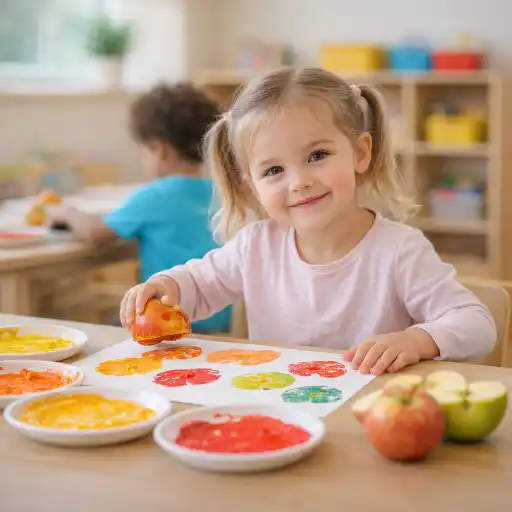
Printmaking invitations using leaves, sponges, and repeated marks are practical ways to keep attention on exploration rather than a prescribed product. Children may repeat a movement because they are testing it, enjoying its rhythm, or refining a plan. Offer time and space to continue, and let their #patterns develop at their own pace.
How can educators extend learning without taking over?
The educator’s role is to prepare materials, observe closely, and offer support that expands access or thinking. Pause before stepping in: a child who presses repeatedly may be comparing results, working through a sensory experience, or simply enjoying the action. A brief observation can be more helpful than an immediate instruction.
Open questions invite reflection while leaving decisions with the child: “What do you notice?” “How could you make that mark again?” “Where might you try the next print?” If a child asks for help, offer the smallest useful support—hold the paper steady, demonstrate how to lift a tool, or provide a different grip. Do not adjust the child’s composition or finish the work without permission.
Prints can also prompt connections to language, mathematics, and science. Children can describe textures, compare light and dark marks, create repeated sequences, or dictate a story about their design. Document learning with a photograph, a short objective note, and the child’s own words. For example: “Amir pressed the leaf twice and said, ‘The second one is lighter.’” This helps families see the thinking behind a finished piece and supports responsive planning. Respect each child’s #ideas, including when they choose to observe rather than print.
What common pitfalls can you avoid when planning the experience?
Fall themes can be inviting, but a model to copy may narrow children’s choices. Instead of asking every child to make the same seasonal picture, present materials and a brief invitation. You can demonstrate how paint transfers without showing a finished sample or requiring particular colors and placement.
- Too much paint: A deep puddle can obscure texture. Use a thin layer and offer scrap paper for testing.
- Too many materials at once: Start with a few distinct tools; add more in response to children’s exploration.
- Correcting marks or placement: Describe what happened and invite children to decide whether to repeat or change something.
- Focusing only on appearance: Notice persistence, strategies, comparisons, and choices as well as the final print.
- Assuming participation looks identical: Make room for watching, directing an adult, using an adapted tool, or joining later.
Planning can remain intentional and flexible at the same time. Identify one or two possible learning intentions—such as exploring pressure, strengthening hand control, or using descriptive language—then observe what children actually do. Use those observations to decide whether to repeat the invitation, change one material, or connect the prints to a later leaf walk or story. ChildCareEd’s Open Heart, Open Art Buy Now $16.00 course offers further professional learning about open-ended art and children’s social-emotional development.
Conclusion: How can repeated fall prints make room for meaningful learning?
Repeated-print art gives preschoolers a concrete way to explore pressure, placement, texture, and design while expressing their own ideas. Providers can make the experience successful with a few safe, accessible materials, a short demonstration, open prompts, and enough time to repeat and revise. Children’s marks need not match to show purposeful learning.
The central takeaway is to plan for exploration rather than a uniform product. Observe what children try, describe what you notice, and use their questions and strategies to shape what comes next. A child’s next print might be lighter, closer, rotated, or entirely unexpected—and that discovery is part of the value of the experience.
For a deeper foundation in planning developmentally appropriate preschool experiences, explore Lesson Planning for Preschoolers Buy Now $24.00. Providers interested in more related professional learning can also consider DAP for Preschool Buy Now $35.00, Inclusive Lessons for Preschoolers Buy Now $16.00, and Power of Art: Building Self-Esteem & Positive Behavior for All Abilities ONLINE Buy Now $24.00.
- Understanding Print Knowledge in Preschool
- Moving About the Classroom: Effective Transitions for Everyday
- CDA Subject Area 2
- CDA Home Visitor Subject Area 3 Part 3 Birth to 5
- What Makes Me Special: An Overview of Autism and ADHD
- Art from the Heart for Preschoolers: Open Ended Art Projects that Build Self-Esteem
- Creating Engaging and Meaningful Learning Experiences
- Lesson Planning for Preschoolers
- Supporting School Age Development ONLINE
- Montessori Cultural Activities: Exploring the World Through Play and Learning
- CDA Certification en Español: Recursos y Consejos para Educadores Bilingües
- Apoyo en Español para Capacitaciones Grupales Presenciales y por Zoom en Cursos Selectos
- Actividades de Motricidad Gruesa que Desarrollan el Equilibrio, la Coordinación y la Fuerza
- Capacitación en Salud y Seguridad Preventiva en Línea para Proveedores de Cuidado Infantil
- Proporciones de Cuidado Infantil y Tamaños de Grupo por Edad en Maryland (Guía Rápida para Centros y Hogares)
- Proporciones de Cuidado Infantil y Tamaños de Grupo por Edad en Virginia (Guía Rápida para Centros y Hogares)
- Actividades de Otoño Fáciles para Preescolares esta Temporada
- Cómo Trabajar en el Cuidado Infantil en Carolina del Norte: Requisitos y Pasos
- Calabazas, hojas y manzanas: actividades de otoño para preescolares
- Celebrando la amistad en el cuidado infantil durante el Día de los Mejores Amigos
- Canciones, juegos y preguntas de círculo para niños
- Cómo simplificar la capacitación para sus empleados de daycare
- Reglas y regulaciones de guarderías en Minnesota 2026: Requisitos actuales y próximos cambios
- How Can Halloween Fine-Motor Activities Be Fun Without Being Scary?
- Why Did My Stamp Print Backward? Discover Reversal Through Printmaking
- How Can Child Care Providers Make Fall Activities Inclusive for Every Child?
- How Can Fall Art Leave Room for Children’s Ideas Beyond Matching Pumpkins?
- How Can Fall Collage Activities Support Children Still Learning to Use Scissors?
- How Can Fall Repeated-Print Art Help Preschoolers Explore Pressure, Placement, and Design?
- How Can Children Build a Scarecrow That Balances and Stands?
