A scarecrow that stays upright is more than a charming fall craft—it is a lively invitation to explore balance, materials, and design. With the Basic Science in Early Childhood Buy Now $25.00 training, providers can strengthen their approach to hands-on inquiry and help children investigate why structures stand, lean, or topple. Read on for a practical challenge you can adapt to your group, then explore the course for deeper support in planning meaningful science experiences.
Why combine sculpture and balance in a scarecrow challenge?
Children are already testing ideas when they prop up a stick, stack blocks, or notice that a paper figure keeps falling over. A standing-scarecrow challenge makes that thinking visible. Children create a three-dimensional figure and investigate a meaningful design problem: how can it stay upright? The activity brings together visual art, early science, engineering, language, and mathematics without requiring children to follow one model or produce identical results.
Open-ended design challenges invite children to plan, build, test, and revise. NAEYC describes how tinkering and iteration help young learners discover how materials work and develop persistence, flexible thinking, and problem-solving. A scarecrow offers a playful context for these processes: a wider base, lighter arms, or a different placement of materials may change whether a sculpture stands.
For educators, the goal is not to deliver a mini-lecture on physics. It is to offer thoughtful materials and questions, then observe how children reason. Treating a topple as useful information communicates that learning comes from trying ideas, noticing results, and making adjustments. This is one way to nurture #curiosity and show children that their ideas are worth investigating.
What materials and preparation help children get started?
Gather open-ended, age-appropriate materials that children can combine in different ways. You might offer craft sticks, sturdy cardboard, paper, fabric scraps, yarn, tape, play dough, large buttons, leaves, and clean recycled containers. Natural materials can enrich the seasonal connection, but check for allergies, sharp edges, choking hazards, and other risks before the activity. Avoid small loose parts with children who may mouth objects, and keep adult-only tools out of reach.
Prepare a work surface where children can see and reach the materials. A tray or small selection at a time can make choices manageable without narrowing the possibilities. Invite children to look at pictures of different scarecrows or talk about what they already know. Some children may enjoy sketching a plan; others may prefer to begin building and decide as they go.
- Ask what the scarecrow needs to do: “How might we help it stand on its own?”
- Invite children to choose a base, body, and ways to attach the parts.
- Offer options for participation through drawing, pointing, building, describing, or working with a partner.
- 🧺 Keep spare materials nearby so children can test a new idea without interrupting the whole group.
For an activity with a clearer record of testing, the featured Standing Scarecrow Construction Challenge resource can support planning and documentation. Use it as a starting point, adapting the materials and level of adult guidance to fit your setting and children.
How can children investigate balance while they build?
Begin with a simple design prompt: “Can you make a scarecrow that stands without someone holding it?” Let children explore how a base, body, and added details affect stability. A sculpture may balance on a broad cardboard foot, a lump of play dough, or a container used as a stand. Children can discover that the way parts are attached matters as much as how they are decorated.
Use familiar language first—steady, wobbly, heavy, light, wide, narrow, lean—and introduce terms such as balance or stable when they fit naturally. Ask children to describe what they notice: “Where does it touch the table?” “What happens when we move the arms?” “Would a wider base help?” Exploratorium’s balancing-sculpture activity highlights how changing the arrangement and weight of objects can prompt playful exploration of stability and balance.
Keep the design challenge open rather than demonstrating one “correct” solution. Some children will build a vertical figure; others may create a leaning or unusual sculpture that can still stand. Welcome different approaches and let the group decide what counts as success for the challenge. Encourage children to make predictions before a test, then compare the prediction with what happens.
- Try one change at a time, such as widening the base or moving an arm.
- Compare two versions: which stands longer, or which needs less support?
- Use a photo or quick drawing to remember a design that worked or changed.
These exchanges support #observation and early scientific reasoning while keeping the experience playful.
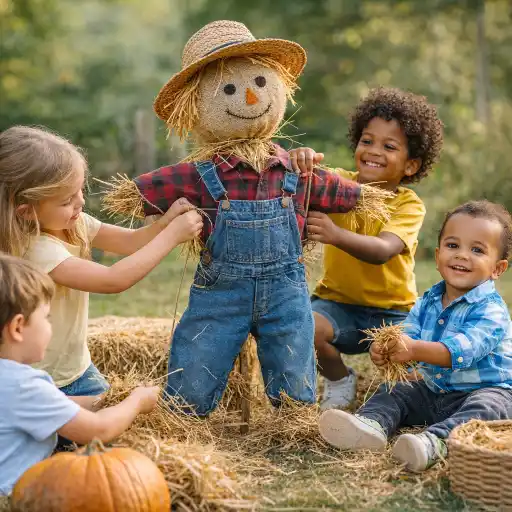
How can educators guide testing, redesign, and conversation?
Children benefit from time to try their own ideas before adults step in with solutions. Observe closely, describe what happened without judging the design, and ask a question that helps children think about a next step. If a figure falls, try: “It tipped when we added the hat. What could we change?” This frames the result as evidence—not failure—and encourages children to test a new possibility.
Offer prompts that invite explanation and comparison:
- “What do you notice about the bottom of your scarecrow?”
- “Which part seems to make it lean?”
- “What would you like to try next?”
- “How could we make the arms stay in place?”
Give children enough wait time to respond. Their thinking may appear through speech, gesture, drawing, building, or communication supports. NAEYC’s discussion of design challenges emphasizes that young children may move back and forth between planning, building, testing, revising, and sharing rather than following a strictly linear sequence. Let the learning process remain flexible.
Document the process, not just the finished sculpture. A photograph of a leaning version beside a revised design, a child’s dictated explanation, or a brief note about a prediction can help children revisit their thinking. If several children are working together, invite them to share strategies and notice how different ideas can contribute to a shared project. Specific feedback—“You tried a wider base after it leaned”—recognizes persistence and problem-solving.
How can you make the challenge inclusive, creative, and safe?
Adapt the experience so each child has a meaningful way to participate. Offer larger, easy-to-grip pieces; pre-cut materials when appropriate; stable work surfaces; picture choices; and additional time. Children can contribute by selecting colors, arranging materials, testing stability, describing an idea, or photographing the process. A child does not need to complete every construction step independently to be an active designer.
Keep art genuinely open-ended. A scarecrow can be silly, gentle, abstract, colorful, or inspired by a child’s interests. Process-art experiences value children’s choices and exploration more than matching a sample. The ChildCareEd article fun and easy STEM activities for preschoolers also reinforces the value of open-ended materials, child-led exploration, and celebrating mistakes as part of learning.
Safety planning is part of thoughtful teaching. Select materials based on children’s ages and abilities, supervise tools and small objects closely, and check recycled items for cleanliness and damage. Avoid requiring children to balance on furniture or use sharp, hot, or heavy construction materials. State requirements vary - check your state licensing agency.
Common pitfalls to avoid include:
- Prioritizing a polished product over children’s experimentation.
- Fixing a leaning structure before children have time to investigate it.
- Offering only one model or insisting all scarecrows look alike.
- Using materials that are unsuitable for the group’s ages or supervision capacity.
Conclusion: What do children learn from building a scarecrow that stands?
A standing-scarecrow challenge invites children to combine art and early engineering as they plan, construct, test, and revise a three-dimensional creation. By exploring bases, weight, and the placement of parts, children build an intuitive understanding of balance while practicing observation, communication, creativity, and persistence. The most valuable outcome is not a perfect scarecrow; it is children’s growing confidence in asking questions and trying another approach.
Keep the invitation manageable: offer safe, flexible materials, ask a clear question, and give children room to make decisions. Notice and document their ideas, adapt participation for different abilities, and treat each test as useful information. To deepen your skills in planning purposeful science experiences, explore ChildCareEd’s Basic Science in Early Childhood Buy Now $25.00 training. When educators support inquiry with patience and curiosity, a fall sculpture can become a memorable investigation into how things stand.
Explore related ChildCareEd courses
- Building Early Science Foundations
 Buy Now $16.00 — strategies for supporting young children’s exploration and scientific inquiry.
- Enhancing STEM Education for Infants and Toddlers Buy Now $16.00 — guidance for fostering early STEM learning through age-responsive experiences.
- Art from the Heart for Preschoolers Buy Now $35.00 — explores open-ended art and children’s confidence through creative choices.
- Creating Safe & Healthy Child Care Environments Buy Now $55.00 — supports providers in identifying hazards and planning safe learning spaces.
- From Play to Planning: Building Culturally Competent, Child-Centered Curriculum
- Balancing Physically Active Play in Child Care
- Basic Health & Safety and Breastfeeding Awareness
- What Makes Me Special: An Overview of Autism and ADHD
- Balancing Act: Record Keeping & Supervision
- CDA Bridge Bundle: Family Child Care without Portfolio Review
- CDA Bridge Bundle: Infant/Toddler without Portfolio Review
- CDA Bridge Bundle: Preschool without Portfolio Review
- Building Early Science Foundations
- Balancing Active Play in Child Care
- CDA Certification en Español: Recursos y Consejos para Educadores Bilingües
- 💛🧩 ¿Cómo puedo hacer que mi enseñanza sea inclusiva para los niños con autismo?
- 👶 ¿Cuáles son las proporciones y grupos requeridos en Dakota del Norte? 🏫
- ¿Cómo Crear Rutinas Saludables Para Niños Pequeños (sin estrés)?
- Recursos en Español sobre el Sueño Seguro del Bebé
- Apoyo en Español para Capacitaciones Grupales Presenciales y por Zoom en Cursos Selectos
- 10 Ejemplos de Cómo la Cultura Influye en el Desarrollo Infantil
- Proporciones de Cuidado Infantil y Tamaños de Grupo por Edad en Maryland (Guía Rápida para Centros y Hogares)
- Proporciones de Cuidado Infantil y Tamaños de Grupo por Edad en Nueva Jersey (Guía Rápida para Centros y Hogares)
- Proporciones de Cuidado Infantil y Tamaños de Grupo por Edad en Virginia (Guía Rápida para Centros y Hogares)
- Lista para Guardería en Casa en Illinois: Cómo Iniciar una Guardería en el Hogar
- Por Qué la Supervisión Activa Es Clave para la Seguridad en el Cuidado Infantil
- Consejos de Supervisión Activa para Salones de Preescolar y el Juego al Aire Libre
- Celebrando la amistad en el cuidado infantil durante el Día de los Mejores Amigos
- Canciones, juegos y preguntas de círculo para niños
- Cómo simplificar la capacitación para sus empleados de daycare
- Who Gets to Design the Scarecrow? How Can After-School Groups Make Fair Decisions?
- How Can Fall Word Play Help Preschoolers Hear Syllables?
- What Would the Scarecrow Say? How Can Fall Storytelling Help Children Explore Different Perspectives?
- How Can Children Build a Scarecrow That Balances and Stands?
