When a child says, “Odd numbers are smaller,” they may be revealing a pattern they have noticed—not simply making a mistake. Help them test that idea with hands-on pairing, conversation, and a practical Sorting Mat - Odd or Even Buy Now $1.49; for a deeper look at how children learn through play and active exploration, consider ChildCareEd’s Theory of Learning course  Buy Now $24.00.
Why might a child believe odd numbers are always smaller?
A child’s statement that odd numbers are “always smaller” can make sense from the examples they have encountered. Perhaps they have compared 3 with 4, or seen an activity where odd quantities were consistently placed before even ones. They may have noticed that odd and even numbers alternate on a number line, but not yet separated that pattern from the idea of size. Rather than treating the comment as carelessness, treat it as a window into the child’s current thinking.
Oddness and evenness describe a number’s relationship to pairs; they do not tell us whether a number is large or small. Three is odd and smaller than four, but seven is odd and larger than four. The child may need experience comparing numbers across both categories to recognize that parity and magnitude are different attributes. In even-versus-odd sorting and early number sense, hands-on sorting is used to connect quantities, classification, and explanation.
This kind of misconception is a productive starting point. A confident claim gives educators something to investigate together: What does “odd” mean? What does “smaller” mean? Can we find an example that challenges the rule? A warm, curious response protects the child’s willingness to share ideas and positions math as something learners can test and revise.
- Separate the two questions: “How many?” and “Can they make complete pairs?”
- Ask for an example before correcting the generalization.
- Affirm the thinking effort: “You noticed a pattern. Let’s see if it works for every number.”
How can pairing objects clarify what odd and even mean?
Begin with quantities children can see and move. Offer large counters, blocks, toy figures, or pairs of classroom objects, then invite the child to match them two at a time. Explain that a quantity is even when every object finds a partner, and odd when one object remains without a partner. The distinction is about pairing, not about whether the set looks bigger or smaller.
Use two collections that make the child’s claim testable. For example, compare four objects with seven. Four makes two pairs; seven makes three pairs with one left over. Ask which collection has more, then ask which one has a leftover. This helps children see that seven is odd while still being greater than four. A thoughtful sequence moves from concrete objects to drawings or dot cards, and only then to numeral symbols.
Try questions that invite children to demonstrate and explain:
- “Can every object find a partner?”
- “How many are in this group altogether?”
- “Which group has more objects? How did you check?”
- “What is different about the pairs in this group?”
- “Can you find an odd number that is larger than this even number?”
Keep the task exploratory rather than turning it into a speed drill. Children may arrange pairs in a row, a circle, or two groups; the arrangement can change without changing the quantity. The NAEYC discussion of meaningful math for young children emphasizes active, relevant exploration and open-ended questions as ways to help children make sense of mathematical ideas.
How can a sorting mat help without reinforcing the confusion?
The Sorting Mat - Odd or Even gives children a visual way to classify numbers from one through eight. Used thoughtfully, it can help connect the number symbol to the child’s concrete experience. First count out the matching number of objects and pair them; then place the numeral in the odd or even column. This sequence makes the mat a record of reasoning rather than a guessing exercise.
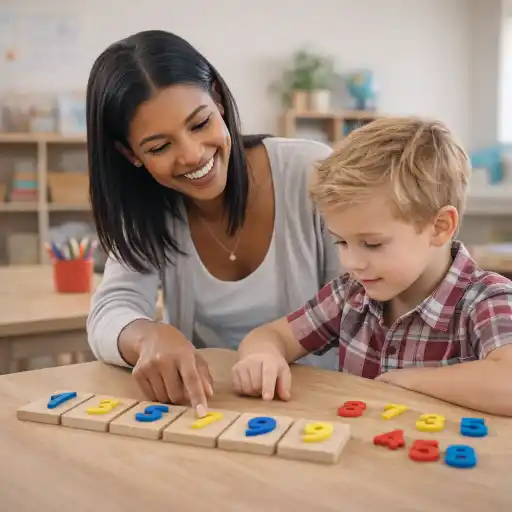
Invite children to explain their placement. If a child puts seven under “even” because seven seems larger than six, avoid simply moving the card and announcing the correct answer. Instead, say, “Let’s check seven with our counters. Can everyone find a partner?” Once the unpaired object is visible, ask where the numeral belongs and why. The child can revisit the classification with evidence.
Extend the activity with different representations:
- 🎲 Roll a die, collect that many counters, pair them, and sort the number.
- Use dot cards or drawings so children do not depend only on numeral recognition.
- Place two sorted numbers side by side and compare which is greater.
- Ask children to predict whether adding one counter changes the pairing result.
Revisit the same number range over several short sessions. Consistent practice with different materials can help children transfer the idea beyond one mat or one arrangement. The visual-pattern approach to introducing even and odd numbers likewise recommends grounding numerals and patterns in concrete quantity experiences.
How can providers support different learners and keep the activity inclusive?
Children may be developing counting accuracy, number recognition, fine-motor control, expressive language, or sustained attention at different rates. Adjust the pathway while preserving the central idea: complete pairs or one leftover. For a child who is still coordinating one-to-one counting, begin with two or three large objects and model touching each one once. Clear spaces, nonslip surfaces, and visual boundaries can make the task easier to manage.
Language should support access, not become a barrier. Pair words with gestures and objects: “two together,” “partner,” “one left,” and “no one left.” Welcome children’s home languages and allow them to respond by pointing, moving objects, drawing, speaking, or working with a peer. A child might understand the unpaired-object idea before independently using the words “odd” and “even.” That understanding is a valuable next step to build on.
- Beginning: Adult models pairs while the child counts, points, or notices partners.
- Developing: Child pairs a small collection and classifies it with prompts.
- Extending: Child predicts the category before pairing and checks the result.
- Ready for more: Child compares parity and magnitude across different quantities.
Choose age-appropriate materials and supervise closely. Small objects can pose choking hazards, especially for younger children; follow program safety policies and use larger materials when needed. Research on guiding preschool children’s mathematical understanding highlights the value of noticing children’s demonstrated strategies and using that information to plan meaningful next experiences.
How can educators observe progress and avoid common pitfalls?
Look beyond whether the child places a numeral in the expected column. A child may have memorized labels without understanding pairs; another may reason accurately with objects but not yet read the numeral. Observing the strategy helps you decide what support will be useful next. The What Works Clearinghouse guide, Teaching Math to Young Children, recommends a developmental progression and monitoring instruction in relation to what each child knows.
Record brief, specific observations rather than vague judgments. For example: “Maya paired eight bears independently, then said seven was bigger than six even though one bear was left over.” This note shows the child can pair a set and compare magnitude, while still working to separate the two ideas. A next step could be comparing three and six, then five and eight, using both pairing and counting.
Common pitfalls are easy to avoid with a few deliberate choices:
- Starting with the last-digit shortcut: Begin with pairs and leftovers; introduce digit patterns only when children are ready.
- Correcting without investigation: Ask, “How could we check?” and make the quantity visible.
- Focusing on speed or worksheet accuracy: Allow time to count, rearrange, and explain.
- Assuming one correct layout: Accept different arrangements that preserve the number of objects.
State requirements vary - check your state licensing agency when determining whether a training activity or professional development course meets a particular requirement.
Conclusion: How can we help a child separate oddness from size?
When a child thinks odd numbers are always smaller, respond as a supportive investigator: explore the claim together instead of treating it as a failure. Odd and even describe whether a quantity can be arranged in complete pairs; size describes how many objects there are. Pairing real objects, comparing different quantities, and inviting explanations help children distinguish these ideas.
Use the sorting mat after hands-on exploration, adapt materials and language to each learner, and observe the reasoning behind each choice. Keep the experience playful, safe, and open to revision. For a broader professional learning experience in how children learn through play and development, explore ChildCareEd’s Theory of Learning course Buy Now $24.00. For additional practical math strategies, providers may also explore Early Mathematics Through Play Buy Now $24.00, Math Foundations in Early Childhood Buy Now $16.00, and No Such Thing as Boring Math Buy Now $24.00.
- 45 Hour Child Growth and Development
- 45 Hour Preschool Methods and Materials
- 45 Hour Infant and Toddler Methods and Materials
- 45 Hour School Age Methods and Materials
- CDA Bridge Bundle: Family Child Care without Portfolio Review
- CDA Bridge Bundle: Infant/Toddler without Portfolio Review
- CDA Bridge Bundle: Preschool without Portfolio Review
- Texas Director Credential
- CDA Certification en Español: Recursos y Consejos para Educadores Bilingües
- Cómo Abrir Una Quardería En Casa Sin Dinero?
- ¿Cómo empiezo mi certificación CDA en Florida en línea?
- Capacitación en Salud y Seguridad Preventiva en Línea para Proveedores de Cuidado Infantil
- Regulaciones de Licenciamiento de Cuidado Infantil en California para Centros y Hogares de Cuidado Infantil Familiar
- Normas de Licenciamiento de Cuidado Infantil en Virginia para Centros Diurnos Infantiles y Hogares Diurnos Familiares
- Proporciones de Cuidado Infantil y Tamaños de Grupo por Edad en Maryland (Guía Rápida para Centros y Hogares)
- Proporciones de Cuidado Infantil y Tamaños de Grupo por Edad en Nueva Jersey (Guía Rápida para Centros y Hogares)
- Proporciones de Cuidado Infantil y Tamaños de Grupo por Edad en Virginia (Guía Rápida para Centros y Hogares)
- Lista para Abrir una Guardería en Casa en Virginia: Cómo Empezar
- Lista para Guardería en Casa en Texas: Cómo Iniciar una Guardería en el Hogar
- Cómo Trabajar en el Cuidado Infantil en Carolina del Norte: Requisitos y Pasos
- Cómo Trabajar en el Cuidado Infantil en Wisconsin: Requisitos y Pasos
- Celebrando la amistad en el cuidado infantil durante el Día de los Mejores Amigos
- Canciones, juegos y preguntas de círculo para niños
- Cómo simplificar la capacitación para sus empleados de daycare
- How Can Even vs. Odd Sorting Introduce Early Number Sense?
- How Can Child Care Providers Introduce Even and Odd Numbers Through Visual Patterns?
- How Can Sorting Help Kindergarteners Understand Odd and Even Numbers?
- Why Does a Child Think Odd Numbers Are Always Smaller—and How Can Providers Help?
