Professional development can make daily work easier and help children learn more. This article is for directors and child care providers who want simple, practical ideas for staff learning. You will find clear steps, helpful links to ChildCareEd resources, and quick ways to plan training that fits your team. For a concise overview of online and onsite training options suitable for preschool and kindergarten teachers, see the Professional Development for All Teachers guide.
You'll see numbered lists, short paragraphs, and real steps you can try tomorrow. This information supports thoughtful, respectful growth for your staff and better outcomes for the children you serve. Remember: state requirements vary - check your state licensing agency.
Why does professional development matter for my program?
- 🧠 Teacher knowledge: PD helps staff learn about child development, behavior, and safe routines. See ideas from ChildCareEd.
- 🤝 Better interactions: Training that focuses on adult–child interactions improves learning. Research shows focused, ongoing PD boosts classroom quality (ECRP study).
- 📈 Child outcomes: When teachers try new strategies, children often show better social, language, and thinking skills. The OECD and other reports highlight the value of continued learning for educators (OECD).
- 💼 Staff confidence and retention: PD that respects adult learners and gives useful tools helps teachers feel supported and stay in their jobs.
Why this matters: Teachers who get meaningful training make classrooms calmer, safer, and more joyful. That matters for your program's reputation and for family trust. Use #professionaldevelopment, #earlychildhood, #educators, #training, and #children in your notes so staff can find helpful resources quickly.
What types of professional development actually work?
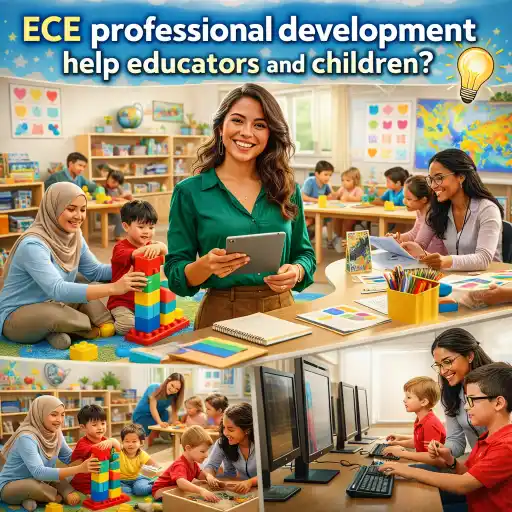
Not all PD is the same. Good PD is useful, ongoing, and tied to the work teachers do every day. Below are types that work well and where to find them.
- 📚 Self-paced online courses
- Why: Staff can learn on their schedule. ChildCareEd offers many self-paced options that meet state needs; see their catalog.
- Tip: Pair online study with a short team meeting to share what staff learned.
- 🧑🏫 Coaching and mentoring
- Why: Job-embedded coaching helps teachers apply skills in the classroom. Distinguish coaching from mentoring to match needs (ChildCareEd guide).
- 🏅 Microcredentials and stackable learning
- Why: Short, competency-based modules let teachers show new skills. See trends in microcredentials.
- 👥 Collaborative learning
- Why: Teachers report that learning with peers is especially helpful. Use study groups or professional learning communities (PLCs) to reflect together (GAO summary).
- 📑 Workshops with follow-up
- Why: Short workshops are okay only if there is follow-up coaching or practice. The best PD is sustained, not one-time (OECD).
Practical step: Mix 1–2 self-paced courses with one coaching cycle and monthly PLC meetings. Use ChildCareEd courses that match your state rules and center goals, for example child development or inclusion trainings (meaningful courses).
How can directors plan, track, and pay for staff PD?
- Set clear goals
- 1) Choose 2–3 program goals (example: reduce drop-in behaviors, improve language support).
- 2) Match goals to trainings (use ChildCareEd topic pages and course lists: ChildCareEd).
- Make a yearly PD plan
- 1) List required courses (health, safety, mandated reporter).
- 2) Add growth topics (classroom management, inclusion).
- Track progress and certificates
- 1) Use a simple spreadsheet or the ChildCareEd group admin feature to manage bulk purchases and certificates (group admin info).
- 2) Encourage staff to upload certificates to state registries when required. For example, Pennsylvania and California have registries and approved course lists—check local rules (PA guidance, CA guidance).
- Support and fund learning
- 1) Budget small stipends or paid time for staff to finish courses.
- 2) Use bulk buys or scholarships; ChildCareEd often supports centers with group options (group training).
Remember: state requirements vary - check your state licensing agency. A clear plan keeps PD useful, fair, and tied to classroom change.
How do we avoid common mistakes and make PD meaningful?
Many programs spend time on training that does not change classroom practice. Here are common mistakes and ways to avoid them.
- ❌ Mistake: Only counting hours, not impact
- ✅ Fix: Ask staff to show one short change they made after training (a photo, a note, or quick reflection). Use evidence to guide future PD.
- ❌ Mistake: One-off workshops with no follow-up
- ✅ Fix: Pair workshops with coaching cycles and PLC check-ins. Research shows sustained, job-embedded PD works best (GAO).
- ❌ Mistake: Irrelevant topics for staff
- ✅ Fix: Use adult learning principles: build on experience, be practical, and let adults choose relevant topics (ECRP).
- ❌ Mistake: No time to practice new skills
- ✅ Fix: Give short paid time slots for practice or peer observation during the week.
Quick checklist to make PD meaningful:
- 🔁 Make PD ongoing (not one day).
- 🧩 Match PD to classroom goals.
- 📎 Require a short evidence piece from staff after training.
- 💬 Schedule reflection with peers.
FAQ (short)
- Q: How many hours should staff do each year? A: It depends on your state and center. Many states set 5–20 hours depending on role; check state rules and use approved courses like those on ChildCareEd.
- Q: Can online PD count? A: Yes, many states accept online PD if the provider is approved. Save certificates and registry IDs.
- Q: What if staff resist training? A: Ask them what they need, offer choices, and pair training with paid time and coaching.
- Q: Are microcredentials useful? A: Yes—microcredentials show specific skills and can stack for larger growth (microcredential trends).
Summary
Good PD helps your staff feel capable, improves classroom routines, and supports better learning for children. Use a mix of self-paced courses, coaching, and peer learning. Plan yearly goals, track progress, and avoid one-off trainings without follow-up. For practical course options and group admin ideas, start at ChildCareEd and read center-focused articles on planning and meaningful PD (meaningful PD).
You are doing important work. Small, steady investments in staff learning pay off in kinder, calmer classrooms and in the long-term success of the children you serve. Use the hashtags #professionaldevelopment #earlychildhood #educators #training #children so staff can quickly find your notes and resources.
Professional development (PD) matters because it helps teachers learn better ways to teach, care for, and understand young children. When teachers grow, children grow. Here are the main reasons PD is important:Directors can make PD work without chaos. Plan, track, and support staff so learning becomes part of your center routine. Here are steps you can follow.- 45 Hour Child Growth and Development
- Birth to Five CDA Credential with Portfolio Review
- CDA Family Child Care Credential with Portfolio Review
- CDA Bridge Bundle: Family Child Care
- CDA Bridge Bundle: Family Child Care without Portfolio Review
- CDA Bridge Bundle: Infant/Toddler without Portfolio Review
- CDA Bridge Bundle: Preschool without Portfolio Review
- Texas Director Credential
- Effective Coaching & Mentoring in ECE
- Early Childhood Education Online Courses
- CDA Council's Early Educators Leadership Conference
- ChildCareEd Celebrates AMS Approval for Professional Development Courses
- CDA Certification en Español: Recursos y Consejos para Educadores Bilingües
- The Future is Flexible: Online Childcare Certificates and Early Childhood Education
- Keeping Your Florida CDA Current: A Guide to Renewal
- Why Florida Loves CDA: The Value of Certification in a Growing Field
- How Can North Dakota Educators Stay Current and Advance Their Careers?
- Guiding the Future: Directors and Administrators Are the Heart of ECE in Pennsylvania
- Why Professional Development & Continuing Education Spark Joy (and Growth!)
- Online Early Childhood Education Courses: Learn, Grow, and Advance Your Career
- How Do You Upgrade From Alberta ECE Level 1 to Level 2?
- Are 12 ECE Units the Same as 12 CEUs or 12 College Credits?
- What Are ECE Units, CEUs, Clock Hours, and College Credits—and How Do They Differ?
- Free ECE Courses in Canada: Test the Field Before You Commit to a Diploma
- Early Childhood Education Certification: What Do You Need—and How Long Will It Take?
- What Training Do You Need to Become a Preschool Teacher?
