Classroom labels are more than signs on shelves: they shape how children navigate a room and whether families see their language and knowledge reflected in it. Invite children and caregivers to review labels together, and use the Bridging Cultures: Family Communication & Collaboration  Buy Now $55.00 course to build practical skills in listening, culturally responsive communication, and family partnership. A shared review can strengthen children’s connection to print while making classroom cues clearer and more welcoming.
Why invite children and families to review classroom labels?
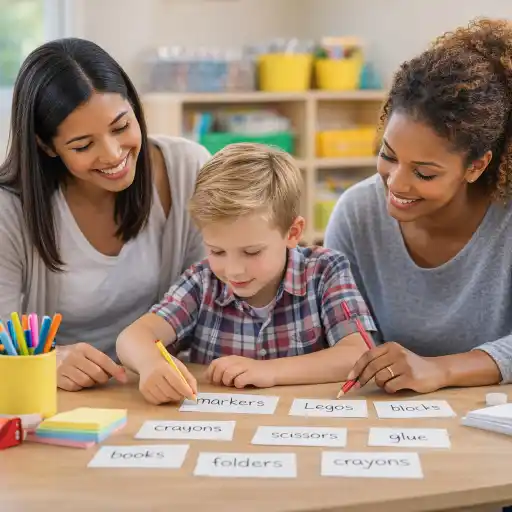
Labels carry messages about how a classroom works and whose words belong in it. When children help check a label, they encounter print as something meaningful: a word identifies a place or material and can guide an action. This is an authentic opportunity to notice environmental print, connect spoken words with written ones, and help children take part in shaping their learning environment.
Family participation adds another important perspective. Caregivers can confirm familiar names, suggest accurate home-language translations, identify images that make sense to their child, and point out wording that feels unclear. This is not a test of families’ knowledge or a request that any one person represent an entire culture. It is a way to treat family expertise as a resource and strengthen two-way communication.
A label review also helps educators check whether classroom print is useful rather than decorative. ChildCareEd’s guidance on how classroom labels help children understand print emphasizes connecting labels to objects and everyday routines. When children and families contribute to that connection, labels can support participation, belonging, and early #literacy.
- Children can share what pictures and words help them find materials.
- Families can contribute language, pronunciation, and context that staff may not know.
- Providers gain useful feedback about whether labels are clear, accurate, and current.
How can you prepare an inclusive label-proofreading activity?
Begin with a small, purposeful selection: perhaps labels on frequently used baskets, cubbies, learning centers, or the book area. Check that every selected label matches its current contents and has a clear function. Pair a short, familiar word with a recognizable picture or photograph, and consider whether children can see the label from their height.
Plan participation options before inviting families. Some may prefer a brief conversation at pickup, while others may want to review a printed page, send a message, or share feedback in a home language. Keep participation optional and low pressure; schedules, access, and comfort with written feedback differ. Ask families which language or communication method works best, and use qualified interpretation for nuanced conversations when needed.
Explain the purpose plainly: “We’re checking whether these pictures and words help children find and return things. Would you like to share what you notice?” Invite children to point, match, draw, dictate, or speak. Their contribution does not need to look like conventional reading or writing to be meaningful.
- Gather current labels, photographs, sticky notes, and simple feedback sheets.
- Offer a few clear prompts rather than a long questionnaire.
- Make sure families know their feedback is welcome, voluntary, and will be considered.
- ✨ Invite children to match a label to the real item before discussing whether it works.
What questions help children and families give useful feedback?
Use open, concrete prompts that invite observation rather than a “right” answer. Children may have different ways to respond: pointing, gesturing, using a home language, drawing, or speaking. Give them time, and describe what you notice without turning the activity into a reading quiz. For example, ask, “Which picture helps you find the blocks?” or “Where would you look for the paint?”
Families can consider whether the wording and visuals are familiar, respectful, and easy to understand. Ask for specific feedback rather than a general judgment. A caregiver might know that a child uses a different everyday word for an item, or that a photograph would be more recognizable than a generic icon. The Multilingual Learning Toolkit recommends placing home-language print on an equal footing with English when labels are included; families can help teams make that practice accurate and meaningful.
- For children: “Can you show me where this belongs?”
- For families: “Is this the word your child usually hears for this item?”
- For everyone: “Does the picture match what is actually in the basket?”
- Ask whether a label is easy to see and whether any part feels confusing or missing.
Avoid asking families to translate every label or speak for all speakers of a language. Invite contributions, check preferences, and acknowledge uncertainty with respect. If you are unsure about pronunciation or meaning, ask for guidance rather than assuming a literal translation is appropriate.
How should you act on feedback and update labels?
Collect feedback in a way that preserves the actual suggestions, then look for patterns. If several children search in the wrong place, the label may need a more recognizable image or a better location. If families recommend a familiar word or translation, verify the wording with the people who use it and decide how to display languages clearly and equitably.
Make changes with children rather than quietly replacing labels. Explain what is changing: “You told us the picture was hard to match, so we took a photo of our classroom basket.” Children can help photograph materials, choose between clear images, dictate a word, or place a new label. This process connects print with decisions and daily classroom use.
After updating, observe whether children can use the label during play, cleanup, or arrival. A label that looks attractive to adults may still be difficult for children to interpret; continued observation matters. Keep a simple review record with the label, feedback received, action taken, and a date to check whether the change helped. Protect any family information gathered during the process and follow program privacy practices.
- Prioritize accuracy, visibility, readability, and a real classroom purpose.
- Use family-provided language thoughtfully and check that translations reflect intended meaning.
- Review labels when materials move, rotate, or change.
- Tell families how their suggestions influenced the classroom, even when a proposed change is not adopted.
What common pitfalls should providers avoid?
A label review can feel collaborative only when people have a genuine opportunity to participate. Avoid sending one dense English-only survey and treating a lack of response as a lack of interest. Offer short, accessible options and multiple ways to contribute. The Multilingual Learning Toolkit’s family-engagement guidance stresses ongoing, responsive, two-way communication; a single request followed by no follow-up is unlikely to build a partnership.
Do not ask children to read words independently or correct their families’ language. Children may recognize labels through context or images before they identify letters, and families’ everyday vocabulary may differ from a program’s preferred term without being wrong. Keep feedback focused on clarity, familiarity, inclusion, and function—not on judging a child’s ability or a caregiver’s language.
Other preventable problems include leaving obsolete labels in place, posting too many cues at once, or adding translations that have not been checked. Avoid tokenism: a few translated signs do not substitute for listening to families or making home languages visible in meaningful classroom routines. Ask permission before displaying family-provided names, photographs, or contributions. State requirements vary - check your state licensing agency, particularly when changes affect room layout, accessibility, safety, or privacy.
- Do not pressure families to participate or share personal information.
- Do not rely on text alone when pictures or other supports would help children access the cue.
- Do not make changes without ensuring labels still match materials and routines.
How can programs make label review an ongoing partnership?
Instead of treating label proofreading as a one-time event, make it a simple part of classroom reflection. Review a small area when materials change or when observation suggests children are having trouble finding or returning items. Ask staff to use consistent words and refer to labels naturally during routines, so children encounter print as a practical communication tool.
Directors can support consistency by setting a manageable review rhythm and making accessible materials available to staff. Teams might agree to check one learning area each month, keep a shared list of labels needing attention, and invite family input through existing communication channels. Close the loop: tell caregivers what was changed and show children how the new cue works.
For a practical next step in developing culturally responsive collaboration, explore ChildCareEd’s Bridging Cultures: Family Communication & Collaboration Buy Now $55.00. The course addresses listening, intercultural communication, and meaningful ways to include families—even when they cannot be physically present. Providers seeking more focused literacy learning can also explore Understanding Print Knowledge in Preschool Buy Now $16.00, Classroom Tools for Emergent Literacy Buy Now $25.00, Building Bridges for Dual Language Learners Buy Now $16.00, and Family Voices Matter: Tools for Meaningful Collaboration Buy Now $55.00.
Conclusion: How can children and families help proofread classroom labels?
Children and families can help proofread labels by checking whether words, pictures, translations, and placement make sense in real classroom routines. Children bring firsthand knowledge of what they notice and can use; families contribute language, pronunciation, and context. Educators bring responsibility for making informed, safe, and consistent updates.
Start small: choose a few high-use labels, invite voluntary feedback in accessible ways, and ask concrete questions. Revise labels based on what you learn, model their use with children, and observe whether the new cues help. Most of all, show families that their input matters by sharing what changed and continuing the conversation. A thoughtful review turns classroom print into a shared resource—and reminds children that their ideas and languages belong.
- 45 Hour Child Growth and Development
- CDA Home Visitor Subject Area 3 Part 3 Birth to 5
- Nutrition Essentials for Child Care Providers
- CDA Bridge Bundle: Family Child Care
- Creating Environments that Nurture Growth and Community
- Texas Director Credential
- Classroom Tools for Emergent Literacy
- Classroom Tools for Emergent Literacy
- Families, Communities, and Classrooms: Working Together for Children
- Supporting Families and Caregivers in Language and Literacy
- CDA Certification en Español: Recursos y Consejos para Educadores Bilingües
- 10 Mistakes Candidates Make When Building Their CDA Portfolios
- 💛🧩 ¿Cómo puedo hacer que mi enseñanza sea inclusiva para los niños con autismo?
- 👶 ¿Cuáles son las proporciones y grupos requeridos en Dakota del Norte? 🏫
- Recursos en Español sobre el Sueño Seguro del Bebé
- ¿Cuáles son las mejores actividades del Día de la Tierra para niños en casa o en el aula?
- 10 Ejemplos de Cómo la Cultura Influye en el Desarrollo Infantil
- Proporciones de Cuidado Infantil y Tamaños de Grupo por Edad en Maryland (Guía Rápida para Centros y Hogares)
- Proporciones de Cuidado Infantil y Tamaños de Grupo por Edad en Nueva Jersey (Guía Rápida para Centros y Hogares)
- Proporciones de Cuidado Infantil y Tamaños de Grupo por Edad en Virginia (Guía Rápida para Centros y Hogares)
- Lista para Guardería en Casa en Illinois: Cómo Iniciar una Guardería en el Hogar
- Retraso del Habla en la Guardería: Cómo Pueden Ayudar los Proveedores
- Cómo Trabajar en el Cuidado Infantil en Carolina del Norte: Requisitos y Pasos
- Celebrando la amistad en el cuidado infantil durante el Día de los Mejores Amigos
- Canciones, juegos y preguntas de círculo para niños
- Cómo simplificar la capacitación para sus empleados de daycare
- CDA Scholarship Application Checklist: What You Need Before You Apply
- How Do You Turn CDA Family Questionnaires Into a Strong Summary Sheet?
- What Should a CDA Portfolio PDF Look Like Before You Upload It?
- How Can Children and Families Help Proofread Classroom Labels?
