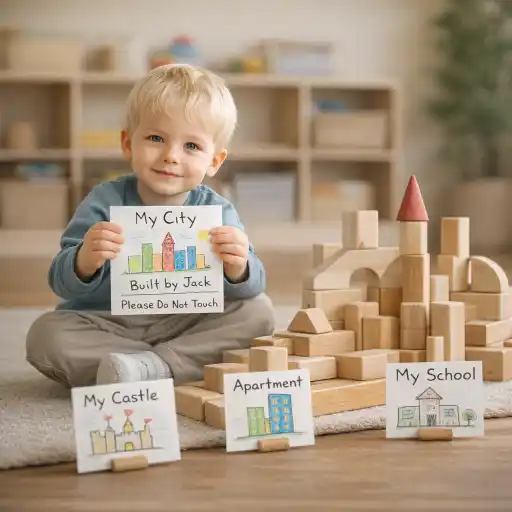
That block tower is more than a construction—it holds children’s plans, problem-solving, and stories worth sharing. Turn block play into a child-created exhibit with simple labels and interview prompts, while building meaningful speaking, writing, and early literacy experiences. For practical strategies you can use across classroom centers, explore ChildCareEd’s Classroom Tools for Emergent Literacy  Buy Now $16.00 course and its approaches to labels, interactive reading, and language-rich learning.
Why turn block play into an exhibit?
Block construction naturally invites children to plan, test ideas, negotiate with peers, and describe what they are making. A museum-style exhibit gives those efforts a real audience and a reason to communicate: children can explain a structure to classmates, families, or visitors who were not there when it was built. This public purpose can make writing and speaking feel useful rather than like an isolated assignment.
Labels also make learning visible. A child’s dictated words, drawing, or early writing can show how they understand shape, balance, space, and collaboration. Documentation that includes children’s words and the process—not only the finished product—helps families see what children learned through play. This aligns with guidance on documentation boards, which can connect children’s actions and thinking with learning goals.
For children, the exhibit is a chance to be recognized as makers and experts. For educators, it is a useful occasion to notice language, early writing, and social problem-solving in an authentic context. The goal is not a polished display; it is to honor children’s thinking and invite conversation.
How do you prepare the exhibit without taking over?
Start by observing the builders. Notice what they choose to build, the words they use, how they respond when a structure falls, and whether they collaborate. Ask permission before photographing or displaying identifiable work, and follow program privacy practices. Preserve the children’s structure when possible; if it must be moved, ask the builders how they want it represented or make a photo record together.
Invite children to decide what belongs in their exhibit. They might choose a name for the building, select a feature to highlight, or decide where the label should go. Offer simple materials—index cards, markers, clipboards, drawing paper, and reusable stands—without prescribing one finished look. An exhibit can be a small tabletop display or a temporary gallery near the block area.
- Use children’s own language and ideas as the starting point.
- Offer options to draw, dictate, mark, or write; participation does not depend on conventional spelling.
- Keep structures and labels accessible to children, including those who use mobility or communication supports.
- ✨ Invite children to choose a role: builder, interviewer, illustrator, label maker, or guide.
Project displays are most meaningful when the work remains child-led and connected to an inquiry. The Illinois Early Learning Project’s display and documentation resources offer examples of documenting learning experiences and project work.
What makes an engaging museum label for a block building?
A useful label is brief, readable, and anchored in what the child wants visitors to notice. Rather than asking preschoolers to write a formal paragraph, invite them to contribute one or two details. An adult can transcribe the child’s exact words while making clear that the words belong to the child. Children can add a drawing, their name or chosen mark, or a dictated title.
Try a flexible label frame:
- Title: What is your building called?
- Maker(s): Who helped build it, if they want their names included?
- About it: What is it for, or what should visitors notice?
- Materials or idea: What blocks or special feature did you use?
- Visitor question: What would you like people to wonder about?
For example: “The Rainbow Bridge / Built by Maya and Luis / It connects two towns. We made the top wide so cars can cross / What else could travel over it?” Keep language clear and concrete. If a child uses a technical word, preserve it and ask them what it means; introduce new vocabulary naturally rather than replacing the child’s voice. Guidance on writing exhibit labels for children and families similarly emphasizes clear language, a compelling detail, and questions that invite visitors to look and think.
Offer home-language versions or invite family contributions when appropriate. Display text at a height children can see, use strong contrast, and avoid crowding the construction. The point is to make the label a bridge between the builder and the visitor—not a test of reading or spelling.
Which interview prompts help children explain their ideas?
A short, conversational interview can help children reflect on their process and give you authentic language to document. Ask one open-ended question, listen, and allow time for a response. Children may answer with words, gestures, drawings, home-language phrases, or by showing a feature of the structure. Each is a valid way to communicate.
Try prompts such as:
- “What did you decide to build?”
- “What part are you proud of?”
- “How did you make this part stay up?”
- “What happened when the blocks moved or fell?”
- “Did you build with someone? How did you decide what to do?”
- “What would you tell someone who is visiting your exhibit?”
- “If you had more blocks, what might you add?”
Follow the child’s lead. If the answer is “It’s a house,” you might ask, “What makes it a good house for the people who live there?” Avoid turning the exchange into a quiz or correcting an imaginative explanation. Instead, echo and extend: “You said the tall blocks hold the roof. You figured out how to make it steady.” This models richer language while respecting the child’s contribution.
Use prompts in brief moments during play rather than interrupting a child’s concentration. A pair of children may want to interview one another, or a teacher can jot down a quotation and later invite the child to approve the label. These interactions support oral language and vocabulary, which are foundational to later reading and writing; see the Massachusetts Department of Elementary and Secondary Education’s overview of oral language in early literacy.
How can providers make the exhibit inclusive and document learning?
Offer multiple ways for children to contribute. Some may write or draw independently; others may dictate, point to picture choices, use an augmentative communication system, or ask an adult or peer to record their words. Invite multilingual children to use the languages they know. Families can help with translation or contribute a word or phrase, while educators ensure the display remains understandable to its intended visitors.
Document the process with a few purposeful pieces rather than trying to capture everything: a brief observation, a child quote, a drawing or label draft, and—if permitted—a photograph of the structure. Record what the child said or did in context, without interpreting beyond the evidence. For example: “After the roof tilted, Jordan added two blocks underneath and said, ‘Now it won’t slide.’” Use these observations to plan what might extend the inquiry, such as exploring stability, comparing bridges, or revisiting new vocabulary.
Assessment should be ongoing, responsive, and used to inform teaching—not to rank children. NAEYC’s guidance on observing, documenting, and assessing children’s development and learning emphasizes developmentally, culturally, and linguistically appropriate methods and the use of information to guide curriculum. If you display photographs or names, follow consent, confidentiality, and program policies. State requirements vary - check your state licensing agency.
What common pitfalls should you avoid, and what can you try next?
The most common pitfall is making the exhibit adult-authored: adults choose the title, write the description, and decide what the construction means. That may look tidy, but it can erase the child’s perspective. Another is expecting every child to produce the same amount or kind of writing. Children’s developmental pathways vary, and a dictated sentence or pointing response can be meaningful participation.
- Avoid: Treating the interview as a test with a correct answer. Try: Asking open questions and accepting different explanations.
- Avoid: Overloading labels with adult terminology. Try: Keeping the child’s words and adding one clarifying detail if needed.
- Avoid: Displaying work without checking permission or respecting a child’s choice about names. Try: Ask how and whether the child wants to be represented.
- Avoid: Focusing only on the finished structure. Try: Include a photo or note that shows planning, revision, or collaboration.
For a low-prep start, choose one block structure this week. Invite its builders to name it, ask one interview question, and co-create a short label. Then observe how visitors respond and what the children want to add or change. If you want to strengthen the literacy strategies behind this work, Reading Aloud and Storytelling Buy Now $16.00 can extend your toolkit for interactive language and storytelling experiences.
Conclusion: How can a block-building exhibit make learning visible?
Child-created museum labels transform block buildings into opportunities for meaningful communication. When educators listen to children’s ideas, offer accessible ways to contribute, and use short interview prompts, the exhibit can strengthen oral language, emergent writing, vocabulary, collaboration, and reflection—while celebrating the imagination already present in block play.
Keep the process simple: preserve children’s ownership, document their words accurately, and invite families and peers to look closely and ask questions. A label does not need to be polished to be powerful; it needs to sound like the child who built the structure. To build a deeper foundation for everyday literacy practice, explore ChildCareEd’s Classroom Tools for Emergent Literacy Buy Now $16.00, a course focused on practical strategies and materials for supporting young children’s language and emerging literacy.
Related resource: Block Builder Exhibit Labels and Interview Prompts.
- Turning Behavior Around for Toddlers and Preschoolers
- Basic Health & Safety and Breastfeeding Awareness
- Teacher & Me Playtime
- From Play to Planning: Building Culturally Competent, Child-Centered Curriculum
- Health & Safety Requirements for Childcare Providers
- Creating Engaging and Meaningful Learning Experiences
- Texas Director Credential
- Health and Safety Orientation
- Letter & Number Planning in Child Care
- Resources: Building Blocks to Excellence
- CDA Certification en Español: Recursos y Consejos para Educadores Bilingües
- 💛🧩 ¿Cómo puedo hacer que mi enseñanza sea inclusiva para los niños con autismo?
- 10 Ejemplos de Cómo la Cultura Influye en el Desarrollo Infantil
- Proporciones de Cuidado Infantil y Tamaños de Grupo por Edad en Nueva Jersey (Guía Rápida para Centros y Hogares)
- Proporciones de Cuidado Infantil y Tamaños de Grupo por Edad en Virginia (Guía Rápida para Centros y Hogares)
- Cómo Trabajar en el Cuidado Infantil en Carolina del Norte: Requisitos y Pasos
- Best Daycare Field Trip Ideas in Wisconsin
- What California children’s museums best support hands-on preschool learning?
- Summer Field Trips for Daycares in Nevada
- Celebrando la amistad en el cuidado infantil durante el Día de los Mejores Amigos
- What can the National Mall teach us about building a classroom where every child has a voice?
- Canciones, juegos y preguntas de círculo para niños
- La mejor manera de hacer seguimiento a la capacitación de su equipo de daycare How to Organize Staff Training for Your Child Care Center Cómo organizar la capacitación del personal para su centro de cuidado infantil
- Cómo simplificar la capacitación para sus empleados de daycare
- How can Michigan providers teach community and citizenship for the 250th anniversary?
- How can Michigan providers teach community and citizenship with America’s 250th activities?
- Field Trips for Elementary Students: 15 Adventures That Bring Learning to Life
- How Can Child Care Providers Create Effective Learning Centers in Small Spaces?
- Bad Weather on a Field Trip: When Should Child Care Programs Change the Plan?
- How Can Child-Created Museum Labels Turn Block Buildings Into Exhibits?
