Planet art can do more than brighten a classroom wall: paired with thoughtful conversation, it can help children notice patterns, share ideas, and build early science habits. Explore Basic Science in Early Childhood Buy Now $25.00 for practical guidance on planning investigations and supporting children’s scientific reasoning; this two-hour training can strengthen your classroom practice as you turn creative curiosity into meaningful learning.
Why combine art and conversation when introducing the solar system?
For young children, the solar system is fascinating but distant and difficult to experience directly. Art makes the topic tangible: children can represent a planet with color, shape, texture, and marks, while conversation gives them a way to explain what they notice and imagine. The goal is not to expect preschoolers to master astronomy facts. It is to nurture curiosity, observation, vocabulary, and confidence in expressing ideas.
This approach also honors children’s different ways of participating. Some may talk readily; others may point, gesture, draw, or listen before contributing. When adults welcome these forms of communication, a shared art experience can support belonging as well as early science.
How can providers prepare a purposeful planet-coloring invitation?
Begin with a small group, a few planet images or coloring pages, and a manageable selection of drawing tools. Introduce a clear but open invitation: “Let’s look closely at these planets and make a picture that shows something you notice.” A useful resource to feature is ChildCareEd’s Coloring Activity Planets Buy Now $1.49—check the resource page for availability and details.
- Offer crayons, washable markers, or pencils suited to children’s ages and abilities.
- Include images or simple reference cards, but avoid insisting that children reproduce a model exactly.
- Provide larger paper, adapted grips, or pre-positioned pages when these support participation.
- Keep enough room for children to work comfortably and talk with one another.
- 🪐 Invite children to select a planet, color combination, or invented planet of their own.
Before the activity, decide what you hope to observe—for example, whether children compare visual features, use new vocabulary, or explain an artistic choice. That intention helps keep the experience purposeful without turning it into a test.
Which questions help children think and talk about planets?
Open-ended prompts invite children to notice, wonder, and explain without requiring a single predetermined answer. Start with what is visible in the picture and give children time to respond. A quiet pause is not a problem to solve; it can give a child space to form an idea or choose a way to communicate it.
- “What do you notice about this planet?”
- “What colors or shapes do you see?”
- “What made you choose those colors?”
- “How is this picture like—or different from—another planet picture?”
- “What would you like to find out about it?”
Listen closely and build on children’s words. If a child says, “This one has a stripe,” you might respond, “You noticed a band of color across the planet. What do you think it could look like up close?” Model accurate vocabulary gently while valuing imaginative interpretations. For example, distinguish between what a picture shows and what a child is inventing: “In this image, Saturn has rings. Your drawing gives your new planet glowing green rings.”
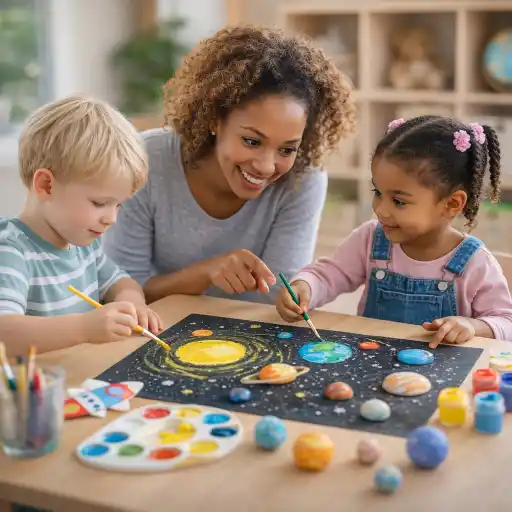
How can coloring support science, art, and development together?
Coloring and drawing involve more than fine-motor practice. Children make choices, sustain attention, compare details, and represent ideas visually. When educators add conversation, children have opportunities to explain a decision, listen to a peer, and revise their thinking. These experiences link creative expression with the habits of science: observing, asking questions, describing, and representing.
To extend the activity, invite children to sort their pictures by a feature they choose, such as color, size in the illustrations, or visible rings. Make clear that a sorting category is a way to compare pictures, not necessarily a claim about the actual planets. Children might also arrange planet images in a simple sequence with adult support. Keep facts accurate and brief; preschoolers benefit from clear language and repeated opportunities to revisit ideas.
- Use child-created captions dictated to an adult, such as “My planet has a blue storm.”
- Make a shared display that includes children’s words alongside their artwork.
- Invite children to compare two images: “What is the same? What looks different?”
- Document observations with a short note or photograph, following program privacy practices.
How can educators adapt the experience and avoid common pitfalls?
Plan for access from the beginning. Children differ in fine-motor control, attention, sensory preferences, language, and prior experience. Offer alternatives such as stickers, chunky crayons, digital-free picture choices, verbal dictation, or pointing to select colors. A child does not need to finish a page to participate meaningfully. Support children who use communication devices, gestures, or home languages by making room for their preferred ways to share ideas.
Keep the setting calm and flexible. A coloring invitation should not become a quiz about planet names or a demand to stay within lines. Avoid correcting imaginative choices as “wrong” when the goal is creative representation. At the same time, when you present factual information, use reliable sources and distinguish science facts from make-believe. State requirements vary - check your state licensing agency, especially when selecting materials or planning activities that involve tools, small parts, or other safety considerations.
- Common pitfall: giving a long lecture before children can explore. Try instead: offer a brief introduction and let children’s questions guide the discussion.
- Common pitfall: praising only neatness or accuracy. Try instead: notice effort, observation, choices, and ideas.
- Common pitfall: asking questions rapidly. Try instead: ask one open prompt, pause, and listen.
How can you extend and reflect on the solar system activity?
Children’s pictures and comments can guide what happens next. Display the work at children’s eye level and revisit it during a later conversation: “What do you remember about the planet you drew?” Add a simple book, planet photographs, a movement game, or a model made from larger safe materials. The Astronomical Society of the Pacific’s age-appropriate astronomy resources and NASA’s printable solar system activities provide possible extensions.
For a quick reflection, record a child’s exact words, what they observed, and a possible next step. One child’s interest in rings might lead to comparing planet images; another child’s questions about night skies could inspire a moon-observation conversation with families. Share the learning with families through a short description of the process, not only a picture of the finished page. This helps make children’s thinking visible and invites family knowledge into the classroom.
Conclusion
Introducing the solar system through art and conversation means making space for children to observe, choose, imagine, and explain. A planet-coloring invitation can foster early science language, creative expression, fine-motor practice, and peer connection when educators plan intentionally and respond warmly. Keep materials accessible, questions open-ended, facts accurate, and participation flexible. Above all, follow children’s curiosity: their comments and creations can show you where the next investigation should begin.
- Positive Attention: Interactions & Supervision of Infants & Toddlers
- Basic Health & Safety and Breastfeeding Awareness
- Building Early Science Foundations
- Open Heart, Open Art
- Power of Art: Bldg Self-Esteem & Positive Behavior for ALL Abilities
- Children at the Wheel: Emergent Curriculum
- Art from the Heart for Preschoolers: Open Ended Art Projects that Build Self-Esteem
- Texas Director Credential
- Building Vocabulary
- Montessori Cultural Activities: Exploring the World Through Play and Learning
- CDA Certification en Español: Recursos y Consejos para Educadores Bilingües
- 📊¿Cómo puedo hacer un seguimiento de la capacitación de mi personal en GAPDS como proveedor?✨
- 🍑 ¿Qué capacitación requiere DECAL cada año para el personal de cuidado infantil en Georgia?
- Cómo Abrir Una Quardería En Casa Sin Dinero?
- Recursos en Español sobre el Sueño Seguro del Bebé
- Apoyo en Español para Capacitaciones Grupales Presenciales y por Zoom en Cursos Selectos
- ¿Cuáles son los pasos, requisitos y opciones en línea para la certificación de 90 horas en cuidado de Infantes/Toddlers en Maryland?
- 10 Ejemplos de Cómo la Cultura Influye en el Desarrollo Infantil
- ¿Cómo solicito la licencia para una guardería en California?
- Proporciones de Cuidado Infantil y Tamaños de Grupo por Edad en Maryland (Guía Rápida para Centros y Hogares)
- Proporciones de Cuidado Infantil y Tamaños de Grupo por Edad en Nueva Jersey (Guía Rápida para Centros y Hogares)
- Proporciones de Cuidado Infantil y Tamaños de Grupo por Edad en Virginia (Guía Rápida para Centros y Hogares)
- Actividades de Otoño Fáciles para Preescolares esta Temporada
- Las Mejores Ideas de Excursiones para Guarderías en Dakota del Norte
- Celebrando la amistad en el cuidado infantil durante el Día de los Mejores Amigos
- Canciones, juegos y preguntas de círculo para niños
- Cómo simplificar la capacitación para sus empleados de daycare
- How Can Art and Conversation Introduce Preschoolers to the Solar System?
- ¿Qué habilidades preceden al recorte y cuándo deben aprender los niños a usar tijeras?
