A child who hangs back during circle time may still be learning—watching, listening, and deciding how to join. Child care providers can support participation without forcing it by adjusting group size, routines, and ways to contribute; Inclusive Lessons for Preschoolers  Buy Now $16.00 offers practical guidance for adapting activities, materials, and classroom practices. For a broader approach to recognizing individual strengths and needs, explore Recognize, Respond, Respect: Supporting Diverse Learners Buy Now $55.00 as a professional learning next step.
Not every young child is ready to participate in a large group in the same way or for the same amount of time. Readiness is not a fixed trait, and hanging back does not necessarily mean a child is disengaged, defiant, or behind. A responsive program treats group learning as one option among several, observes what helps each child feel secure, and makes meaningful participation possible at an individual pace.
Why is flexibility in group learning important?
Large-group activities place several demands on young children at once: shifting away from play, attending to spoken directions, coping with noise and close proximity, waiting for a turn, and communicating in front of peers. For some children, that combination can be tiring or overwhelming. Others may need extra time to understand a new routine, feel comfortable with the adults and children present, or process language in the group setting.
Instead of measuring learning by whether a child sits still or answers aloud, consider what the child is doing and what the activity makes possible. Watching carefully, moving to a song, selecting a picture, holding a prop, or listening from the edge can all be ways of engaging. NAEYC’s discussion of moving from circle time to small groups recommends adapting the format to children’s needs and using smaller groups to create more opportunities for responsive conversation.
Flexible participation supports #belonging and agency. It communicates that children do not have to perform in one particular way to be valued members of the classroom. This matters for the whole group: shorter gatherings, clearer routines, and varied response options often make learning more inviting and manageable for everyone.
How can educators recognize a child’s readiness and strengths?
Begin with observation rather than a conclusion about the child. Notice when participation seems easier or harder: Is the group especially loud, long, or unfamiliar? Is the child more comfortable with a particular adult, peer, topic, or position in the room? Does the child watch, copy a gesture, move closer, or respond in another way? Patterns across different activities give educators more useful information than one difficult moment.
Record objective details, including the activity, setting, child’s communication, supports offered, and what happened next. For example, “Mina stood beside the rug and copied the hand motions during two verses” is more useful than “Mina refused to join.” NAEYC guidance on planning for individuality emphasizes observing children’s interests and abilities and building relationships with families to understand their experiences and context.
Use those observations to build from the child’s existing strengths. A child who loves vehicles might carry a toy bus to the gathering; a child who communicates through gestures might choose a song card; a child who is comfortable beside one familiar peer may start there. These small bridges keep the group’s shared purpose while offering a more accessible entry point. Avoid assuming the reason for a child’s hesitation or treating a single observation as a diagnosis.
What practical changes make group activities easier to enter?
Make the gathering predictable and focused. Give a familiar transition cue, preview what will happen, prepare materials before children arrive, and keep the activity short enough to match children’s attention and interest. If the goal is to introduce a story, a brief greeting followed by an interactive read-aloud may be more useful than a long sequence of announcements and questions.
- Offer flexible places to participate: a chair, a cushion, a standing spot, or a place at the edge.
- Pair spoken directions with pictures, gestures, demonstrations, or real objects.
- Allow different responses: speaking, pointing, signing, choosing a picture, moving, or observing first.
- Reduce avoidable noise and crowding, and make pathways and materials accessible.
- Consider a small group of two to four children when the learning goal calls for conversation, practice, or close adult support.
- 🧸 Offer an optional, meaningful role such as page-turner, prop holder, or song-card chooser.
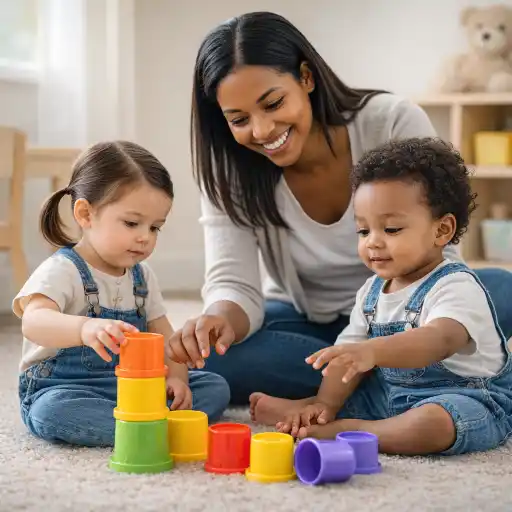
Small groups are not a reward or a permanent placement for a child who finds large groups difficult. They are one useful format among many. A child may benefit from joining a short small-group experience before choosing to approach the larger gathering later. As NAEYC notes in its article on circle time and small groups, smaller groups can support differentiated learning, open-ended conversation, and child-led exploration.
How can providers invite participation without pressure?
Use warm, neutral invitations that leave room for a child to decide. For example: “You can watch from this spot, hold the picture, or join us when you’re ready.” Then give the child time to respond. Repeating prompts, calling attention to the child in front of peers, or physically placing a child in the group can turn an invitation into a demand and may increase discomfort.
Let participation grow in small, flexible steps. A child might begin by watching, then sit nearby, hold a related object, join alongside one peer, or take part in one part of the activity. These steps are not a test, and children may move forward, pause, or return to observing. If a child needs a break, offer a calm nearby option while maintaining supervision and connection. Keep the opportunity to return available without making rejoining a requirement.
Support peer connection thoughtfully. Shared materials, complementary helper roles, and activities linked to children’s interests can create natural opportunities to interact. Model simple language such as “Would you like a turn?” and help peers respect a child’s response. As children practice relationships and express preferences, adults can notice and affirm their efforts without spotlighting them. Trusting teacher-child relationships, as NAEYC describes in its guidance on social and emotional health, help children feel safer exploring new experiences.
How should programs collaborate, assess progress, and avoid common pitfalls?
When a child regularly finds group activities difficult, look for patterns across the day and partner with the family. Begin with strengths and specific observations, then ask what the family has noticed and what helps the child feel comfortable in other settings. With appropriate consent, coordinate with the child’s existing support team and follow any applicable plans. Educators should share factual observations and avoid diagnostic conclusions.
Assess whether the activity is becoming more accessible—not whether the child is complying. Look for small signs of comfort or engagement: moving closer, choosing a prop, responding with a gesture, participating briefly, or returning after a pause. Reflect with colleagues on the group’s length, noise, directions, timing, and available choices, then make one practical adjustment and observe what changes.
- Avoid: interpreting quiet observation as refusal or lack of learning.
- Avoid: expecting every child to sit still, make eye contact, or speak aloud.
- Avoid: offering choices that are not genuinely available or repeatedly prompting after a child declines.
- Try instead: documenting what happened, what support was offered, and what participation looked like for that child.
State requirements vary - check your state licensing agency for applicable program, supervision, and documentation requirements.
Conclusion: What does supportive group learning look like?
Child care programs can support children who are not yet ready for large-group learning by adapting the experience rather than demanding that every child participate in the same way. Observe the child’s cues and strengths, make routines predictable, offer small groups and varied participation options, and invite rather than pressure. Watching, listening, moving, choosing a prop, or joining briefly can all be meaningful ways to take part.
Partner with families and colleagues, record specific observations, and make thoughtful adjustments over time. The goal is not identical participation; it is a respectful opportunity for every child to connect with learning and peers at a pace that feels manageable. For further professional development, explore Inclusive Lessons for Preschoolers Buy Now $16.00, Recognize, Respond, Respect: Supporting Diverse Learners Buy Now $55.00, Planning for Every Child: Responsive Strategies in Action Buy Now $55.00, Preschool Assessments & Observations Buy Now $24.00, and Social Foundations and Responsive Classrooms Buy Now $24.00.
- CDA Home Visitor Subject Area 3 Part 3 Birth to 5
- Positive Attention: Interactions and Supervision of Infants and Toddlers: For Workforce Solutions
- What Makes Me Special: An Overview of Autism and ADHD
- 45 Hour Infant and Toddler Methods and Materials
- CDA Bridge Bundle: Family Child Care without Portfolio Review
- CDA Bridge Bundle: Infant/Toddler without Portfolio Review
- CDA Bridge Bundle: Preschool without Portfolio Review
- Positive Attention: Interactions & Supervision for Infants & Toddlers
- Texas Director Credential
- CDA Certification en Español: Recursos y Consejos para Educadores Bilingües
- The Beginner’s Guide to Buying a Child Care Business
- Child Care Business Matchmaking: Where Buyers, Sellers, and Big Dreams Meet
- Manage Training Across Multiple Child Care Sites with ChildCareEd Group Admin
- What Should You Say in a Daycare Interview If You Have No Experience?
- First Week of Pre-K Lesson Plans: What Can You Learn About Your New Class?
- Child Care Administration Course: Are You Ready to Manage Adults, Not Just Classrooms?
- How Can Bingo Games Support Turn-Taking and Social Skills?
- How Can Child Care Programs Make Nature-Based Learning Meaningful, Inclusive, and Safe?
- How Can Child Care Providers Create Effective Learning Centers in Small Spaces?
- How Can Sorting Activities Strengthen Early Thinking Skills?
- How Can Early Math Activities Build Young Children’s Mathematical Thinking?
- What Should a 4-Year-Old Know Before Pre-K?
- How Can Providers Connect Letter Formation, Sound, and Vocabulary in Phonics Instruction?
- A Child Counts Correctly but Cannot Show the Quantity: What Comes Next?
- What Is the Difference Between Parallel Play and Cooperative Play?
- Why Can a Child Match a Shape but Struggle to Rebuild It with Pieces?
- Fever-Free and Ready to Return? How Can Child Care Programs Make Safe, Fair Decisions?
- Why Is Symmetry Difficult for Some Kindergarten Children?
- How Can Child Care Programs Support Children Who Are Not Yet Ready for Large-Group Learning?
