Have you ever noticed a group’s play stall when an adult steps into the middle of the action? Small adjustments to where we stand can protect children’s space to explore while keeping supervision strong. The Creating Environments that Nurture Growth and Community  Buy Now $55.00 course offers practical guidance on classroom arrangement, learning centers, inclusion, and outdoor environments; explore it for a fuller learning experience as you refine your classroom practice.
Why can an adult’s position change the course of play?
Adults shape children’s play not only through words and planned activities, but through their physical presence. Standing in a pathway, leaning over a construction project, or occupying the only open spot near a play center can unintentionally signal that children should stop, wait, or seek permission. Even when an adult intends only to observe, their body may interrupt access to materials, block a child’s view, or shift the group’s attention away from its own ideas.
This matters because child-led play depends on choice, movement, and sustained engagement. Research on teacher positioning during imaginary play describes different ways educators may be near, alongside, or inside children’s play. Each position carries different possibilities for participation and influence. The goal is not to keep adults distant; it is to notice how proximity and placement affect children’s agency.
Adult presence can also communicate welcome and safety. A nearby, attentive educator may help a child enter play or feel secure enough to experiment. Yet when adults unintentionally dominate a center, children may change direction, abandon materials, or wait for the adult to move. Thoughtful positioning allows providers to remain available without becoming the center of the activity.
- Notice whether children can reach materials and move freely around you.
- Consider what your position communicates, even when you are silent.
- Balance children’s uninterrupted play with attentive, active supervision.
Which standing habits most often create barriers?
Blocking play rarely comes from a lack of care. It often happens during busy classroom moments, when providers naturally gravitate toward the center of the room, a popular activity, or a colleague. Repeated habits can create subtle barriers, however, especially when classroom traffic is already tight.
Common examples include standing in a doorway children use to move between centers, hovering over a child who is concentrating, or placing a body between children sharing materials. Adults may also gather together in one area, leaving other centers less visible and less supported. A tall adult standing in front of a low shelf can make materials harder for children to see and reach. A chair pulled into a narrow path can turn ordinary movement into a queue.
Pay attention to children’s responses rather than assuming your presence is neutral. Do they pause when you arrive? Do they move around you, ask you to get something they could usually reach, or leave the center? These behaviors are useful feedback about how the environment and adult positioning are working together.
- Standing directly between children and the materials they are using.
- Occupying a doorway, narrow pathway, or shared center entrance.
- Hovering so closely that children shift attention from play to the adult.
- Clustering with colleagues instead of distributing supervision across zones.
Try a simple reset: step to the edge of the play area, lower your profile when appropriate, and check whether children can continue without navigating around you. The aim is not to become invisible, but to avoid making your body an unnecessary obstacle.
How can providers stay attentive without taking over?
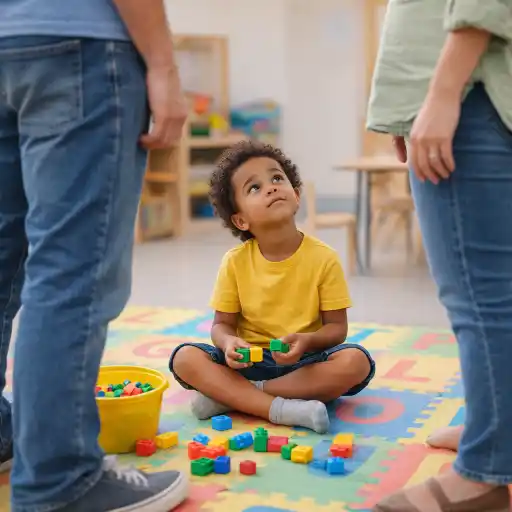
Effective positioning integrates supervision with respect for children’s play. Choose a place where you can see and hear the children in your assigned area, respond promptly, and avoid cutting across the play’s main routes. Active supervision is not passive standing; it involves watching, listening, moving intentionally, anticipating needs, and engaging when support is warranted.
Before play begins, identify high-interest areas, blind spots, and pathways. During play, scan systematically and make small adjustments as children’s activity changes. If a center becomes crowded, reposition yourself to open access rather than directing every child to move. If safety requires closer proximity, explain your presence calmly and preserve as much child choice as possible.
Use a light-touch sequence when a child encounters a manageable challenge: pause and observe; move closer without interrupting; acknowledge what is happening; and offer a question or specific help only if needed. Some children may welcome an adult as a play partner, while others communicate a preference for space through gesture, movement, or focused attention. Respond to those cues rather than treating one interaction style as universal.
- 👀 Select a vantage point with clear sightlines that does not occupy children’s work space.
- Keep exits, pathways, and frequently used materials accessible.
- Move when the play pattern, safety needs, or group distribution changes.
- Join play when invited or when meaningful support is needed; return ownership to children when possible.
State requirements vary - check your state licensing agency. Positioning plans should support, not replace, required supervision practices and ratios.
How can a position-and-movement map help the team?
A simple map can turn an abstract reminder—“be aware of where you stand”—into a practical team routine. On a sketch of the classroom or playground, mark play zones, entrances, pathways, sightline challenges, and activity areas that call for closer attention. Then note where each staff member will begin and how they will reposition as children move.
Use the map as a planning and reflection tool, not a rigid set of posts. One adult may begin near blocks while another covers the art area, but roles should shift when a group moves outdoors, a high-interest activity draws a crowd, or a child needs focused assistance. Agree on how staff will communicate when someone changes zones, steps away, or needs backup. Directors can invite staff to test the map during a short observation period and revise it based on what they see.
The Creating Environments that Nurture Growth and Community Buy Now $55.00 training provides a broader foundation for arranging spaces, materials, and learning centers to support development and community. A mapping activity can complement that learning by making adult movement visible and discussable.
- Draw pathways children actually use, not only the routes shown on the room plan.
- Mark places where an adult’s body could block access, views, or participation.
- Review the map after room changes, schedule changes, or shifts in children’s interests.
- Discuss what worked in a supportive, non-blaming staff huddle.
What common positioning mistakes should teams avoid?
One frequent mistake is equating closeness with good supervision. Proximity matters, but standing directly over children may distract them, limit independent access, or turn a play area into an adult-controlled space. Conversely, staying fixed in one location can leave other areas unseen. Strong supervision requires intentional movement and awareness of the whole environment.
Another pitfall is interpreting children’s movement around an adult as proof that the placement is harmless. Children may accommodate the obstacle rather than protest: they might reach awkwardly, wait, take a longer route, or abandon a material. Look for patterns across children and activities, and ask colleagues what they notice. Children’s different abilities, mobility, sensory needs, and communication styles can make the same layout accessible to some and limiting to others.
Avoid solving every congestion problem by telling children where to go. First consider whether furniture, material placement, group size, or adult positioning contributes to the crowding. Small adjustments—moving a chair, shifting to the perimeter, or opening a route—may restore access while preserving children’s choices.
- Do not remain anchored to one spot when children and risks shift around the room.
- Do not assume a quiet child is disengaged; observe nonverbal participation and access.
- Do not prioritize paperwork or conversation over active supervision.
- Do not treat the mapping sheet as a substitute for scanning, listening, and responding.
Teams can use the active supervision strategies for indoor and outdoor play as a reminder that staff placement is one part of a continuous process, alongside scanning, listening, and anticipating children’s needs.
Conclusion: How can adult positioning protect children’s play?
Adult standing positions can accidentally block play when they interrupt pathways, limit access to materials, draw attention away from children’s ideas, or leave parts of the room less supervised. Providers can reduce these barriers by observing children’s cues, selecting clear vantage points, moving with the group, and arranging staff coverage collaboratively.
Use a teacher position and movement map to notice where adults stand, how children travel, and which areas need a change. Keep supervision active and responsive, while making room for children to direct their own exploration. The central question is not simply where an adult should stand, but how an adult can be present, attentive, and available without becoming an obstacle to play.
For additional professional learning on designing inclusive environments, arranging learning centers, and supporting children’s exploration, consider Creating Environments that Nurture Growth and Community Buy Now $55.00. For practical supervision strategies, explore Active Supervision: A Strategy That Works Buy Now $35.00, Classroom Setup for Child Care Buy Now $24.00, and The Best Promotion is Play Buy Now $35.00.
- 18-Hour Train the Trainer
- Emergent Learning & Development
- Basic Health & Safety and Breastfeeding Awareness
- Bienvenido! Welcoming All Families
- Birth to Five CDA Credential with Portfolio Review
- Pediatric RSV First Aid & CPR/AED
- CDA: Stand With Respect and Professionalism
- Character Development for Childcare Professionals
- Creating Environments that Nurture Growth and Community
- Texas Director Credential
- CDA Certification en Español: Recursos y Consejos para Educadores Bilingües
- 💛🧩 ¿Cómo puedo hacer que mi enseñanza sea inclusiva para los niños con autismo?
- 🚌 ¿Qué Significan las Regulaciones de Transporte de Illinois para las Excursiones Infantiles? 🚦
- ¿Cómo puedo usar escenarios de juego de roles de primeros auxilios en mi aula?
- 10 Ejemplos de Cómo la Cultura Influye en el Desarrollo Infantil
- Proporciones de Cuidado Infantil y Tamaños de Grupo por Edad en Maryland (Guía Rápida para Centros y Hogares)
- Proporciones de Cuidado Infantil y Tamaños de Grupo por Edad en Nueva Jersey (Guía Rápida para Centros y Hogares)
- Proporciones de Cuidado Infantil y Tamaños de Grupo por Edad en Virginia (Guía Rápida para Centros y Hogares)
- Actividades de Otoño Fáciles para Preescolares esta Temporada
- Por Qué la Supervisión Activa Es Clave para la Seguridad en el Cuidado Infantil
- Consejos de Supervisión Activa para Salones de Preescolar y el Juego al Aire Libre
- Cómo Trabajar en el Cuidado Infantil en Carolina del Norte: Requisitos y Pasos
- Celebrando la amistad en el cuidado infantil durante el Día de los Mejores Amigos
- Canciones, juegos y preguntas de círculo para niños
- Toddler Classroom Ideas: What Should Be at a Child’s Eye Level?
- How Can Child Care Providers Nurture Critical Thinking in Young Children?
- How Can You Create a “Yes Space” Where Infants and Toddlers Explore Safely?
- What Should Child Care Staff Check Before Outdoor Play?
- What Makes an Infant Play Area Easy for Staff to Supervise?
- How Can Adult Standing Positions Accidentally Block Children’s Play?
