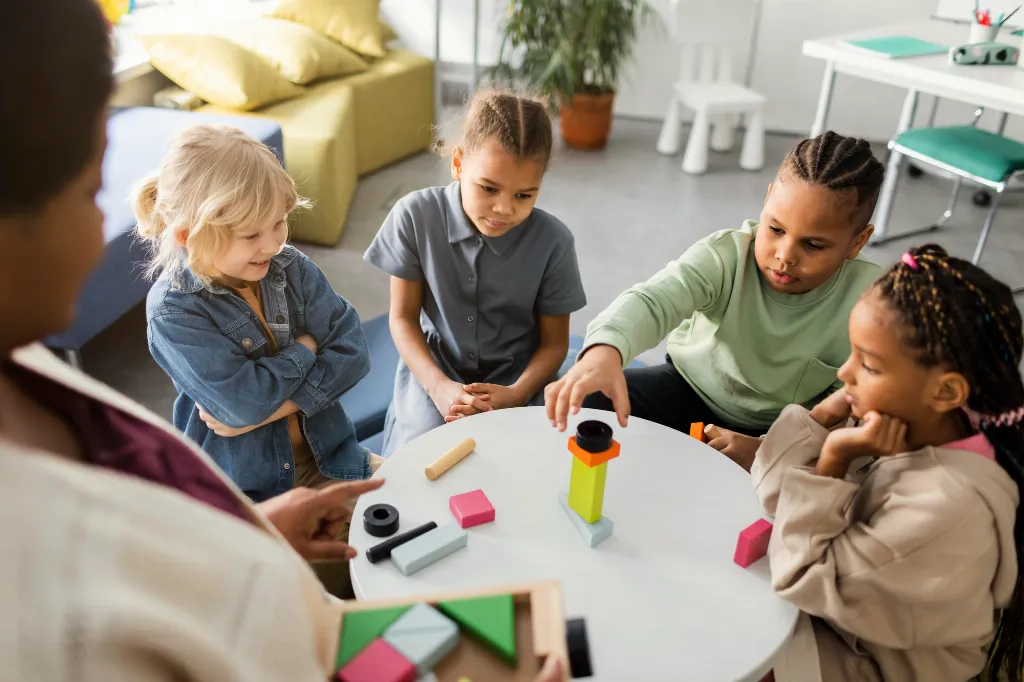
 Quick note: a short playful cue like “1, 2, 3… Eyes on me” is a simple tool you can teach and use right away. This article helps child care providers and directors learn what the cue does, how to teach it, when to use it, and how to include all children so it works for your whole group. Use the links below for ready scripts and extra practice ideas.
1) What is "1, 2, 3… Eyes on Me" and why does it matter?
"1, 2, 3… Eyes on Me" is a short, predictable attention signal that tells children to stop, look, and listen. When you use one simple signal, children learn the meaning quickly. That helps build calmer transitions, stronger #routines, and better #listening across your room.
Why it matters:
- Calm and safety: A consistent cue reduces yelling during busy moments (e.g., clean-up, lining up).
- Learning time: Faster attention means more time for teaching during circle and activities.
- Skills practice: Children practice self-control and quick listening — early executive skills that help them in school and life.
Tip: choose 1–2 signals and use them each day so kids learn fast.
2) How do I teach and practice the cue so it really works?
Teaching takes clear steps. Use a short, repeatable plan and practice several times while children are calm. ChildCareEd suggests modeling, practicing, praising, and using the cue in real moments; see their teaching loop here: Attention Signals That Help Children Listen.
- 🔹 Model it: Show the phrase and the ready body (hands in lap, eyes forward).
- 🔁 Practice it: Do it together 3–5 times with smiles and short scripts.
- ✅ Notice it: Give specific praise when children respond (“Thank you—eyes on me!”).
- 🔄 Use it for real: Try it at circle time, clean-up, lining up, and door transitions.
Quick script example you can use:
- Teacher: "1, 2, 3… Eyes on me!"
- Children: "1, 2… Eyes on you!"
- Teacher: "Voices off. Eyes front. Thank you, helpers."
Practice tip: keep each practice under 2–5 minutes so it stays fun. If a child needs extra help, use a visual cue or move a seat closer so they can see your face and the signal.
3) When should I use this cue during the day and what do transitions look like?
Use the cue whenever you need quick, calm attention. Best moments include: circle time, clean-up, lining up for outside, snack, and safety drills. Using the same cue in the same situations makes it reliable for children.
- 🎯 Circle time: Start by using the cue at the start so the group learns the routine.
- 🧹 Cleanup: Use the cue, then give one short action: “Hands in. Put toys away.”
- 🚶 Line up: Cue, then one direction: “Walking feet to the door.”
- 🔔 Emergencies or drills: A practiced cue helps everyone respond quickly and safely.
Also pair the verbal cue with a nonverbal signal (a raised hand, a chime, or a pose). Nonverbal signals protect your voice and help children with hearing or language needs. For lots of cue ideas (no-talk signals, rhythms, chimes) see resources like Classroom Management Attention Getters Without Talking.
4) How do I include children with different needs and avoid common mistakes?
Inclusion and consistency are key. Make small changes so the cue works for all learners, including children with attention differences or language delays. Use visuals, seat choices, and short practice so everyone knows the meaning.
- 📷 Visual supports: Add a picture card that shows the cue and the ready body. ChildCareEd recommends visuals for routines: How can preschool teachers use simple classroom management techniques.
- 🪑 Seating options: Offer chairs, cushions, or standing spots for children who need movement.
- 🤝 Extra practice: Re-teach one-on-one or with a small group for children who need more time.
- 🔁 Pair cues: If one cue stops working, re-teach the new cue slowly and keep it predictable.
Common mistakes and how to avoid them:
- 🚫 Too many signals — fix: pick 1–2 and stick with them.
- 🚫 Not teaching the cue — fix: model and practice several times, not just post signs.
- 🚫 Inconsistent adult responses — fix: staff agree on scripts and follow the same steps.
For support with behavior plans or when a child needs more help, look to evidence-based frameworks like PBIS and CSEFEL: CSEFEL What Works Briefs and the CDC guidance on classroom strategies for attention needs: CDC: ADHD in the Classroom.
Conclusion and FAQ
Try this simple plan tomorrow:
- Pick one cue (“1, 2, 3… Eyes on me”).
- Teach it with modeling + 3 quick practices.
- Use it at circle and transitions. Praise children who respond quickly.
Short FAQ:
- Q: How long to practice? A: 2–5 minutes at circle time, repeated daily.
- Q: What if a child doesn’t respond? A: Move closer, say the child’s name, re-teach gently.
- Q: Can I change cues mid-year? A: Yes, but re-teach the new cue with practice.
- Q: Where to find visuals/scripts? A: See ChildCareEd attention signal and circle time pages: Attention Signals and Circle Time Activities.
Using one clear, playful cue supports calmer days, stronger #attention, and smoother #routines. Small, consistent steps make a big difference for your #preschoolers and your team. Keep it kind, keep it short, and celebrate the wins.
- 💛🧩 ¿Cómo puedo hacer que mi enseñanza sea inclusiva para los niños con autismo?
- Apoyo en Español para Capacitaciones Grupales Presenciales y por Zoom en Cursos Selectos
- ¿Qué Calificaciones Necesitas para Trabajar en Cuidado Infantil?
- ¿Cómo empiezo mi certificación CDA en Florida en línea?
- 10 Ejemplos de Cómo la Cultura Influye en el Desarrollo Infantil
- Normas de Licenciamiento de Cuidado Infantil en Virginia para Centros Diurnos Infantiles y Hogares Diurnos Familiares
- Proporciones de Cuidado Infantil y Tamaños de Grupo por Edad en Maryland (Guía Rápida para Centros y Hogares)
- Proporciones de Cuidado Infantil y Tamaños de Grupo por Edad en Virginia (Guía Rápida para Centros y Hogares)
- Cómo Ser Maestra de Preescolar en Dakota del Norte
- Cómo Ser Maestra de Preescolar en California
- Capacitación Previa al Servicio para Proveedores de Cuidado Infantil en Dakota del Norte
- Celebrando la amistad en el cuidado infantil durante el Día de los Mejores Amigos
- Canciones, juegos y preguntas de círculo para niños
- La mejor manera de hacer seguimiento a la capacitación de su equipo de daycare How to Organize Staff Training for Your Child Care Center Cómo organizar la capacitación del personal para su centro de cuidado infantil
- One, Two, Eyes on You: Classroom Attention Getter for Preschool
- One, Two, Eyes on You: A Fun Way to Build Listening Skills
- 1 2 3 Eyes on Me: What to Do When This Attention Getter Stops Working
- Attention Signals: Which Ones Work Best for Toddlers, Preschoolers, and School-Age Kids?
- Proporciones para guarderías en casa bajo el Título 22: Cómo la mezcla de edades cambia su capacidad en California
- ¿Todos los niños deben participar en el tiempo de círculo?
