When fall rain arrives, a toy house can become the perfect reason to investigate how materials and design work. Try this low-cost roof challenge to help children predict, test, and improve an idea—and explore Building Early Science Foundations  Buy Now $16.00 for practical ways to nurture inquiry through play. For a broader set of classroom science strategies, you can also explore Basic Science in Early Childhood Buy Now $25.00.
A roof that leaks is not a failed project; it is evidence children can use. With a simple setup, thoughtful questions, and a consistent test, providers can turn a rainy-day idea into a meaningful experience in science, engineering, language, and collaboration.
Why is a toy-house roof challenge meaningful early STEM?
The question “How can we keep the toy dry?” is concrete, motivating, and open-ended. Children encounter a problem, consider possible solutions, build a model, and see what happens when water meets their design. This brings early #STEM practices into children’s play without requiring specialized equipment or lengthy instruction.
The investigation can connect several areas of development at once. Children compare materials, describe surfaces as wet or dry, count sprays, talk about where water travels, and listen to peers’ ideas. Their words—“it went through the paper” or “let’s cover that corner”—make their reasoning visible. NAEYC describes preschool engineering as a process of identifying a problem, imagining and planning, creating, and improving; a roof challenge offers a natural opportunity to practice that cycle (NAEYC’s preschool engineering design process).
For educators, the point is not to produce a perfect miniature roof. The value is in supporting children to notice, explain, and revise. When a design leaks, children gain useful information and another reason to test a new idea.
How can you set up a safe, engaging investigation?
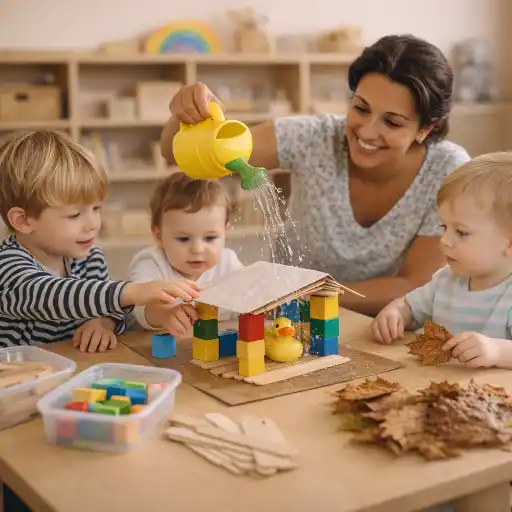
Choose a small, sturdy toy house or make a model from a reusable container or box. It needs an opening so children can check whether water reached the interior. Offer a few age-appropriate roof materials—for example, foil, plastic sheet, waxed paper, fabric, paper, leaves, or craft sticks. Inspect materials in advance and avoid small pieces that may pose choking or other hazards.
Place the model on a tray or in a shallow bin to contain spills. Keep towels nearby, and use a spray bottle or small cup as simulated rain. A fresh piece of absorbent paper inside the house can make moisture easier to notice and compare.
- Introduce the problem: “How might we make a roof that keeps the toy house dry?”
- Invite children to touch and describe the materials before choosing one.
- Ask children to explain or sketch a plan, in whatever way works for them.
- 💧 Make cleanup part of the routine: use a contained work area and involve children in simple, predictable cleanup tasks.
Participation can look different from child to child. Some children may build independently; others may choose a material, point out a leak, hold the model with an adult, or help observe. Each role can support meaningful engagement.
How can you make roof tests fair enough to compare?
A consistent test helps children interpret the results. If one roof gets much more water, covers a larger area, or is tested for longer, it is hard to know whether the material or the testing conditions shaped the outcome. The goal is not laboratory precision; it is a repeatable routine children can understand.
Keep the house, approximate roof area, water amount, and testing time as similar as practical. Cut roof pieces to roughly the same size and apply the same number of sprays from a similar distance. Replace the paper inside before each trial and check it the same way each time. Activities from The STEM Hub and Science Sparks likewise emphasize consistent water amounts and checking for moisture inside the model.
- Keep one variable in focus, such as the roof material, while holding other conditions steady.
- Use the same spray count and approximate distance for each design.
- Check the interior using the same method each time.
- Record observations with drawings, symbols, photos, or words dictated by children.
If the test varies, treat it as a chance to reflect: “This roof is wider. How could we make the next test more alike?”
What can children discover from materials and results?
Children can observe that materials interact with water in different ways. Some paper and fabrics absorb water; some foil and plastic surfaces may allow water to bead or run off. Roof design also matters: gaps, loose edges, overlaps, and slope can affect where water travels. The challenge therefore investigates both material properties and how materials are arranged.
Invite children to describe what they see instead of announcing a winner. Ask: “What do you notice inside?” “Where did the water go?” and “Which part of the roof helped?” Introduce words such as absorb, waterproof, leak, edge, slope, and #materials in context. A child may notice that water passed through a seam, ran down a slanted surface, or collected on a flat roof.
Results may differ depending on material coverage, construction, and test conditions. One waterproof-roof investigation notes that the amount and coverage of materials can affect how fair comparisons are. Treat each result as evidence to explore rather than an answer children must reproduce. This approach supports #curiosity and invites children to explain why they think a design worked—or did not.
How can teachers guide children without taking over?
Educators can make the problem clear, offer purposeful materials, and leave room for children’s own ideas. Rather than telling children which material should work, invite a prediction and give them time to test it. If a roof leaks, resist the urge to fix it. A prompt such as “What could we change?” keeps children in the role of designers.
- Before testing: “What do you think might happen when the rain starts?”
- During testing: “What do you notice? Where is the water moving?”
- After testing: “How can we tell whether the inside stayed dry?”
- During redesign: “What might happen if we overlap these pieces?”
Allow time for thinking and accept different ways of communicating. Children may respond with speech, gesture, a drawing, or a material choice. NAEYC’s design-process guidance emphasizes that improving a model is a normal part of engineering, not evidence of failure (NAEYC). A quick photo, a child’s exact words, or a simple comparison chart can document learning and help you decide what to explore next.
How can you extend the challenge and avoid common pitfalls?
After children test a few roofs, invite them to improve one design or pose a new question. They might add a peak, overlap materials, compare flat and sloped surfaces, or test whether a second layer changes the result. Keep comparisons manageable by changing one feature at a time. If children are ready, invite them to agree on criteria, such as “the roof stays in place” and “the paper inside stays dry.”
You can connect the activity to a weather story, photographs of roofs from different places, or outdoor observations of how rain moves across a shelter. For a related engineering challenge, see Explore Engineering’s waterproof-roof design activity.
- Changing several test conditions at once? Change one design feature per retest.
- Treating a leak as failure? Describe it as information that can inspire a new idea.
- Offering too many choices? Begin with a few materials and add more as interest grows.
- Concerned about spills? Use a tray, active supervision, and prompt cleanup.
Adapt tools and roles so every child can take part. State requirements vary - check your state licensing agency.
Conclusion: What makes the toy-house roof challenge worthwhile?
Can children build a roof that keeps a toy dry? They can investigate that question by predicting, building, testing, observing, and redesigning. A clear problem, a small selection of safe materials, consistent test conditions, and open-ended teacher prompts bring early science, engineering, language, and collaboration together in a playful, visible way.
Remember that a leak is not the end of the activity; it is an invitation to learn more. Start with a simple model, document one observation, and give children a chance to improve their design. To deepen your planning for play-based science, explore Building Early Science Foundations Buy Now $16.00, Basic Science in Early Childhood Buy Now $25.00, Enhancing STEM Education for Infants and Toddlers Buy Now $16.00, Tomorrow’s Einsteins: Infant and Toddler Science Buy Now $16.00, and Math Foundations in Early Childhood Buy Now $16.00. These English-language courses offer additional perspectives for strengthening classroom practice; check course details and your state’s requirements as applicable. The goal is not a flawless roof—it is to help children see themselves as capable investigators and problem-solvers.
- 45 Hour Preschool Methods and Materials
- What Makes Me Special: An Overview of Autism and ADHD
- The ABCs of Behavior: Turning Challenges into Learning Opportunities
- 45-Hour School Age Curriculum
- Using Toys to Support Learning
- 45 Hour Infant and Toddler Methods and Materials
- 45 Hour School Age Methods and Materials
- Creating Engaging and Meaningful Learning Experiences
- Meeting Adult Learners' Needs
- CDA Certification en Español: Recursos y Consejos para Educadores Bilingües
- 💛🧩 ¿Cómo puedo hacer que mi enseñanza sea inclusiva para los niños con autismo?
- 👶 ¿Cuáles son las proporciones y grupos requeridos en Dakota del Norte? 🏫
- 🚌❄️ Ideas de excursiones en Dakota del Norte
- Celebra El Cumpleaños de Dr. Seuss En Tu Guardería Con Actividades Fáciles y Divertidas!
- Apoyo en Español para Capacitaciones Grupales Presenciales y por Zoom en Cursos Selectos
- Actividades de Otoño Fáciles para Preescolares esta Temporada
- Capacitación Previa al Servicio para Proveedores de Cuidado Infantil en Dakota del Norte
- Calabazas, hojas y manzanas: actividades de otoño para preescolares
- Celebrando la amistad en el cuidado infantil durante el Día de los Mejores Amigos
- Diversión fresca de verano: actividades del Día Nacional del Helado para niños
- Canciones, juegos y preguntas de círculo para niños
- What’s Happening Outside? Fall Science Adventures for Preschoolers
- Can You Build It With Fall? Nature-Based Building Challenges for Preschoolers
- Can You Build a Leaf Bridge? Fall STEM Challenges for Pre-K
- Can You Keep a Toy House Dry? How Can Roof Materials Turn Play Into Early Science?
- How Can Fall Nature STEM Activities Spark Preschoolers’ Scientific Thinking?
- How Can Drawing an Imaginary Invention Help Preschoolers Explain Their Thinking?
- Can You Build a Roof That Keeps a Toy Dry? A Fall Rain STEM Challenge
- How Can Preschool Teachers Encourage Inventive Thinking Without Expensive STEM Materials?
