Outdoor play is not a break from learning—it is one of the richest settings for children to move, investigate, communicate, and build confidence. Explore practical ways to make outdoor experiences intentional and inclusive, then deepen your planning skills through Creating the Natural Outdoor Classroom  Buy Now $16.00, a focused course that can help providers design nature-rich environments and strengthen everyday classroom practice. check Mastering Supervision: Keeping Children Safe in All Settings Buy Now $16.00 useful reource.
Why does outdoor play matter for the whole child?
Young children learn through movement, sensory experience, relationships, and repeated opportunities to test ideas. Outdoor environments expand these possibilities by offering open space, changing conditions, natural materials, and developmentally appropriate challenges. Running, climbing, balancing, digging, carrying, and navigating uneven surfaces support coordination, strength, body awareness, and confidence.
The value is also cognitive and emotional. A child wondering why a puddle disappeared is practicing observation, prediction, language, and problem-solving. A group building a shelter is negotiating roles, testing designs, and managing frustration. The NAEYC discussion of outdoor play describes how these experiences connect science, social interaction, physical health, creativity, and real-world learning.
Outdoor time also communicates that children are capable investigators. Rather than treating it as a reward or merely a way to release energy, providers can position outdoor play as an essential part of the curriculum. This perspective is especially meaningful for educators who already see children’s curiosity but need practical ways to document and extend it.
How does outdoor play support physical health and motor development?
Outdoor spaces naturally invite large-muscle movement. Children can accelerate, stop, change direction, climb, jump, push, pull, throw, and balance. These actions develop gross-motor skills while supporting cardiovascular fitness, muscular development, coordination, and healthy patterns of daily activity. The CDC guidance on outdoor play and safety identifies outdoor activity as an opportunity to support movement milestones and healthy development.
Movement outdoors may also prepare children to participate more successfully in later learning. Research on active outdoor play has examined relationships with on-task behavior and self-regulation, although results should be interpreted thoughtfully rather than as guarantees for every child. Quiet walking, gardening, observing insects, and sensory exploration are valuable too; the goal is variety.
- Offer climbing, balancing, riding, hopping, and throwing experiences at different levels of challenge.
- Provide water breaks and adapt clothing and schedules to weather conditions.
- Use accessible pathways, flexible seating, modified equipment, and varied textures so every child can participate.
- Observe individual progress rather than comparing children’s physical performance.
Follow current health guidance for sunlight, hydration, heat, cold, and air quality. State requirements vary - check your state licensing agency.
How does nature-based play strengthen thinking, language, and creativity?
Nature provides open-ended materials and unpredictable events. A stick may become a measuring tool, bridge, wand, or part of an imaginary home. Mud, stones, leaves, water, and pinecones invite children to classify, compare, count, design, test, revise, and explain. These experiences create authentic contexts for early science, mathematics, engineering, literacy, and creative expression.
Outdoor inquiry is particularly powerful when it begins with children’s questions. An interest in an acorn can lead to planting seeds, reading informational books, documenting growth, learning vocabulary, and comparing time. Watching ants may prompt discussion about movement, habitats, cooperation, and size. The learning becomes meaningful because it is connected to something children have directly noticed. For a themed science extension, educators can use ideas for celebrating Space Exploration Day to encourage children to observe the sky and ask questions about space.
Nature play can also support executive functions, including working memory, inhibitory control, and cognitive flexibility. Children remember expectations, wait for turns, change plans when materials shift, and manage impulses while moving around others. The Center for Early Education and Development summarizes research suggesting that even moderate, consistent nature-based experiences can support executive-function growth.
- 🍃 Ask open questions such as “What do you notice?” and “What might happen next?”
- Document children’s theories through photographs, dictation, drawings, and observations.
- Connect outdoor discoveries to books, songs, counting, storytelling, and classroom investigations.
- Leave projects unfinished so children can return, revise, and deepen their thinking.
How does outdoor play build social-emotional competence?
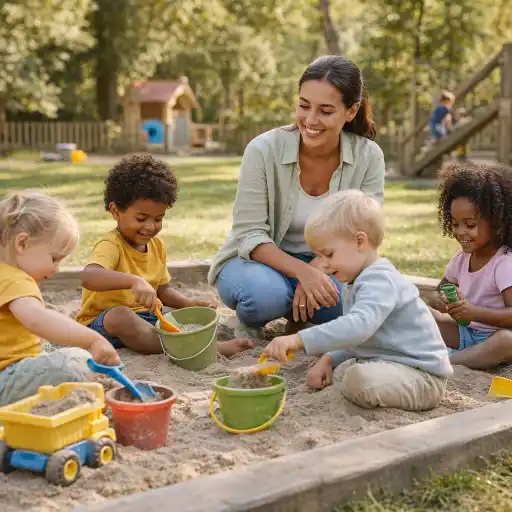
Outdoor spaces often give children room to negotiate roles, invent games, and solve problems together. A group building a structure must decide which materials to use, who will carry them, and what to do when the structure falls. In the process, children practice communication, turn-taking, cooperation, perspective-taking, conflict resolution, and empathy.
Outdoor play can also support emotional regulation. Movement may help children release tension, while natural settings can offer calming sensory experiences and opportunities for retreat. A shaded reading area, garden bed, or listening walk may be especially helpful for children who become overwhelmed by crowded indoor spaces. Providers can name emotions without taking over: “You look frustrated because the bridge collapsed. What could we try next?”
Appropriate challenge is another important benefit. When children climb, balance, jump, or navigate unfamiliar terrain, they experience uncertainty and learn to assess their abilities. The goal is not danger; it is high challenge with low risk, supported by attentive adults. Encourage effort, persistence, and helping—not only speed, height, or success—to build confidence and resilience.
How can providers create outdoor experiences that are meaningful and safe?
Effective outdoor programming begins with intentional planning rather than expensive equipment. Organize the space into flexible zones for active movement, messy sensory exploration, construction, quiet observation, and social play. Rotate loose parts and natural materials so the environment remains interesting without becoming overwhelming.
Safety should protect children without removing developmentally appropriate challenge. Before play, scan for broken equipment, sharp objects, animal waste, standing water, poisonous plants, traffic hazards, and hot surfaces. During play, use active supervision: position yourself to see and hear children, scan continuously, count during transitions, anticipate likely actions, and interact rather than becoming distracted.
- Check weather, heat, cold, and air quality; shorten or relocate activities when conditions are unsafe.
- Use shade, protective clothing, hydration, and sunscreen procedures consistent with permissions and program policy.
- Match equipment and surfacing to children’s ages, abilities, and developmental readiness.
- Give water play constant, close supervision; drowning can happen quickly and silently.
- Teach clear safety expectations while preserving manageable choices and independence.
Common mistakes include treating outdoor time as unplanned recess, stopping all risk-taking, offering too many materials, and failing to adapt for disability or sensory differences. The 1,2,3, Eyes on Me: Classroom Safety Buy Now $32.00$24.00 course offers additional strategies for supervision and safe indoor and outdoor environments.
How can programs make outdoor play consistent, inclusive, and curriculum-connected?
Consistency matters more than occasional elaborate events. Directors can protect outdoor time by placing it into the daily schedule, preparing clothing and materials in advance, and creating predictable transition routines. Several shorter blocks may work well for toddlers, while preschoolers may benefit from extended investigations. Follow local regulations for schedules, ratios, space, and supervision.
A practical planning cycle is:
- Observe: Notice children’s interests, movement patterns, questions, and social needs.
- Invite: Add one or two materials or prompts that extend exploration.
- Interact: Use language, modeling, and questions without directing every action.
- Document: Record children’s words, strategies, discoveries, and emerging skills.
- Reflect: Adjust the environment and plan the next experience.
Inclusion begins with the assumption that every child belongs outdoors. Adapt pathways, seating, communication supports, materials, and expectations so children can participate in different ways—moving, touching, listening, looking, building, communicating, or resting. Families can contribute cultural knowledge, gardening traditions, weather practices, and children’s interests. A gear-lending shelf with boots, coats, and hats can reduce barriers.
Programs can evaluate progress with light-touch documentation: participation, new vocabulary, problem-solving, peer cooperation, or calmer transitions. The Creating Environments that Nurture Growth and Community Buy Now $55.00 course can help directors and providers connect environmental design, inclusion, family partnership, and outdoor learning.
Conclusion: Why is outdoor play important in early childhood education?
Outdoor play is important because it supports the whole child at once. Children strengthen their bodies, practice #problem-solving, develop language and creativity, build relationships, regulate emotions, and connect learning to the real world. These benefits do not require a forest or an expensive playground; they require consistent access, thoughtful observation, responsive interaction, and safe, inclusive design.
Start with one dependable outdoor block, one daily hazard scan, and one intentional invitation. Document what children notice and use their questions to guide future curriculum. For deeper professional learning, explore CDA: Creating the Outdoor Classroom Buy Now $16.00, which focuses on planning and implementing a natural outdoor classroom. With steady support, outdoor play becomes more than #recess: it becomes a joyful, evidence-informed foundation for #development, belonging, and lifelong learning.
References: ChildCareEd: The Importance of Outdoor Play; ChildCareEd: Outdoor Play for Toddlers and Preschoolers; CDC; NAEYC; Early Childhood Education Journal; Children & Nature Network; University of Minnesota CEED.
- Creating the Natural Outdoor Classroom
- CDA Home Visitor Subject Area 3 Part 3 Birth to 5
- 45 Hour Preschool Methods and Materials
- From Play to Planning: Building Culturally Competent, Child-Centered Curriculum
- 1,2,3, Eyes on Me: Classroom Safety
- Pediatric RSV First Aid & CPR/AED
- The Best Promotion is Play
- Family Child Care: Building, Premises, and Outdoor Safety
- Mindful Supervision: Balancing Safety & Independence in Montessori
- Did Someone Say Free? ChildCareEd Does!
- CDA Certification en Español: Recursos y Consejos para Educadores Bilingües
- Consejos de Supervisión Activa para Salones de Preescolar y el Juego al Aire Libre
- What Should DC Early Childhood Teachers Know About Pay Equity Right Now?
- How Do Minnesota Winters Affect Young Children's Mental Health?
- What Do Pre-K Teacher Requirements Really Mean for Your Program?
- What Is the Difference Between Early Childhood Education and Child Development?
- More Than ABCs and 123s: The Real Importance of Early Childhood Education
- 40 Hour Director Training Georgia: Is the Course All You Need to Become a Director?
- Preschool Teacher Qualifications: What’s Required to Get Hired—and What Helps You Move Up?
- Early Childhood Administration Certificate Online: Will It Qualify You to Be a Director?
- What Qualifications Do You Need to Be an Assistant Director at a Daycare?
- Why Is Outdoor Play Important in Early Childhood Education?
