When a table measures six blocks long but only three large books long, children are noticing a powerful mathematical idea: the size of the unit changes the number. Help them investigate that relationship through hands-on classroom play, and build your own practice with Early Mathematics Through Play Buy Now $24.00, a course that explores measurement and other math concepts through routines and exploration. Keep reading for practical ways to turn different answers into a meaningful learning opportunity.
Why does unit size matter in early measurement?
Measurement is more than naming a number. It describes an attribute—such as length—by comparing it with a chosen unit. If a child measures a book using small linking cubes, the count will be larger than when the same book is measured with longer blocks. The object has not changed; the unit has.
This can initially feel confusing to children and to adults who expect one “right” count. Yet the variation is the lesson. When children compare results, they begin to understand that measurement numbers are meaningful only when we know what unit was used. A report such as “the table is eight blocks long” includes more information than “the table is eight.”
Early measurement experiences also build comparison language, counting, estimation, and reasoning. As Stanford’s DREME resource explains in its overview of the mathematics of measurement, children need opportunities to compare attributes and explore consistent units. A playful investigation supports these ideas without requiring preschoolers to master formal rulers or abstract procedures.
For providers, this is a chance to honor children’s curiosity. A surprising result is not a mistake to erase; it is evidence to examine together. Ask, “What changed in our measuring?” and help children connect the different counts to the size of the units.
How can children investigate one object with different units?
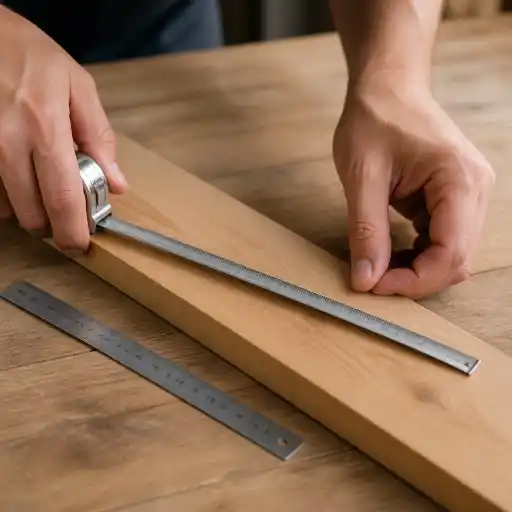
Choose one familiar object, such as a book, table edge, rug strip, or toy road. Invite children to predict how many units might span its length, then measure it using two or three distinct objects—for example, large blocks, small cubes, and paper clips. Keep the measured object and starting point the same so that unit size is the key variable.
Before beginning, model how to line units up end to end with no gaps or overlaps. Use one consistent kind of unit at a time: a collection of identical blocks is easier to interpret than a mixture of shapes and sizes. Have children count each unit as it is placed, and record results with numerals, drawings, marks, or dictated words according to their emerging skills.
- Estimate first: “Will it take more small cubes or large blocks?”
- Measure the same object with both units and say the unit name with each count.
- Compare the results: “Why did we need more cubes?”
- Invite children to demonstrate how they kept the units aligned.
🧩 Try a “measurement detective” station with an object, two unit choices, a recording card, and a picture prompt. Materials should be suitable for the children’s ages and abilities; supervise small manipulatives closely. The Measuring Mania lesson also demonstrates how comparing large and small units can make the relationship visible through investigation.
What mathematical ideas should educators help children notice?
Guide children toward a few connected ideas rather than a memorized rule. First, the measured attribute must stay the same: when measuring a table’s length, do not switch midway to its width. Second, units should be equal in size and placed consecutively. Third, a smaller unit generally requires more placements to cover the same distance, while a larger unit requires fewer.
Children may say “the table got longer” when the number increases. Acknowledge the observation, then distinguish the count from the object: “We counted more small cubes, but the table stayed the same length.” This language makes the relationship concrete without dismissing the child’s reasoning.
- “What did we use as our unit?”
- “Which unit was longer? How can you tell?”
- “Why did the count change if the object did not?”
- “How could we help another group get a similar result?”
These questions encourage reasoning, comparison, and mathematical communication. The Rutgers early measurement framework notes that measuring the same object with different units helps children see that a larger unit yields a smaller count. Keep the focus on explaining and testing ideas, not on speed or a single expected answer.
How can you scaffold the activity for different learners?
Start from what each child can already do. Some children may be ready to estimate, iterate units independently, and explain why counts differ. Others may benefit from direct comparison first: place a long block beside a short block and discuss which covers more of the object. Model one step at a time, then invite children to take over portions of the process.
Make participation accessible in more than one way. Offer large, easy-to-grip units, high-contrast measurement strips, picture choices, partner roles, or the option to point, gesture, draw, or dictate an explanation. Children learning more than one language can connect meaning to movement—for example, using hands to show “longer” and “shorter”—while adults introduce the corresponding words.
Use observations to plan the next prompt. If a child leaves spaces between units, model how to place them together. If a child begins at different points on repeated trials, mark a shared starting line. If the child counts the unit objects accurately but does not name them, prompt: “Eight what?” These supports address the challenge without taking over the investigation.
Assessment can remain informal: jot down the child’s estimate, method, explanation, or question. DREME’s formative assessment guidance for measurement emphasizes meaningful tasks and questions that reveal children’s thinking. Revisit the same concept later with a new object or setting to notice growth over time.
What common pitfalls can programs avoid?
A frequent pitfall is changing several factors at once. If children use different objects, different starting points, and different measuring methods, the results are difficult to compare. Keep the investigation focused: use the same object, align the start, and change only the unit size when exploring how size affects count.
Another common issue is mixing unit sizes or leaving gaps. If one child uses a large block and a small block in the same row, the count cannot be interpreted as a consistent measure. Demonstrate how to use matching units and place them edge to edge. If the object’s length falls between units, accept an approximate description such as “four blocks and a little more” rather than forcing a whole-number answer.
- Avoid treating different counts as errors: Ask what unit was used and compare its size.
- Avoid rushing to rulers: Establish the idea of a repeatable unit before emphasizing numerals and marks.
- Avoid over-directing: Offer a clear invitation, then leave room for children to test their own theories.
- Avoid unsafe or unsuitable materials: Select age-appropriate units and follow supervision practices.
Standard tools can extend learning when children are ready, but they do not replace the underlying ideas. As Sarama and colleagues describe in their study of early length measurement learning trajectories, instruction and children’s strategies develop over time. Keep practice responsive rather than expecting every child to reach the same understanding at once.
Conclusion: How can providers make different measurements meaningful?
The same object can produce different measurement counts because units differ in size. Children can discover the relationship by estimating, measuring one object with consistent units of different sizes, and discussing why a smaller unit usually produces a larger count. Alignment, equal-sized units, and naming the unit make results easier to interpret.
Keep the experience playful and responsive: use familiar materials, invite children to explain their thinking, and treat unexpected results as opportunities to investigate. Observe how children place, count, compare, and describe units so you can choose a supportive next step. For a ready-to-use classroom activity, explore ChildCareEd’s Different Units Measurement Investigation Pack (check the product page for current details). To strengthen your broader approach to playful measurement and early math, consider Early Mathematics Through Play Buy Now $24.00. State requirements vary - check your state licensing agency.
Explore related ChildCareEd courses
- Early Mathematics Through Play Buy Now $24.00 — approaches for integrating measurement and other early math concepts into play and routines.
- No Such Thing as Boring Math
 Buy Now $24.00 — strategies for intentionally planning play, exploration, and math learning.
 - Math Foundations in Early Childhood Buy Now $16.00 — practical approaches to creating hands-on, math-rich experiences.
- Enhancing STEM Education for Infants and Toddlers Buy Now $16.00 — strategies for introducing early math and inquiry with infants and toddlers.
- Building Early Science Foundations Buy Now $16.00 — supports play-based exploration, experimentation, and discovery.
- 45 Hour Child Growth and Development
- Early Mathematics Through Play
- Birth to Five CDA Credential with Portfolio Review
- 45 Hour School Age Methods and Materials
- Emergent Learning & Development
- 45-Hour Infant and Toddler Curriculum
- Creating Environments that Nurture Growth and Community
- Texas Director Credential
- Every Moment Matters: Schedules and Transitions
- CDA Certification en Español: Recursos y Consejos para Educadores Bilingües
- 🌙 ¿Cómo afecta el tiempo frente a las pantallas el sueño y el comportamiento infantil? 😴
- 🩺 Cumplimiento de Salud e Inmunización en Cuidado Infantil de Nevada ✔️
- Cómo Abrir Una Quardería En Casa Sin Dinero?
- ¿Cuáles son las mejores actividades del Día de la Tierra para niños en casa o en el aula?
- ¿Cómo puedo usar escenarios de juego de roles de primeros auxilios en mi aula?
- Normas de Licenciamiento de Cuidado Infantil en Virginia para Centros Diurnos Infantiles y Hogares Diurnos Familiares
- Lista para Abrir una Guardería en Casa en Virginia: Cómo Empezar
- Cómo simplificar la capacitación para sus empleados de daycare
- Fall Challenge Accepted! Hands-On Learning Games for Pre-K
- Teaching Math to Young Children: Why Counting to 20 Doesn’t Mean They Understand 20
- Can You See the Wind? 8 Outdoor Spring Activities That Help Children Explore It
- How Do Light vs. Heavy Activities Build Early Measurement Skills?
- How Can Even vs. Odd Sorting Introduce Early Number Sense?
- How Can Themed Activity Bundles Simplify Weekly Planning?
- How Can Sink-or-Float Water Play Become a Meaningful Science Investigation for Preschoolers?
- A Child Counts Correctly but Cannot Show the Quantity: What Comes Next?
- How Can You Keep a Group Story Going When Children Introduce Conflicting Characters?
- Why Does the Same Object Have Different Measurements?
